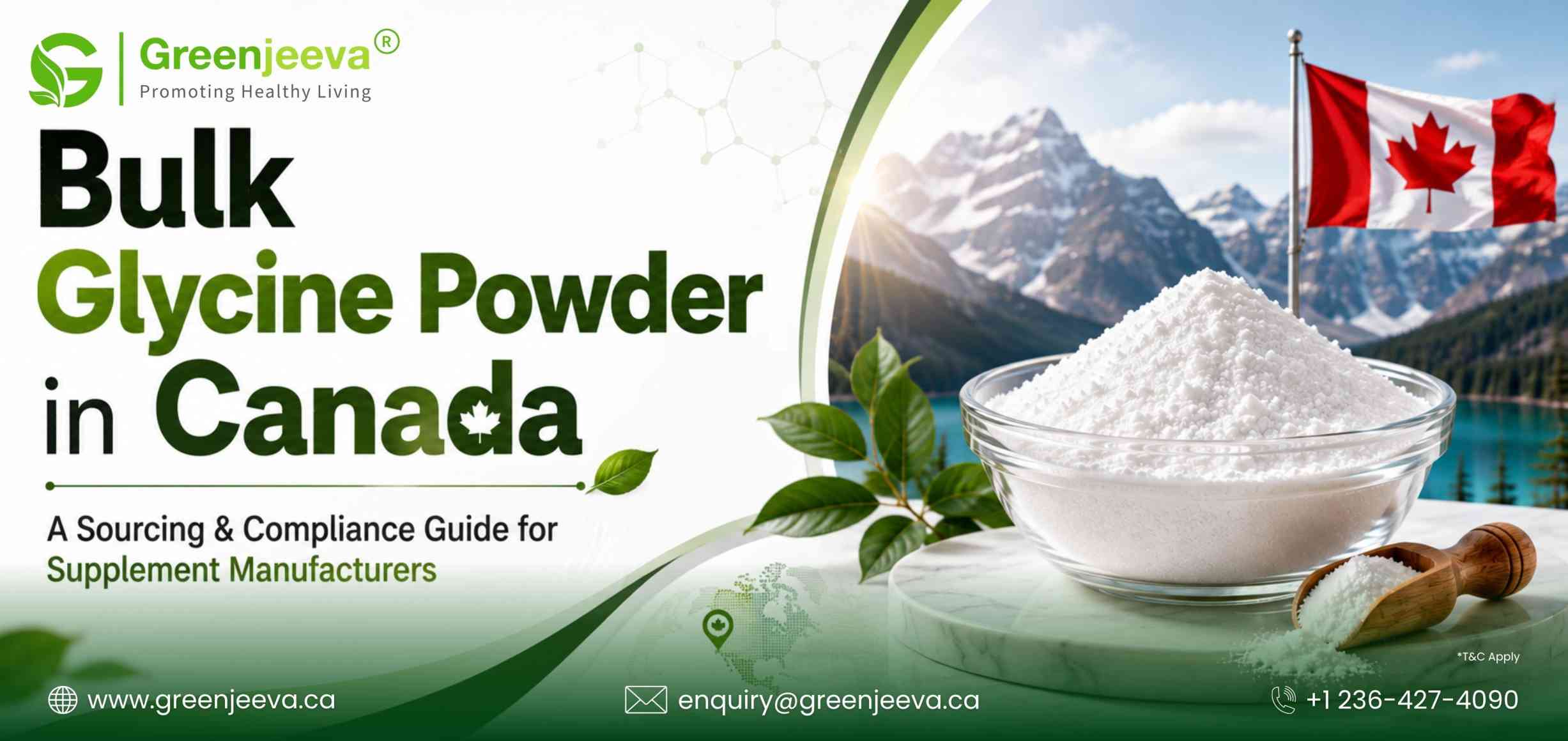
Bulk Glycine Powder in Canada: A Sourcing and Compliance Guide for Supplement Manufacturers
Glycine is the simplest of the proteinogenic amino acids and one of the most heavily traded. For Canadian manufacturers that creates an odd situation: the ingredient is a commodity but sourcing it compliantly into Canada is anything but.
Most technical content on glycine pure powder is written for the American market. It leans on GRAS assumptions, quotes prices in USD, and treats FDA compliance as the finish line. None of that carries across the border. This guide covers what matters when you buy glycine powder in bulk for Canadian production: regulatory classification, the spec parameters that decide whether a batch works, and the documentation your QA team should insist on.
What Glycine Powder Is, and Why Volumes Keep Climbing
Glycine (CAS 56-40-6, aminoacetic acid) is a white crystalline, water-soluble powder with a faintly sweet taste and no odour, produced commercially by chemical synthesis via the chloroacetic acid and ammonia route.
Functional versatility drives the volume. Glycine works as a nutritional amino acid, flavour enhancer, sweetness modifier, buffering agent and pharmaceutical intermediate, which is why it sits among the highest-volume amino acids in global trade. Future Market Insights values the global market at USD 1.5 billion in 2026, reaching USD 2.7 billion by 2036 at a 6.8% CAGR.
FMI also flags a supply-side concern. A major US producer has exited and European amino acid portfolios have been restructured, concentrating capacity in China. FMI frames this as increasing procurement risk for food-grade and pharmaceutical glycine buyers outside China, which means single-origin arrangements carry more risk than they did five years ago.
The Canadian Regulatory Reality
This is the part US-oriented content skips, and where Canadian brands get caught out.
Glycine is a Natural Health Product ingredient. Health Canada's Natural Health Products Ingredients Database classifies glycine under Schedule 1, Item 4 (an amino acid) of the Natural Health Products Regulations (see the NHPID listing). Any glycine-containing supplement sold here needs a Natural Product Number (NPN), obtained through a Product Licence Application reviewed against the NNHPD Compendium of Monographs. Monograph-compliant applications follow the Class I pathway with a 60-day review target. Your manufacturing, packaging, labelling and importing sites each need a Site Licence under Canadian GMP, and the import-site requirement is the one buyers find out about last.

Food additive status does not port from the US. Formulating into a functional food rather than a licensed NHP changes the framework. Under Canada's Food and Drug Regulations, a food counts as adulterated if it contains an additive not expressly permitted in that food. Permitted uses and maximum levels live in Health Canada's Lists of Permitted Food Additives. American formulators routinely treat glycine as GRAS for flavour work, and that reasoning has no standing here.
Bilingual labelling and claim limits. Every NHP needs English and French across product name, recommended use, dose, risk information and ingredient declaration, so build translation in early. What you may claim is bounded entirely by the monograph your NPN was granted against. An ingredient supplier cannot hand you a claim, and no COA authorises one.
Spec Parameters That Decide Suitability
Two glycine powders can both assay above 98.5% and behave completely differently in your process.
Assay and grade. Confirm the purity figure and the pharmacopeial standard: USP, FCC or food grade. "Suitable for nutraceutical use" is marketing language, not a specification.
Particle size and mesh. This causes more failed batches than anything else. Fine powders blend uniformly in low-inclusion premixes but bridge and flood on high-speed filling lines. Coarser material flows better in stick-packs but can segregate in a blend.
Density and dissolution rate. Bulk and tapped density govern fill weight consistency and whether existing tooling holds the intended dose. Glycine is freely water-soluble, but dissolution rate shifts with particle size, which matters for ready-to-mix beverages where people use cold water.
Hygroscopicity, heavy metals, microbiological limits and residual solvents. Do not accept "screened." Ask for numerical limits and batch results, plus non-GMO, allergen and gluten statements. A supplier who cannot produce a number on request usually cannot hold it batch to batch either. Green Jeeva's glycine powder page carries the batch-specific spec sheet, composition statement and MSDS.

Where Glycine Powder Goes
The categories below describe where the ingredient is commercially used, not what it does physiologically.
Bulk powders glycine volumes flow mainly into amino acid and protein blends, where bulk nutrients glycine is a standing line item in multi-component formulas. It also features in the sleep and relaxation category, often alongside magnesium and L-theanine, and in collagen-adjacent products, where relevance is compositional: glycine is roughly a third of collagen's amino acid profile. Gelita USA launched collagen hydrolysate and glycine complexes for sports nutrition in March 2025, processing 15,000 tons per year.
In functional foods, glycine's sweetness-modifier function offsets the aftertaste of stevia and sucralose, subject to the food additive check above. Personal care formulations use glycine derivatives, which brings the Cosmetic Regulations into scope for the finished-product holder.
A Direct Answer on Organic Glycine Powder
This search term gets real volume, so it deserves a straight answer.
Commercial glycine is synthesised from chloroacetic acid and ammonia. It has no farm origin and therefore cannot be certified organic under the Canada Organic Regime or any equivalent standard. Suppliers marketing organic glycine powder are either misusing the term or holding a company-level certificate for unrelated botanical lines and letting the halo drift. Implying organic status on a synthetic amino acid is a labelling misrepresentation risk under CFIA oversight.
What you can legitimately claim: non-GMO status, allergen-free and gluten-free declarations, Halal and Kosher certification, and batch traceability. Green Jeeva holds Canada Organic Regime certification, and it covers our botanical lines rather than glycine. We would rather say that plainly than let a badge imply otherwise. See certified ingredients.
Documentation and Canadian Stock
A qualified supplier produces all of this without friction: a Safe Food for Canadians Licence, business licence, liability insurance and Halal and Kosher certification at company level; a Certificate of Analysis, spec sheet, composition statement, Safety Data Sheet, Certificate of Origin and non-GMO and allergen statements at batch level. Check expiry dates, because a certificate that lapses mid-contract leaves a gap in your audit trail. Green Jeeva publishes them on every downloadable document (certifications).
Stock location matters as much as spec. Green Jeeva holds glycine bulk powder in a Canadian warehouse (Pantos), which takes border clearance off your critical path. Offshore or US-origin material carries customs processing, possible CFIA examination and brokerage, and that matters most when you are covering a production slot.
Green Jeeva's Value-Added Services
Testing in-house, never outsourced. Our R&D Lab runs HPTLC for identity verification, ICP-MS for ultra-trace elemental analysis, LC-MS/MS and GC-MS/MS for pesticide residues, and full microbiological analysis. No third-party lab queue between you and an answer.
Blends and private label. Signature Premix Solutions covers formulation from pilot to commercial scale, and our Surrey, BC facility handles blending and private label domestically, so finished goods do not cross a border either.
Documentation and planning. Paperwork assembled for your NPN dossier, plus procurement forecasting and buffer stock strategy. A 2,000+ SKU catalogue lets you consolidate glycine into one shipment (browse products).
Closing
Glycine is chemically simple. Sourcing it into Canadian production is not, because the regulatory framework, the documentation burden and the specification detail all sit outside what a spot price tells you. The manufacturers who handle it well treat glycine as a qualification exercise rather than a purchase: confirm grade and particle size against your own equipment, verify NPN pathway and food additive status before formulating, and hold domestic buffer stock.
View glycine powder specifications and request a 20 g sample
Discuss custom blends and premix development
Book a demo or contact our team
This article is for business-to-business ingredient buyers and formulators. It is not consumer health information and makes no representation about the effects of any ingredient in the body.