What Canadian Buyers Should Verify on an Organic Psyllium Certificate
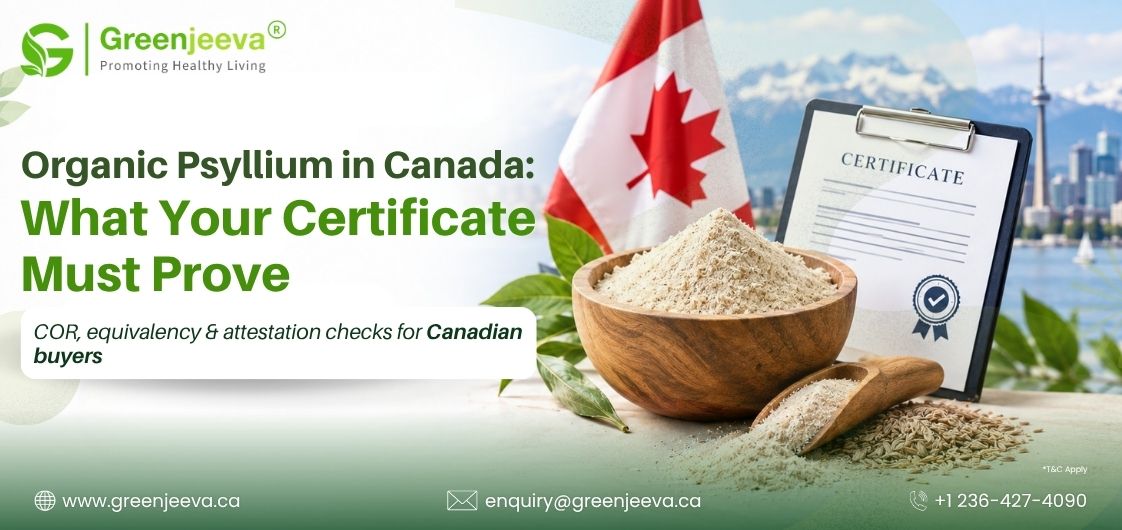
A Canadian brand places a purchase order for bulk organic psyllium husk powder 95%. The supplier sends a valid organic certificate. The material arrives, passes identity and microbial testing, and goes into a fibre drink mix destined for retail across Canada. Then, during regulatory review, someone asks a simple question: which certification body issued this, and is it accredited under the Canada Organic Regime?
The answer determines whether the word "organic" can legally appear on the finished label.
This is the part of organic psyllium certification that trips up otherwise well-run procurement teams. Organic status in Canada is not a property of the crop or the country it grew in. It is a property of who certified it, under which standard, and with which paperwork attached. A certificate can be entirely genuine, current, and fraud-free, and still fail to support an organic claim in the Canadian market.
If you are earlier in the evaluation process and still comparing grades, purity and functional specs, start with our Bulk Organic Psyllium Husk Powder Buyer's Guide to Quality and then return here for the certification layer.
What "organic" legally means in Canada
Organic claims in Canada are governed by the Canada Organic Regime (COR), administered by the Canadian Food Inspection Agency (CFIA) under the Safe Food for Canadians Act and the Safe Food for Canadians Regulations (SFCR). The technical requirements sit in two national standards:
CAN/CGSB-32.310 covers organic production systems, general principles and management standards
CAN/CGSB-32.311 covers permitted substances lists
Under this framework, CFIA does not certify products itself. It accredits certification bodies, and those bodies certify operators. That distinction is the whole basis of organic certificate verification in Canada: your assurance chain runs product, to operator, to certification body, to CFIA accreditation. If any link is missing, the chain does not reach the Canadian market.
Content thresholds matter too. A product must contain at least 95% organic content to be labelled and marketed as "organic" and to carry the Canada Organic logo. Products between 70% and 95% organic content may declare a percentage of organic ingredients but cannot use the logo or the unqualified term.
One clarification worth making early
"95%" on a psyllium spec sheet and "95%" in the organic threshold are two unrelated numbers. Purity grade describes husk content versus seed and foreign matter. The organic threshold describes certified organic content as a share of the formulation. Buyers conflate them regularly. Our sourcing tips for buying psyllium husk powder 95% in bulk covers what the purity grade actually measures and how it maps to 85%, 98% and 99% material.
The two legitimate routes into Canada
There are exactly two ways an imported ingredient can be sold as organic in Canada. Everything else is a compliance gap.
Route A: direct COR certification
An operator anywhere in the world can be certified directly against the Canadian standards by a certification body that CFIA has accredited. Several CFIA-accredited bodies operate internationally, including in the major psyllium growing and processing regions. This is the cleanest route because the certificate speaks directly to the Canadian standard, with no translation layer and no scope interpretation.
Route B: organic equivalency arrangements
CFIA establishes organic equivalency arrangements after assessing another country's regulatory system, standards and procedures against Canada's. Where the systems achieve comparable outcomes, the foreign standard is treated as equivalent, and product certified under it can be sold as organic in Canada.
Canada currently maintains arrangements with the United States, European Union, United Kingdom, Switzerland, Japan, Taiwan, Mexico and Costa Rica. Each arrangement has its own scope and variances. Some exclude specific product categories or production methods, and the list and terms are updated over time. Always confirm the current arrangement and its variances against CFIA's own organic equivalence arrangements page rather than relying on an internal reference document. The Canada Organic Trade Association also maintains useful industry-side commentary on how these arrangements function in practice.
The critical point: the governing factor is the arrangement, not the country printed on the certificate. A certificate issued in a country with no arrangement, by a body not accredited by CFIA, does not become valid because the material is genuinely organic.

What an attestation statement is, and why it decides the outcome
Under the US-Canada Organic Equivalency Arrangement (USCOEA), a certificate is not sufficient on its own. The organic certificate must carry a specific attestation confirming that the product was "Certified in accordance with the terms of the U.S.-Canada Organic Equivalency Arrangement."
That single sentence is what converts a USDA National Organic Program (NOP) certificate into a document that supports an organic claim in Canada. Without it, you hold a valid US certificate and no Canadian organic entitlement. CFIA sets out the terms in its guidance on the US-Canada Organic Equivalency Arrangement, and USDA publishes its own Canada trade policy summary covering labelling and oversight from the US side.
The arrangement also carries supply-chain verification obligations. For product produced or handled in one jurisdiction and traded under the arrangement, the certification bodies and operators involved are responsible for verifying the organic integrity of shipments, and are expected to hold whatever additional documentation demonstrates full supply-chain compliance. Where origin-country export systems issue their own electronic trace certificates, those documents form part of that verification trail and should be requested alongside the organic certificate.
Practical consequence for your team: the attestation statement is a mandatory field on your incoming-goods checklist, not a nice-to-have. It is also the single most common omission on certificates presented to Canadian buyers.
The seven-point organic certificate verification checklist
Read the certificate in this order. Each step should take under a minute once the habit is built.
Certification body name. Identify it, then confirm it appears on CFIA's current list of accredited certification bodies. Do not verify this from the supplier's website or a PDF the supplier provided. Go to the regulator's list.
Accreditation status and validity. Certification body accreditation is a live status, not a permanent attribute. CFIA can suspend and later reinstate a body's accreditation. Check standing at PO issue and again at shipment.
Certification scope. This is where narrow certificates hide. Does the scope cover the product form you are buying, meaning milled powder rather than seed or raw husk alone? And does it cover the operations involved, meaning growing, processing, milling, packing, handling and storage? A farm-gate-only certificate does not cover a processor's milling operation.
Validity dates versus lot manufacture date. The certificate must have been valid on the date your lot was produced and handled, not merely on the date it was emailed to you.
Attestation statement, where the material is routed through an equivalency arrangement. Exact wording matters.
Product description matching your purchase order. Grade, form and botanical name should reconcile with what you ordered. "Psyllium" alone is weaker than Plantago ovata husk powder at a stated grade.
Lot-level traceability documents linking the certificate to the specific material on your dock, including transaction certificates, packing lists, lot numbers, and where applicable the origin-country export trace certificate.
These seven steps sit alongside your technical qualification, not instead of it. Organic certification says nothing about swelling index, mesh consistency or microbial load. For the functional and analytical side of organic supplier qualification, our buyer's guide to psyllium quality covers the specifications that determine whether the material actually performs in your formulation.

Why certification body status is a live procurement risk
Most organic ingredient procurement checklists treat certification body verification as a one-time onboarding step. That is the wrong model.
CFIA has suspended the accreditation of certification bodies operating internationally and, after remediation, reinstated them. One published example is documented in CFIA's enforcement actions record for CU Inspections & Certifications India Private Limited, whose accreditation was suspended in March 2023 and reinstated that July. This is a normal, functioning part of regulatory oversight. But if your supplier's certification body is suspended during the window in which your material was certified, the downstream consequences land on you:
Inventory that cannot be sold or labelled as organic
A stalled product licence filing that relied on the organic claim
Re-labelling, reformulation, or writing the lot down to conventional grade
Requalifying a replacement supplier under time pressure, which for psyllium means revalidating hydration behaviour and batch consistency
Mitigation is procedural, and cheap:
Verify certification body accreditation status at PO issue and again at shipment
Archive the organic certificate against every lot, not against the supplier record
Ask whether the supplier holds certification through more than one accredited body, and whether the material can be routed under an alternative arrangement
Ask who at the supplier owns organic compliance, and how quickly they would notify you of a certification body status change
Where organic verification meets your other Canadian obligations
Organic certification is one layer of the Canadian compliance stack, not the whole of it. Depending on your finished product route, you will also be managing:
Food route: an SFCR licence, a Preventive Control Plan, and traceability records as importer
Natural health product route: a product licence and NPN, a site licence for the importer, packager or labeller, and formulation against Health Canada's psyllium monograph, which governs permitted claims, dose ranges and mandatory risk statements
Labelling: bilingual English and French labelling, Canada Organic logo use conditions, and Quebec's French-language requirements. Note also that Health Canada's guidance document on NHP labelling confirms all natural health products have until June 2028 to comply with the new labelling requirements, including the Product Facts table
Each of these deserves its own treatment, and the psyllium monograph in particular has direct formulation consequences, including permitted dose ranges, the fluid-intake instruction, and pre-cleared laxative and cholesterol claims. Our comparative guide on psyllium husk versus other dietary fibres is a useful companion when you are deciding whether psyllium is the right fibre to build those claims on in the first place.

.jpeg)