Green Tea Extract Powder 50% Polyphenols: What Formulators Should Know
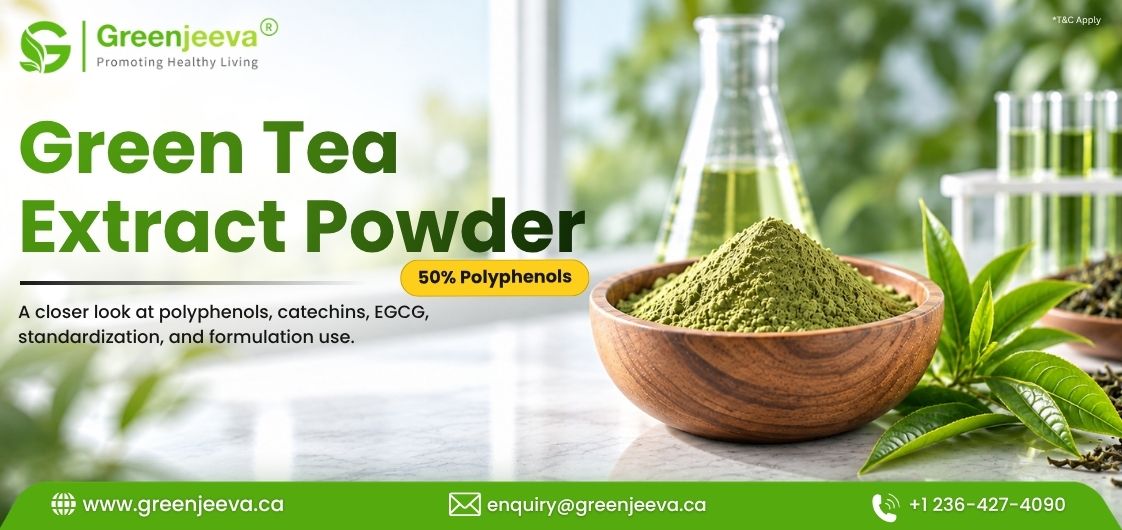
When a green tea extract is labeled “50% polyphenols,” it is easy to assume that the number tells you everything you need to know.
It does not.
For formulators, the more useful question is what sits behind that 50% specification. Is it referring to total polyphenols? How does that relate to catechins and EGCG? What makes the extract different from ordinary green tea powder? And how should its specification be interpreted when developing a finished product?
These details matter because Green Tea Extract Powder 50% Polyphenols is not simply concentrated green tea. It is a standardized botanical ingredient with a defined compositional target.
Once that distinction is clear, it becomes much easier to understand where the ingredient fits into modern food, beverage, supplement, and other formulation systems.
What Is Green Tea Extract Powder 50% Polyphenols?
Green Tea Extract Powder 50% Polyphenols is a powdered botanical extract made from Camellia sinensis, the plant used to produce green tea.
Unlike conventional green tea powder, which is generally made by drying and milling tea leaves, a green tea extract involves extracting selected constituents from the plant material and concentrating them into an extract.
The resulting material can then be standardized to a specified level of compounds or compound groups.
In this case, the 50% polyphenols designation refers to the declared level of polyphenolic compounds measured according to the applicable analytical method.
However, that number should not be confused with the concentration of a single compound.
In particular, 50% polyphenols does not mean 50% EGCG.
That distinction is one of the most important things to understand when evaluating a standardized green tea extract.
What Are Green Tea Polyphenols?
Polyphenols are a broad family of naturally occurring plant compounds. Green tea is particularly known for its catechins, which form an important part of its polyphenol profile.
The major green tea catechins include :
- Epigallocatechin gallate (EGCG)
- Epigallocatechin (EGC)
- Epicatechin gallate (ECG)
- Epicatechin (EC)
So, where does EGCG fit in?
A simple way to look at it is:
Polyphenols → Catechins → EGCG
Catechins are a subgroup of polyphenols, while EGCG is one specific catechin.
Therefore, when a product is standardized to 50% green tea polyphenols, that specification describes a broader group of compounds. It does not, by itself, tell you the exact concentration of EGCG or each individual catechin.
For formulators, this difference becomes important when comparing green tea extract polyphenols with an extract specifically standardized for EGCG.
What Does 50% Polyphenols Actually Mean?
The “50%” represents a standardization target for the extract.
In practical terms, it means the finished green tea extract standardized powder is specified to contain 50% polyphenols according to the stated analytical method.
The remaining portion may include other naturally occurring constituents and processing-related components, depending on the raw material and manufacturing process.
That is why the headline percentage should always be read alongside the full ingredient specification.
For example, a formulation team may also want to know:
- Total catechin content
- EGCG content
- Caffeine content
- Extraction ratio
- Moisture
- Physical characteristics
- Microbiological parameters
- Heavy metals
- Pesticide residues, where applicable
- Residual solvents, where applicable
In other words, standardization gives you one important piece of the ingredient profile, not the entire profile.
Green Tea Polyphenols vs. EGCG: Why the Difference Matters
This is where green tea extract terminology can become confusing.
A supplier may offer a green tea extract powder standardized to polyphenols, while another product may be standardized specifically to EGCG or total catechins.
Although all of these products originate from Camellia sinensis, they should not automatically be considered equivalent.
For example, a formulation may call for a defined EGCG level. In that situation, knowing that the extract contains 50% total polyphenols would not be enough. The EGCG concentration would need to be established separately.
On the other hand, if the formulation specification calls for a particular total polyphenol level, a 50% polyphenol extract may be a more appropriate fit.
The key point is simple: the standardization should match the formulation requirement.
How Is Green Tea Extract Made?
Although manufacturing processes vary, producing a Camellia sinensis extract generally involves several stages.
Raw material selection
Green tea leaves are selected based on botanical identity, plant material, quality parameters, and the intended extract specification.
Extraction
The plant material is processed using an extraction method designed to transfer selected compounds from the leaves into an extraction medium.
Concentration
The resulting extract is concentrated to increase the proportion of the desired constituents.
Drying
The concentrated extract is converted into a powder using an appropriate drying process.
Standardization
Finally, the finished powder is tested against the defined specification. Where applicable, it is standardized to a particular level of polyphenols or another specified marker.
Because extraction conditions can influence the resulting composition, two products made from the same botanical source can still have different technical profiles.
Green Tea Extract Powder vs. Green Tea Powder
The two terms sound similar, but they describe different ingredients.
Green tea powder is generally made by grinding dried tea leaves. As a result, the powder contains the constituents of the leaf in their naturally occurring proportions.
Green tea extract powder, by contrast, is produced by extracting and concentrating selected constituents from the tea leaf.
This difference is particularly relevant when a formulation requires a defined level of green tea polyphenols.
For example, a developer looking for a standardized green tea polyphenol powder would generally evaluate the extract's analytical specification rather than treating ordinary green tea powder as an equivalent ingredient.
Why Standardization Matters in Formulation
Botanical materials naturally vary.
Cultivar, growing conditions, harvest timing, processing, storage, and extraction conditions can all influence the composition of the starting material and the resulting extract.
Standardization provides a measurable target for selected constituents.
For a standardized green tea extract, that can make the ingredient easier to define within a formulation specification.
At the same time, it is important not to overinterpret standardization. A 50% polyphenol specification does not mean that every other component of the extract will be identical from batch to batch.
Instead, it establishes a defined parameter that can be tested and monitored.
That distinction is particularly useful when R&D, quality, and regulatory teams are working from the same ingredient specification.
What Other Characteristics Matter?
Polyphenol content may be the headline specification, but formulators often need a broader view of the ingredient.
Catechin profile
If specific catechins are important to the formulation, the product specification should identify them separately rather than relying only on total polyphenols.
EGCG content
EGCG is one of the major catechins in green tea. If the finished product has a defined EGCG requirement, the actual EGCG level should be confirmed independently.
Caffeine
Green tea naturally contains caffeine, although the amount can vary depending on the raw material and extraction process.
Consequently, caffeine content may need to be considered when developing formulations where caffeine levels are controlled.
Physical properties
Color, odor, particle size, flowability, solubility, and dispersibility can all influence how a green tea extract powder performs during manufacturing.
For beverage and powdered applications in particular, physical behavior can be just as relevant as the chemical specification.
Stability
Storage conditions, packaging, moisture exposure, and other environmental factors can influence botanical ingredient stability. The manufacturer's recommended storage conditions should therefore be considered during product development.

Where Is Green Tea Extract Powder Used?
A standardized green tea extract ingredient can be incorporated into several types of formulations.
Dietary supplement formulations
Green tea extract is used in various supplement formats, including capsules, tablets, powders, and other dosage forms.
The appropriate specification depends on the formulation's intended composition and applicable regulatory requirements.
Food and beverage formulations
Green tea extracts can also be used in food and beverage systems where a concentrated botanical ingredient is appropriate.
Here, formulators may need to consider more than the extract's polyphenol content. Color, flavor, solubility, dispersibility, and dosage can all influence the final product.
Powdered formulations
Because the ingredient is supplied as a powder, it can also be incorporated into dry blends and other powdered systems.
In these applications, particle characteristics and mixing behavior become relevant to achieving a consistent finished formulation.
Green Tea Extract Powder in Canadian Product Development
For Canadian manufacturers, there is another layer to consider: the finished product category matters.
An ingredient specification does not automatically determine whether an ingredient can be used in every type of finished product or at every concentration.
Health Canada's framework for supplemented foods includes specific conditions for green tea extract, including requirements relating to catechin and EGCG content. Therefore, a general 50% polyphenol specification should not be interpreted as blanket approval for every Canadian food application.
For product developers, the practical approach is to connect three things:
Ingredient specification → formulation requirements → applicable Canadian regulatory framework
This is particularly important when a product moves from R&D into commercialization.
What Should a Green Tea Extract Specification Include?
A useful green tea extract specification should provide enough information for the formulation and quality teams to understand the material they are working with.
Depending on the application, this may include:

Not every parameter carries equal importance for every application. The right specification is ultimately the one that aligns with the finished product being developed.
A Practical Way to Understand Green Tea Extract 50% Polyphenols
If there is one takeaway from this ingredient, it is this:
50% polyphenols is a specification, not a complete description of the extract.
To understand what you are actually working with, look at the ingredient from several angles.
First, identify the botanical source.
Is it derived from Camellia sinensis?
Next, understand the standardization.
What does the 50% polyphenol declaration represent, and how is it measured?
Then, look at the catechin profile.
Are EGCG and other catechins separately declared?
Finally, consider the formulation.
Will caffeine, color, flavor, solubility, particle characteristics, or regulatory requirements influence how the ingredient should be used?
This approach gives product developers a much clearer picture than relying on the ingredient name alone.
Bottom Line
Green Tea Extract Powder 50% Polyphenols is more than powdered green tea with a percentage attached to it.
It is a standardized botanical ingredient with a defined polyphenol specification, derived from Camellia sinensis. However, that 50% figure needs context. Polyphenols include several compounds; catechins are one important group within them, and EGCG is one specific catechin.
For formulators, that distinction helps answer the more useful question: Does this particular extract match what the finished product actually requires?
Once the polyphenol standardization is considered alongside the catechin profile, EGCG and caffeine levels, physical characteristics, quality parameters, and applicable Canadian requirements, the ingredient becomes much easier to evaluate as part of a real formulation.
That is ultimately what a good botanical specification should do: turn a familiar plant ingredient into a clearly defined, workable formulation component.