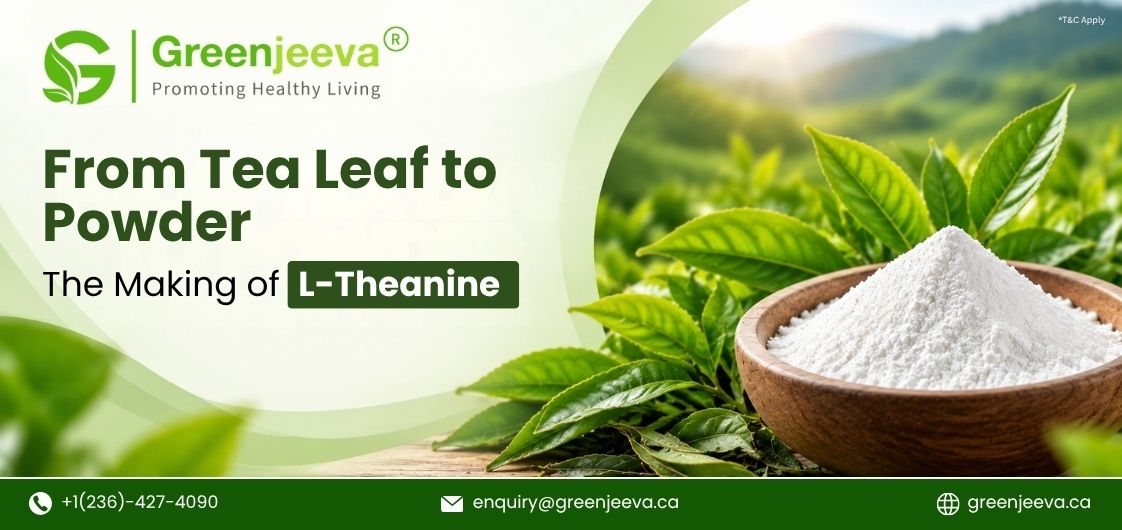
From Tea Leaves to Powder: How L-Theanine Extraction Turns It into a Commercial Ingredient
L-theanine has become one of the most recognized amino acids in the global ingredients industry. Found naturally in tea plants, this compound has moved from being a simple part of a beverage enjoyed for centuries to a standardized, purified powder used across supplement manufacturing, food and beverage formulation, and functional product development. Understanding how L-theanine is made from the tea leaf all the way to a commercial-grade powder shows just how much precision and oversight goes into modern ingredient manufacturing.
This article walks through the full L-theanine extraction process from cultivating the source plant, through purification, to quality control and how it eventually reaches manufacturers as bulk L-theanine powder.
What Is L-Theanine?
L-theanine is a naturally occurring amino acid found mainly in the leaves of Camellia sinensis, the plant behind green, black, white, and oolong tea. Smaller amounts also show up in certain mushroom varieties like Boletus badius. Structurally, it's similar to glutamate, another amino acid known for its role in various biological processes.
Tea itself only contains a modest concentration of this compound. Getting L-theanine from tea leaves into a usable, concentrated ingredient requires a dedicated production process which is where things get technical.
Step One: Sourcing and Cultivating Tea Leaves
The process starts at tea plantations. Not every batch of leaves is equally suited for extraction. A few factors affect how much of the compound the plant naturally produces:
- Growing conditions - Shade-grown tea, like the kind used for matcha and gyokuro, tends to hold higher amino acid levels since reduced sunlight slows the conversion into catechins.
- Harvest timing - Younger leaves and early-season harvests generally carry more of the compound than mature ones.
- Tea varietal - Different cultivars of Camellia sinensis produce different amino acid levels.
- Soil and climate - Altitude, temperature, and soil composition all play a part.
Companies focused on commercial L-theanine production often work directly with growers or agricultural cooperatives to source varietals known for higher natural yields, which makes the downstream extraction easier to standardize.
Step Two: The L-Theanine Extraction Process
Once leaves are harvested, extraction begins - arguably the most technical stage of turning raw plant material into a usable ingredient. Two broad methods dominate the industry.
Natural Extraction (L-Theanine From Tea Leaves)
In this method, tea leaves go through a water- or solvent-based extraction process. They're steeped, processed, and filtered to pull out soluble compounds L-theanine included, along with caffeine, catechins, and other naturally occurring substances. Because tea leaves carry so many compounds at once, extra purification steps are needed to separate L-theanine from everything else.
Common techniques include:
- Hot water extraction - Basically brewing tea, but scaled for industrial volume.
- Solvent extraction - Food-grade solvents pull a broader range of compounds before purification.
- Membrane filtration and chromatography - Separates L-theanine from caffeine, tannins, and other tea constituents.
Fermentation-Based Production
Tea-derived extraction is costly and yields relatively small quantities per batch, so most large-scale commercial L-theanine production today relies on fermentation instead. Specific bacteria or yeast strains are cultivated in a controlled environment and used to biosynthesize L-theanine directly.
This approach has taken over much of the industry because it:
- Delivers higher yield and purity per batch
- Removes dependency on seasonal tea harvests
- Produces more consistent quality from batch to batch
- Scales more easily for global supply chains
Most of the L-theanine powder circulating in the market today especially bulk L-theanine powder sold to formulators comes from fermentation, using a process similar to how other amino acids like lysine are manufactured.
Step Three: Purification and Isolation
Whether the source is tea extraction or fermentation, the next stage is purification. Raw extract is a mixture of compounds, and isolating L-theanine specifically takes several steps:
- Filtration - Removes solid particulates and leftover plant or microbial matter.
- Chromatographic separation - Resin-based or ion-exchange chromatography isolates the target amino acid from other soluble compounds.
- Crystallization - The purified liquid is concentrated until L-theanine crystals form.
- Drying - Crystals are converted into a stable, shelf-ready powder, typically through spray-drying or vacuum-drying.
What comes out the other end is a fine, white, crystalline powder the standardized form used throughout L-theanine powder production worldwide.
Step Four: Quality Control and Standardization
Before any batch moves further down the supply chain, it goes through quality control testing. This step matters a lot in commercial L-theanine production, since buyers expect consistent purity and identity across every batch. Testing usually covers:
- Purity analysis - Confirming the percentage of L-theanine content, typically 98%+ for commercial-grade powder.
- Heavy metal and contaminant testing - Screening for residues from soil, equipment, or agricultural inputs.
- Microbial testing - Especially important for fermentation-derived batches.
- Identity verification - HPLC testing confirms the molecular identity and concentration.
Any established L-theanine ingredient supplier will typically hand over a Certificate of Analysis (COA) with each batch, giving buyers documented proof of purity, specs, and compliance with relevant standards.
Step Five: Packaging and Global Distribution
Once it clears quality control, the powder gets packaged for shipping. Since it needs to stay stable and moisture-free during transport, packaging usually falls into a few categories:
- Bulk drums or bags for large industrial buyers
- Vacuum-sealed pouches for mid-sized manufacturers
- Smaller retail-ready packaging for private-label brands
From here, bulk L-theanine powder moves into global supply chains often shipped from manufacturing hubs in regions with strong tea industries or fermentation infrastructure out to distributors, formulators, and brand manufacturers worldwide.

Commercial Applications of L-Theanine Powder
Once it's standardized into powder form, L-theanine gets used across a range of industries:
- Dietary supplements - Capsules, tablets, and powders from supplement brands.
- Functional beverages - Ready-to-drink formulas, powdered drink mixes, and specialty beverages.
- Food products - Select functional food applications built around amino acid ingredients.
- Nutraceutical blends - Combined with other compounds in proprietary formulations.
It's water-soluble, has a neutral taste profile, and blends easily into formulations which is a big reason product developers reach for it so often.
Choosing an L-Theanine Ingredient Supplier
Behind every batch of commercial powder is a chain of stakeholders:
- Agricultural producers (for tea-derived extraction)
- Fermentation technology companies (for bio-synthesized production)
- Extraction and purification facilities
- Quality control and testing labs
- Ingredient distributors and brokers
- Private-label and contract manufacturers
When brands are vetting an L-theanine ingredient supplier, it usually comes down to a few things: consistent purity across batches, transparent sourcing (tea-derived vs. fermentation), documented testing (COAs on request), and reliable lead times for bulk L-theanine powder orders.
Sustainability Considerations in L-Theanine Production
As demand has grown, sustainability has become a bigger part of the conversation. Fermentation-based production, for one, doesn't rely on land-intensive tea cultivation, which can ease pressure on tea-growing regions.
Beyond that, more manufacturers are investing in:
- Extraction methods that use less water and energy
- Traceability systems so buyers can verify sourcing and production methods
- Packaging that cuts down on waste across the supply chain
These factors are increasingly part of how brands and formulators pick suppliers, especially ones prioritizing transparent sourcing.
Conclusion
How L-theanine is made from a compound sitting in tea leaves to a refined, commercial-grade powder comes down to agricultural sourcing, industrial extraction, and tight quality control working together. Whether it's L-theanine from tea leaves or fermentation-based biosynthesis, the process demands careful sourcing, purification, and testing before it ever reaches a manufacturer's formulation line.
As demand for functional ingredients keeps climbing, understanding this process and knowing what to look for in an L-theanine ingredient supplier gives brands a clearer picture of what they're buying when they order bulk L-theanine powder.