5 Procurement Problems Canadian Buyers Face When Sourcing Pineapple Juice Powder
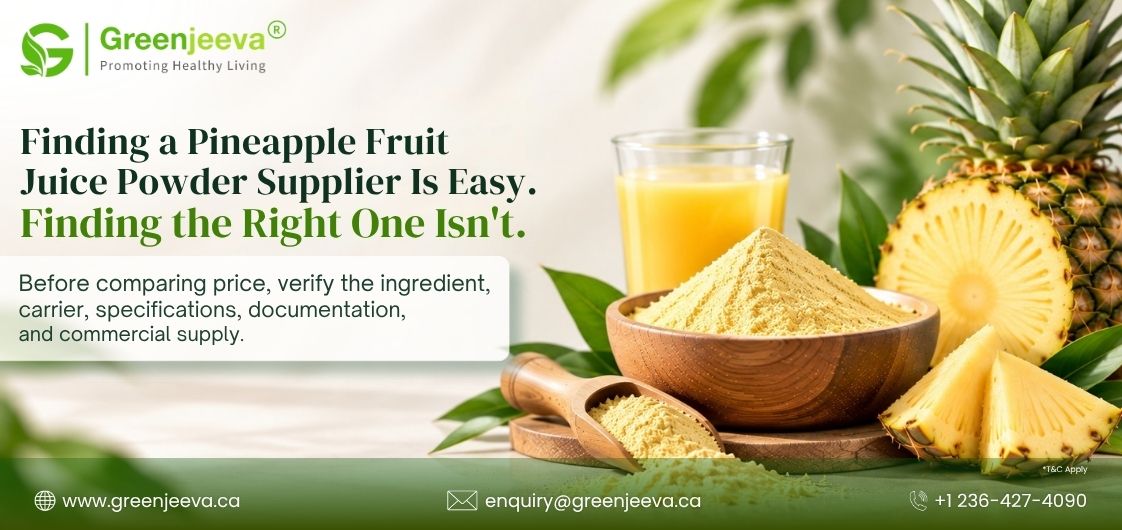
Buying Pineapple Juice Powder Should Be Simple. So Why Does Procurement Take So Long?
Finding a supplier that sells pineapple juice powder is usually not difficult.
Finding a supplier that can provide the right material, the right documentation, a workable sample, and reliable commercial supply is a different matter.
For a Canadian procurement team, the buying process can start with a simple RFQ:
Product + quantity + price + delivery date.
Then the questions start.
What exactly is the supplier quoting? Is it juice powder or whole-fruit powder? Does it contain a carrier? What is the mesh size? Can QA approve the documentation? Will the sample behave the same way in production? Where is the material actually coming from? Can the supplier support the next order?
Suddenly, a simple ingredient purchase becomes a qualification exercise.
That is why sourcing pineapple juice powder is not just about finding a supplier with stock. It is about reducing the uncertainty between RFQ, sample, QA approval, formulation testing, commercial purchase, and repeat supply.
Here are five procurement problems Canadian buyers should consider before placing a bulk order.
1. “Pineapple Powder” Does Not Tell You Enough About What You Are Buying
One of the first problems starts with the product name itself.
A supplier may list:
- Pineapple powder
- Pineapple fruit powder
- Pineapple juice powder
- Pineapple fruit juice powder
- Pineapple concentrate powder
- Pineapple extract powder
These terms should not automatically be treated as interchangeable.
A whole-fruit powder and a juice powder can come from different raw materials and processing methods. An extract is different again because it may be produced to concentrate specific constituents.
For procurement, this matters because you could end up comparing two prices for materials that are not actually equivalent.
What should you define before requesting a quote?
At a minimum, your RFQ should identify:

Green Jeeva Canada's current product listing identifies the ingredient as Organic Pineapple Fruit Juice Powder, with Ananas comosus as the botanical name, fruit as the plant part, and drying and grinding as the listed processing method.
That level of detail gives procurement something concrete to evaluate.
The practical point
Before comparing prices, make sure every supplier is quoting the same type of ingredient.
Otherwise, the cheapest quote may simply be the cheapest quote for a different material.
2. The Carrier Question Can Change Your Formulation and Your Cost
This is a question that is easy to miss during the initial sourcing process:
Does the pineapple juice powder contain a carrier?
The answer can matter more than many buyers initially expect.
Depending on the product and processing method, carrier systems can influence:
- Powder flow
- Hygroscopicity
- Caking
- Solubility and dispersion
- Bulk density
- Flavor intensity
- Formulation loading
- Label declaration
- Cost-in-use
This is particularly relevant when comparing two pineapple juice powders on a simple price-per-kilogram basis.
The two products may not contribute the same amount of pineapple-derived solids to a formulation.
Research on spray-dried pineapple juice has examined how carrier concentration and drying conditions affect properties such as moisture, particle characteristics, density and solubility. Commercial ingredient suppliers also advise buyers to clarify carrier presence because it can affect formulation calculations and finished-product characteristics.
The important point for procurement is simple:
Do not assume that a juice powder is either carrier-free or carrier-containing. Ask the supplier to confirm it.
The supplied Green Jeeva batch COA identifies the material as Organic Pineapple Fruit Juice Powder and provides physical, chemical, heavy-metal and microbiological results. It does not identify a carrier or carrier percentage.
That does not tell us whether a carrier is present or absent.
It tells us that carrier information should be requested separately when it matters to the formulation or label.
The practical point
If your R&D team has a carrier restriction, a target fruit-solids level, or a specific dosage requirement, put that requirement into the RFQ.
Do not leave it to assumption.
3. The Sample Works in the Lab. What Happens When You Buy 500 kg?
This is where sourcing gets more complicated.
A supplier sends a sample. R&D tests it. The formulation works.
Great.
But that does not automatically mean the commercial batch will behave exactly the same way.
Procurement and R&D should think about the transition from sample to commercial supply before the first PO is issued.
For pineapple fruit juice powder, the team may want to evaluate:
- Appearance
- Color
- Flavor
- Odor
- Particle size
- Moisture
- Solubility or dispersion
- Flow behavior
- Caking during storage
- Microbiological quality
- Heavy metals
- Identity
The supplied Green Jeeva COA, for example, reports that 100% of the material passes through #80 mesh and gives a loss-on-drying result of 3.45%. It also reports total ash and TLC identification results.
The same batch includes heavy-metal and microbiological results.
That information is useful for QA, but it does not replace an application trial.
If the ingredient is going into a beverage, dry blend, nutrition powder, sachet, gummy or another finished product, R&D should evaluate it under the actual conditions in which it will be used.
Questions worth asking before approving the supplier
- Is the sample representative of commercial production?
- Will the same specification apply to the production batch?
- Are the critical physical properties controlled?
- Can the supplier provide batch-specific documentation?
- What happens if the commercial batch performs differently?
- Can the supplier support repeat orders against the approved specification?
The practical point
A sample proves that one sample works. Your qualification process needs to establish whether the commercial supply is suitable for ongoing production.
4. The Ingredient Is Available, But QA Is Still Waiting for Documents
This happens often in ingredient procurement.
The supplier has the material.
The price works.
The sample has been sent.
But the purchase still cannot move because QA has questions.
The team may need:
- Product specification
- Batch COA
- Microbiological testing
- Heavy-metal testing
- Identity testing
- Allergen information
- GMO statement
- Country of origin
- Organic documentation
- Shelf life
- Storage conditions
- Packaging information
- Additional testing where required
The issue is not that suppliers need documentation.
The issue is whether the documentation arrives early enough and with enough detail to keep the approval process moving.
The Green Jeeva batch COA provides a useful example. It identifies the batch, botanical source, plant part, country of origin, manufacture date and expiry date, and reports physical, heavy-metal and microbiological results.
For Canadian buyers sourcing organic ingredients, certification also needs to be checked carefully.
Green Jeeva Canada INC is listed by CCOF as certified under the Canada Organic Regime (COR)and COR Food Processing. The listed operation is in Surrey, British Columbia.
Its organic certificate identifies the certification as COR Trade of Organic Products and states that specific certified organic products are identified through the CCOF Client Profile Addendum.
That distinction is important for procurement.
A supplier having organic certification does not mean that every product in its catalog should automatically be assumed to fall within the certified scope.
The practical point
When organic status is part of your purchasing requirement, verify the certification and confirm that the specific product you are buying is covered by the relevant certification scope.
That can save a lot of back-and-forth later.
5. Finding the Supplier Is One Thing. Getting the Next Order Is Another.
The first purchase is not where procurement performance really gets tested.
The second and third orders tell you much more.
Imagine that your formulation has been approved and your production team now needs another 500 kg.
You need to know:
- Is the material available?
- What is the current lead time?
- Is the same specification available?
- What is the MOQ?
- What packaging options are available?
- Can the supplier support higher volumes?
- Will the next batch come with the required documentation?
- Can the material be delivered where and when you need it?
These questions become even more important when production demand changes unexpectedly.
A supplier may be perfectly capable of handling a sample or a small first order. The procurement team still needs to understand whether that supply route will work for ongoing production.
Green Jeeva Canada INC's certified operation is located in Surrey, British Columbia. Its current product listing also shows Organic Pineapple Fruit Juice Powder as an available ingredient for Canadian procurement.
The important point is not simply that the supplier is located in Canada.
It is that Canadian procurement teams have a local commercial contact point while still needing to verify the actual inventory, quantity and lead time for their specific requirement.
The practical point
A good sourcing process should make the second order easier than the first.
If every reorder starts with the same questions, documents and qualification work, procurement is carrying unnecessary friction.
The Hidden Cost Behind a “Good” Pineapple Powder Price
This is where the five problems come together.
A supplier might offer a competitive price per kilogram.
But what happens if:
The ingredient description is unclear
↓
QA needs additional information
↓
The sample does not match the formulation requirement
↓
A second sample is needed
↓
Commercial approval is delayed
↓
Production is waiting
↓
Procurement has to find another supply option
The price per kilogram was never the whole cost.
There is also the cost of:
- Procurement time
- QA time
- R&D trials
- Failed batches
- Re-sampling
- Production delays
- Emergency sourcing
- Requalification
That is why experienced procurement teams look beyond the initial quotation.
The real question is not only “What does it cost per kilogram?”
It is:
“How much effort and risk will it take to get this ingredient approved and keep it in production?”
What Should Canadian Buyers Put in a Pineapple Juice Powder RFQ?
A well-written RFQ can eliminate many of these problems before they start.
Ingredient
- Exact ingredient name
- Botanical name
- Plant part
- Juice powder, fruit powder, extract or concentrate
- Organic or conventional requirement
Processing
- Processing method
- Drying method
- Carrier information
- Carrier percentage, if applicable
- Added ingredients or excipients
Physical specifications
- Mesh or particle size
- Moisture
- Appearance
- Color
- Bulk density, if relevant
- Solubility or dispersion requirements, if relevant
Quality
- Microbiological limits
- Heavy-metal limits
- Identity testing
- Pesticide requirements, where applicable
- Allergen and GMO requirements
Commercial
- Required quantity
- MOQ
- Packaging
- Delivery location
- Required delivery date
- Current stock
- Lead time
Documentation
- Product specification
- COA
- TDS/SDS where applicable
- Organic certificate or supporting documentation
- Country of origin
- Other QA documents required by your organization
The more clearly these requirements are defined, the easier it becomes to compare suppliers on an equal basis.
How Should You Compare Pineapple Juice Powder Suppliers?
Price still matters.
It just should not be the first and only filter.
A simple procurement matrix can help:

This helps avoid one of the most common procurement mistakes:
Choosing the lowest price before confirming that the materials being compared are actually equivalent.
Where Green Jeeva Canada Fits Into the Procurement Process
The value proposition should not simply be that Green Jeeva Canada sells pineapple powder.
The more relevant question is:
Can the supplier help reduce the friction between sourcing, qualification and ongoing purchasing?
For this ingredient, the relevant capabilities include:

This is a more useful way to evaluate a supplier than simply looking at a list of company USPs.
The question is whether each capability solves a problem that procurement actually has.
What Does the Available Green Jeeva COA Tell Buyers?
For procurement and QA teams evaluating the ingredient, the supplied batch documentation provides several useful data points.
The COA identifies:
- Product:Organic Pineapple Fruit Juice Powder
- Botanical source:Ananas comosus
- Plant part:Fruit
- Country of origin:China
- Batch:OPFJP-20250331
- Manufacture date:March 31, 2025
- Expiry date:March 30, 2027
- Mesh:100% passes #80 mesh
- Loss on drying:3.45%
- Total ash:1.97%
- Identification:TLC compliant
The COA also reports lead at 0.05 ppm, arsenic at 0.0122 ppm, mercury at 0.003 ppm and cadmium at 0.005 ppm. Total plate count is reported at 100 cfu/g, while yeast and mold are 6 cfu/g. E. coli and Salmonella are reported as negative/ND.
There is one detail procurement teams should pay particular attention to:
The stated country of origin is China.
This highlights an important distinction:
Supplier location is not the same as ingredient origin.
A Canadian supplier can provide an ingredient that is manufactured or sourced from another country.
Both pieces of information matter.
If country of origin is relevant to your formulation, customer requirements, labeling, or internal sourcing policy, it should be explicitly confirmed during procurement.
A Practical Procurement Workflow for Pineapple Juice Powder
For Canadian buyers, the process can be kept relatively simple.
1. Define the ingredient
Be specific about whether you need:
Pineapple juice powder, pineapple fruit powder, pineapple extract, or pineapple concentrate powder.
2. Define the application
Tell the supplier where the ingredient will be used.
A powder intended for a dry beverage may have different practical requirements from one used in a supplement blend or another finished product.
3. Issue a structured RFQ
Ask for:
- Specification
- Processing information
- Carrier information
- MOQ
- Price
- Lead time
- Documentation
- Origin
- Packaging
4. Test the sample
Use the sample in the intended formulation rather than evaluating it only by appearance.
5. Complete QA approval
Review the specification, COA and relevant regulatory or organic documentation.
6. Confirm the commercial order
Before issuing the PO, confirm:
- Quantity
- Batch availability
- Packaging
- Lead time
- Delivery
- Commercial terms
7. Keep the approved specification for future orders
This step is easy to overlook.
Once an ingredient is approved, keep the agreed specification and qualification information tied to the purchasing record.
That gives procurement a reference point for future orders and reduces the risk of starting the qualification process from scratch every time.
The Procurement Question That Matters Most
Sourcing pineapple juice powder does not have to be complicated.
It becomes complicated when the first question is:
“What's your price per kilogram?”
before the more important questions have been answered:
“What exactly are you quoting?”
“Will it work in our formulation?”
“Can our QA team approve it?”
“Can you supply the quantity we need?”
“Can we get the same level of support when we reorder?”
For Canadian procurement teams, defining the ingredient early, clarifying processing and carrier information, testing a representative sample, completing QA review, and confirming commercial supply can eliminate much of the unnecessary back-and-forth.
The goal is not simply to find a pineapple fruit juice powder supplier.
The goal is to find a procurement-ready supply route that works from the first RFQ through repeat orders.
Sourcing Organic Pineapple Fruit Juice Powder in Canada?
Green Jeeva Canada currently lists Organic Pineapple Fruit Juice Powder, with Ananas comosus identified as the botanical source and fruit as the plant part.
If you are evaluating the ingredient for a formulation or bulk requirement, start with the current specification, request the relevant documentation, obtain a sample, and validate the material in your intended application before moving to commercial volume.