What Canadian Buyers Should Check Before Sourcing Activated Charcoal Powder
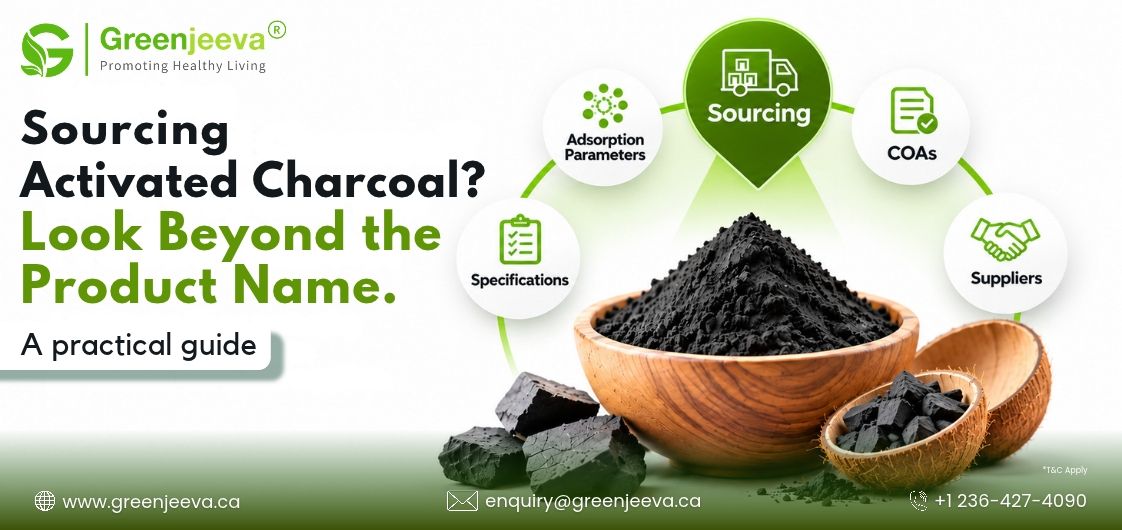
When Canadian buyers source activated charcoal powder, the first specification they often see is mesh size.
But mesh size alone does not establish whether a powder is suitable for a cosmetic, food, or industrial application. Carbon source, activation method, adsorption parameters, and batch documentation all influence whether a material can meet a purchasing requirement consistently.
This guide explains how to evaluate bulk activated charcoal powder before approving a supplier so the decision is based on more than a product name and a price.
What is activated charcoal powder?
Activated charcoal powder is a fine, black powder made from carbon-rich material that has been processed to develop a porous internal structure. That porosity is what gives activated charcoal its characteristic adsorption behavior.
It is important to distinguish activated charcoal from ordinary charcoal. Regular charcoal is produced through carbonization of carbon-rich material under limited oxygen conditions. Activated charcoal undergoes an additional activation process that develops its porous structure and adsorption characteristics.
For B2B buyers, this distinction matters. “Charcoal powder” and “activated charcoal powder” are not interchangeable descriptions, and a product name alone does not establish the material’s quality, processing method, or intended use.
When evaluating activated charcoal powder, buyers should confirm:
- Carbon source or feedstock.
- Activation method.
- Particle-size range or mesh specification.
- Moisture or loss-on-drying limit.
- Ash content, where applicable.
- pH, where relevant.
- Adsorption parameters, such as iodine number or methylene blue adsorption.
- Microbiological and contaminant requirements.
- Packaging, storage, and shelf-life requirements.
- Intended application and applicable regulatory category.
Why coconut shell matters
Coconut shell activated charcoal is produced from coconut shells, a carbon-rich agricultural by-product. The shell material is carbonized and then activated to develop the porous structure associated with adsorption behavior.
For buyers, the coconut-shell designation is more than a sourcing detail. The starting material can influence the characteristics of the resulting carbon. However, final properties also depend on carbonization, activation, and subsequent processing conditions.
That is why buyers should review the full specification rather than selecting a product based on the feedstock alone.
For a broader overview of how coconut shell activated charcoal is produced and used, see Coconut Shell Activated Charcoal Powder: Applications, Specifications, and Bulk Sourcing Guide.
What mesh size tells buyers
Mesh size is one of the first specifications buyers encounter, but it is often misunderstood.
Mesh size describes the particle-size range of the powder how fine or coarse the material is. It does not, by itself, describe adsorption capacity, purity, or performance in a finished product.
Particle size can influence powder handling, mixing, dispersion, and filtration behaviour. The extent of its impact depends on the formulation, equipment, and intended process. Buyers should evaluate the particle-size specification alongside other relevant physical and adsorption parameters.
Before approving a material, ask:
- What mesh size is specified?
- Is a particle-size distribution available?
- What test method is used?
- Is the specification a typical value or an acceptance limit?
- Does the particle size suit the intended application?
For applications where texture, dispersion, or filtration behavior matters, sample evaluation under representative processing conditions is recommended.
Iodine number and methylene blue: what they indicate
Two of the most common technical parameters on an activated charcoal specification are iodine number and methylene blue adsorption. Buyers often see them listed side by side without understanding what each one measures.
Iodine number
Iodine number is a measure of the material’s capacity to adsorb iodine under defined test conditions. It is commonly used as an indicator associated with adsorption of relatively small molecules and micropore development. A higher iodine number generally indicates greater iodine adsorption capacity under the specified test conditions. It is commonly used as an indicator associated with micropore development, but it does not provide a complete picture of the material's pore structure or predict its performance in a specific formulation. Other parameters, such as particle size, moisture, and ash content, must also be evaluated.
Results should be compared using the same or technically equivalent test method and reporting basis.
Methylene blue adsorption
Methylene blue adsorption is commonly used to assess adsorption capacity for a larger dye molecule and provides an indication of adsorption behaviour associated with larger pores.
Like iodine number, it is a useful data point but not a complete quality assessment. A high methylene blue value does not automatically mean the powder is suitable for every application.
What buyers should ask
When reviewing a COA or specification, ask:
- Which parameter is reported: iodine number, methylene blue adsorption, or both?
- What test method is used?
- What are the acceptance limits?
- Is the result batch-specific or a general specification value?
- How do these parameters relate to the intended application?
A strong specification reports the parameters that matter for the intended use, not just the highest number available.
What a COA should include
A COA is one of the most important documents in activated charcoal sourcing, but it is often treated as a formality rather than a quality control.
A lot-specific COA should confirm:
- Product name and grade.
- Batch or lot number.
- Carbon source or feedstock.
- Activation method, where disclosed.
- Particle size or mesh specification.
- Moisture or loss-on-drying result.
- Ash content, where applicable.
- Iodine number and/or methylene blue adsorption result.
- pH, where relevant.
- Microbiological results, where applicable.
- Heavy-metal and contaminant results, where applicable.
- Test methods and reporting units.
- Date of analysis and document identification.
A COA documents results for a specific batch. It does not guarantee that every future lot will perform identically.
The exact parameters reported will depend on the product grade, intended application, and agreed specification. Buyers should confirm that the COA covers the quality attributes and acceptance limits relevant to their requirements.
What should buyers verify before approving a supplier?
A dependable activated charcoal supplier should be able to provide documentation that connects the ingredient, batch, shipment, and quality controls.

A specification and a COA serve different purposes. A specification defines the accepted requirements for an ingredient, while a COA reports the tested results for a particular batch. Buyers should review both documents before approving a commercial order.
Comparing two activated charcoal powders
Two suppliers may offer activated charcoal powder with similar specifications. That does not automatically make the materials equivalent.

A matching specification is a useful starting point. The supporting documentation determines whether two materials meet the same purchasing requirement.
Application considerations: cosmetics, food, and industrial use
Activated charcoal powder is used across a range of applications, but the requirements differ significantly by category.

In cosmetics and personal care, buyers may need to evaluate particle size, sensory profile, colour contribution, and compatibility with the formulation. For food-related applications, the intended use, applicable regulatory category, and supporting documentation must be verified. Industrial buyers may place greater emphasis on adsorption parameters, particle-size distribution, and process requirements.
For supplement-related applications, buyers should verify the intended use, applicable regulatory requirements, ingredient documentation, and contaminant limits before considering the material for formulation.
Across all categories, the material should be evaluated against the finished product's requirements. Coconut-shell origin alone does not establish suitability for a particular application.
The buyer’s principle
Do not qualify activated charcoal powder by its product name or mesh size alone.
Evaluate the carbon source, activation method, adsorption parameters, particle size, documentation, and application fit before approving a bulk order. A structured approach specification review, COA verification, sample evaluation, and repeat-order planning helps manufacturers make a more informed sourcing decision.
Source Activated Charcoal Powder from Green Jeeva Canada
Green Jeeva Canada offers activated charcoal powder coconut shell for businesses sourcing bulk ingredients for manufacturing applications.
Before selecting an activated charcoal powder, review the available product specification and documentation against your internal quality standards. Your team can also confirm the carbon source, activation method, particle size, adsorption parameters, and applicable documentation before proceeding with a purchase.
Explore Green Jeeva Canada’s Activated Charcoal Powder Coconut Shell