What 95% Quercetin Doesn’t Tell You About Sophora Japonica Extract
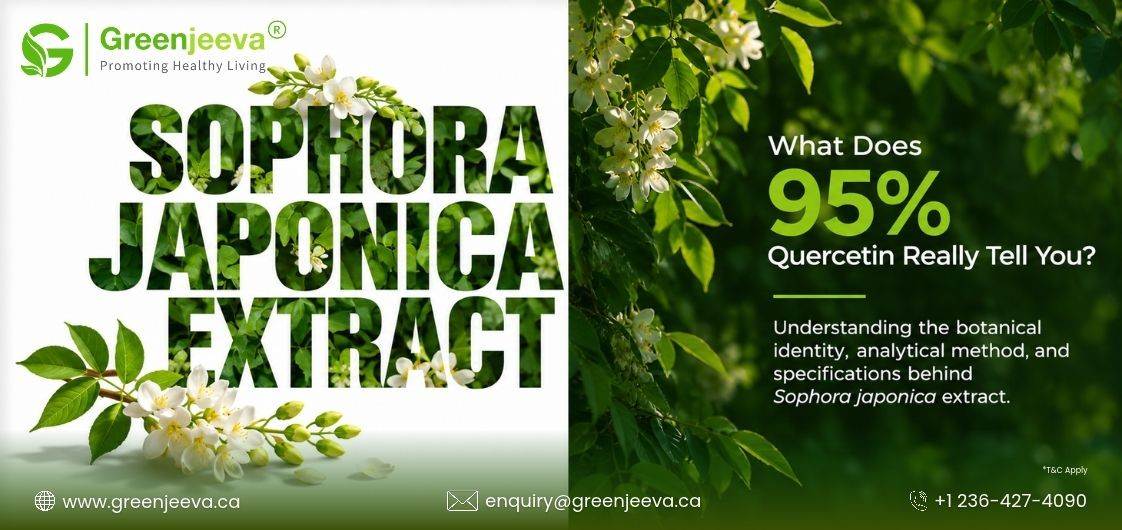
On a quotation, Sophora japonica extract 95% quercetin looks decisive.
It suggests a defined botanical, a clear active marker, and a measurable standard. For a procurement team comparing suppliers, it can feel like the hardest part of the evaluation is already done.
But in ingredient sourcing, a single percentage often creates more questions than it answers.
Ninety-five percent quercetin tells you what was measured. It does not tell you which plant material was used, how the extract was produced, whether the quercetin was concentrated from the naturally occurring plant constituents or obtained through a processing step that converts other flavonoids into quercetin, or whether the powder will behave in the same way across future batches.
For Canadian manufacturers, that gap between the number and the material is where sourcing decisions become interesting.
The percentage is a measurement, not an identity
“95% quercetin by HPLC” indicates that quercetin was quantified at the stated level under a specified analytical method and reporting basis. However, the percentage alone does not provide a complete picture of the material's composition or establish every aspect of its purity.
To interpret the result correctly, buyers should understand whether it represents an assay or chromatographic purity, how the percentage is calculated, and which analytical method and reference standard were used.
A meaningful specification should make several things clear:
- The exact form of quercetin being measured.
- Whether the result is reported on an as-is or dried basis.
- The HPLC method, including sample preparation and detection conditions.
- The reference standard used.
- The batch-specific COA result.
- Whether the COA corresponds to the supplied lot.
- Any applicable acceptance limits and specification ranges.
A useful way to read the specification is this: 95% is the answer to one question. The specification should answer several more.

Sophora japonica is not automatically quercetin
Sophora japonica, commonly called the Japanese pagoda tree, is often associated with flavonoid-rich flower buds. But its natural composition is more nuanced than a single quercetin number suggests.
Studies of Sophora japonica flower buds have reported rutin as a major flavonoid, alongside quercetin, kaempferol, isorhamnetin, and other compounds.
That matters because rutin and quercetin are related but distinct compounds. Rutin is a quercetin glycoside; quercetin is the aglycone form. They are not interchangeable on a specification sheet, and a buyer should not assume that a high quercetin result describes the same material as a high rutin result.
In other words: a Sophora extract can be quercetin-rich without being a simple quercetin powder.
Where the 95% can come from
The more important question is not whether a material reaches 95% quercetin. It is how it got there.
Sophora flower buds naturally contain flavonoid glycosides, including rutin. Under certain processing conditions, rutin can be hydrolyzed to release quercetin. Research on Sophora japonica extracts has examined acid hydrolysis as a way to convert rutin to quercetin, with reaction conditions influencing the conversion.
That does not mean every 95% quercetin material has been hydrolyzed. It means buyers should not infer the manufacturing route from the percentage alone.
These findings demonstrate one possible processing route for obtaining quercetin-rich material. They do not establish the manufacturing process used for every commercial Sophora japonica extract. Buyers should request product-specific process information rather than infer the extraction or conversion route from the final assay percentage.
A supplier should be able to explain:
- Whether the material is a flower-bud extract, flower extract, or another defined starting material.
- Whether quercetin is naturally present, concentrated through extraction, or produced through a conversion process.
- Which form of quercetin was assayed.
- Whether the result is expressed on an as-is or dried basis.
- Which HPLC method was used.
- Whether the COA corresponds to the supplied lot.
These are not technical niceties. They determine whether two products with the same percentage are actually comparable.
The specification behind the percentage
A strong specification does more than state a quercetin result. It defines the boundaries of the material.
For Sophora japonica extract powder, buyers should look for clarity on:
- Botanical identity and plant part.
- Extraction route and solvent, where applicable.
- Quercetin form and assay basis.
- HPLC method and reporting conditions.
- Moisture or loss-on-drying limit.
- Particle-size range or mesh profile.
- Carrier or excipient information, if present.
- Color, odor, and taste requirements.
- Applicable contaminant and microbiological limits.
- Batch identification and traceability.
A percentage without context is a data point. A specification with context is a purchasing control.
Why two 95% materials may not behave alike
In formulation, the quercetin percentage is only one variable.
A powder’s particle-size distribution, moisture level, bulk density, carrier system, and extraction history can all influence how it handles in production. That is why a material that meets a quercetin specification may still require evaluation for flow, blending, dispersion, color contribution, or compatibility with other ingredients.
For example, a powder intended for a capsule blend may need to demonstrate acceptable flow and blend uniformity. A material intended for a beverage premix may need to be evaluated for dispersion and sedimentation behavior. A gummy or confectionery application may raise different questions around flavor balance, moisture sensitivity, and color.
The percentage does not predict those outcomes. The formulation does.
Comparing two 95% quercetin extracts
Two suppliers may offer Sophora japonica extract powder with the same stated quercetin percentage. That does not automatically make the ingredients equivalent.

A matching percentage is a useful starting point. The supporting specification and analytical documentation determine whether two materials meet the same purchasing requirement.
The COA answers a different question
A product specification and a COA are often treated as interchangeable. They are not.
A specification defines what the buyer and supplier have agreed the material should meet. A COA reports what was tested for a particular batch.
That distinction becomes important when a buyer is comparing suppliers or approving an incoming shipment. A general specification can describe an acceptable quercetin range, but it cannot confirm the result for the lot sitting in the warehouse.
Before approving a bulk order, confirm that:
- The COA identifies the same product and grade.
- The COA lot number matches the shipment and label.
- The quercetin result is reported using a defined method and basis.
- The result falls within the agreed specification.
- The COA includes the parameters relevant to the buyer’s quality system.
- Traceability records connect the batch to its documentation.
A COA is evidence for one batch. It is not a promise about the next one.
A better supplier conversation
Instead of asking, “Can you supply 95% quercetin?” a more useful question is:
“Can you tell me exactly what material produced that 95% result and can you demonstrate that consistently?”
That question changes the discussion.
It moves the conversation from price and percentage to botanical identity, process transparency, analytical method, batch documentation, and repeat-order control. It also gives quality and regulatory teams a clearer basis for evaluating whether the ingredient fits the intended product.
For Canadian buyers building a broader botanical sourcing framework, Green Jeeva Canada’s guide to sourcing bulk organic herbs in Canada provides useful context on certification, COAs, traceability, and supplier communication.
The buyer’s principle
A percentage is a starting point, not a specification.
For Sophora japonica extract 95% quercetin, the more useful question is not “Is it 95%?” It is: “What material produced that 95%, how was it measured, and can the supplier demonstrate it consistently?”
Source Sophora Japonica Extract 95% Quercetin from Green Jeeva Canada
A 95% quercetin specification is an important starting point when evaluating a botanical extract. The next step is understanding the botanical source, analytical method, product specifications, and supporting batch documentation.
Green Jeeva Canada offers Sophora japonica extract powder 95% quercetin, HPLC, derived from the flower buds of Sophora japonica.
For manufacturers and bulk ingredient buyers, reviewing the product specification and available quality documentation can help determine whether the ingredient aligns with internal sourcing and formulation requirements.
Explore Green Jeeva Canada’s Sophora Japonica Extract Powder 95% Quercetin, HPLC