Ascorbic Acid Powder for Clean Label Food and Beverage Manufacturing in Canada
Summary, the quick version
Ascorbic acid powder, also called vitamin C powder or L-ascorbic acid, is a multifunctional food ingredient and a recognized food additive.
Its main technical roles are as an antioxidant, a browning inhibitor, and a dough conditioner, which is why it appears across bakery, beverage, and processed foods.
It offers a clean-label alternative to some synthetic preservatives and antioxidants, since it reads as a familiar, recognizable ingredient.
Green Jeeva Canada supplies food-grade ascorbic acid powder tested by USP methods, with documentation for supplier validation.
Supplied in a 25 kg pack. Place a bulk order quotation on the website, with dispatch from the Canada warehouse and documents available after registration.
Ascorbic acid is one of the most functional ingredients a food manufacturer can reach for, doing real chemical work in a formula rather than just sitting on the label. This guide is written for food and beverage manufacturers, product developers, and procurement teams in Canada who are sourcing food-grade ascorbic acid powder. It focuses on the chemistry behind its function, where it fits across product categories, and how to specify and source it, rather than on personal health effects, which are outside the scope of a food ingredient blog.
What Ascorbic Acid Powder Is
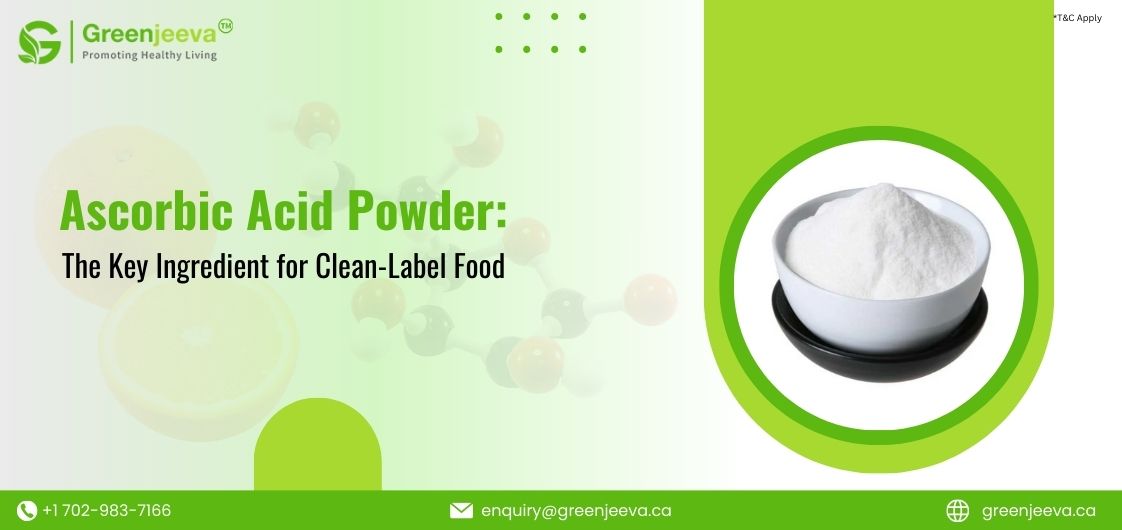
Ascorbic acid powder is the pure crystalline form of vitamin C, also called L-ascorbic acid. In food manufacturing it is used as a functional additive rather than primarily as a nutrient, valued for its chemical reactivity as a reducing agent. It is supplied as a fine, white to almost white, water-soluble powder.
Vitamin C and ascorbic acid are the same compound. Vitamin C is the common name used in nutrition contexts, while ascorbic acid or L-ascorbic acid is the chemical name used on a food additive specification and an ingredient label. In food technology, the compound is usually discussed by its function, as an antioxidant and a reducing agent, rather than by its nutritional role.
The Chemistry Behind Its Function
Ascorbic acid is a reducing agent, meaning it readily gives up electrons in a chemical reaction. That single property is the basis for almost everything it does in food manufacturing, from stopping oxidation to conditioning dough. Understanding this helps explain why one ingredient shows up in such different applications.
Because it oxidizes easily, ascorbic acid reacts with oxygen and other reactive compounds before they can react with the food itself. In practice, this reducing action does three distinct jobs depending on the system it is added to.
As an antioxidant, it reacts with oxygen to slow the degradation of fats, flavours, and colours.
As a browning inhibitor, it interferes with the enzymatic reaction that turns cut fruit and vegetables brown.
As a dough conditioner, it is oxidized during mixing in a reaction that strengthens the gluten network.
These are established food-technology functions, not claims about consuming the finished product. Any statement about the health effects of a finished food remains the manufacturer's responsibility to substantiate.
Applications Across Food and Beverage Categories
Ascorbic acid powder is used across bakery, beverages, processed fruits and vegetables, and processed meats. In each category it performs one or more of its three core functions, antioxidant protection, browning inhibition, or dough conditioning, which is why it is considered a multifunctional ingredient.
Bakery
In bread and other yeast-leavened products, ascorbic acid acts as a dough conditioner. It is oxidized during mixing, which strengthens the gluten network and improves dough handling and loaf volume. It pairs with other bakery functionals such as sodium bicarbonate powder in some formulations.
Beverages
In juices and beverages, ascorbic acid works as an antioxidant, helping protect color and flavor compounds from oxidative degradation and extending the product's usable shelf life.
Processed Fruits and Vegetables
Cut and processed produce browns through an enzymatic reaction with oxygen. Ascorbic acid interrupts that reaction, which is why it is used to help maintain the colour of cut fruit and some vegetable products.
Processed Meats and Other Applications
In cured and processed meats, ascorbic acid and its derivatives support color stability and help the curing reaction proceed efficiently. It also appears in confectionery and functional food fortification, where it serves both a technical and a compositional role.
Ascorbic Acid as a Clean-Label Ingredient
Ascorbic acid offers a clean-label option where a formulator wants to move away from certain synthetic preservatives or antioxidants. It is a recognizable, familiar name on an ingredient list, and food-grade material is manufactured to defined purity standards. Clean-label positioning here refers to label simplicity, not a health claim.
When a brand wants to simplify its ingredient declaration, ascorbic acid is often considered because it is widely recognized and performs a specific job rather than sitting in a formula unexplained. That makes it easier for a brand to communicate what an ingredient does and why it is there, which supports transparency in labeling. Whether ascorbic acid fits a specific clean-label claim depends on the full formulation and the regulations in the target market, and that determination stays with the manufacturer.
Using Ascorbic Acid Alongside Other Antioxidants
Ascorbic acid is often used together with other antioxidants rather than alone, since different antioxidants protect against oxidation in different parts of a formula. Ascorbic acid works well in the water phase, while some other antioxidants work in the fat phase, so pairing them can give broader protection across a formulation.
A common example is the combination of ascorbic acid with tocopherols, where ascorbic acid helps regenerate the active form of tocopherol as it does its own antioxidant work, extending the useful life of both. This kind of synergy is a standard food-technology consideration, and it is one reason ascorbic acid appears in blended antioxidant systems rather than only on its own. When you are designing a shelf-stability strategy, it is worth testing ascorbic acid both alone and alongside a fat-soluble antioxidant to see which combination best protects your specific formulation.
What a Food-Grade Ascorbic Acid Specification Includes
Ascorbic acid is a well-defined chemical compound, so its specification is precise. The Green Jeeva Canada food-grade ascorbic acid powder is assayed by redox titration and tested against a full purity and safety panel. The complete specification and certificate of analysis are available after registration.
When you evaluate a supplier, these are the points worth confirming first.
Assay by redox titration, with food-grade material typically in the 99.0 to 100.5 percent range.
Identification by a positive reaction, confirming the compound's identity.
Melting point and pH, which confirm purity and consistency from batch to batch.
Copper and iron limits, since trace metals can catalyze unwanted oxidation in a formula.
Heavy metal limits, tested to low levels for a food additive.
GMO-free, allergen-free, BSE and TSE-free, and non-irradiated status.
These highlights give a formulator enough to qualify the ingredient at a glance. The full specification, including the complete physical and heavy metal panels with test methods, is available on request and can be downloaded after registration on the website. Reviewing the certificate of analysis for the specific lot remains the final check before you formulate.
Formulating With Ascorbic Acid Powder
Ascorbic acid is used at different levels depending on the function you need, from trace amounts as an antioxidant to higher levels as a dough conditioner. It is highly water-soluble, which makes it easy to dose into a liquid or a dry blend. Confirm the right level for your application through bench trials.
Dissolve it into the aqueous phase where possible, since it is highly water-soluble.
Add it at the stage where it can do its job, early for browning inhibition, or at mixing for dough conditioning.
Watch for copper and iron in your water or other ingredients, since trace metals can work against its antioxidant action.
Confirm the dose through bench trials, since the right level depends on the product and the effect you want.
Store it cool, dry, and sealed, away from heat, moisture, and light, to protect its reactivity until use.
Sourcing Food-Grade Ascorbic Acid Powder from Green Jeeva Canada
Green Jeeva Canada supplies food-grade ascorbic acid powder for clean-label food and beverage manufacturing, backed by documentation. You can qualify a sample, then scale to a bulk order. Here is what a procurement team needs to know.
Food-grade L-ascorbic acid powder, assayed by redox titration.
Green Jeeva Canada is COR, FDA, Halal, Kosher, GMA, and CFIA certified, and the material is fully traceable.
GMO-free, allergen-free, BSE and TSE-free, and non-irradiated, with a certificate of analysis for each lot.
Supplied in a 25 kg pack, suited to production-scale use.
A bulk order quotation can be placed on the website, and a zero-questions-asked return policy backs your first order.
Stock ships from the Canada warehouse, and documents and certificates download after registration.
If you are building a clean-label formulation, ascorbic acid pairs with other functional and clean-label ingredients such as sorbitol powder and rice maltodextrin powder, which you can sample through the same process. Review the certificate of analysis for the specific lot before you formulate.
Ready to source bulk ascorbic acid powder in Canada?
View the stock, the pricing structure, compliance documents, MOQ, and pack size on the website, and place a bulk order quotation with Green Jeeva Canada.
Ascorbic acid powder is supplied by Green Jeeva Canada as a raw ingredient for food and beverage manufacturing. Finished-product claims, including any clean-label, preservative, or nutrition statement, should be verified and substantiated by the manufacturer and comply with applicable regulations in the target market. This article is written by the Green Jeeva Canada QA and RA team for sourcing and formulation guidance.