Bromelain Powder Specifications: How to Compare GDU Activity Before Buying in Bulk
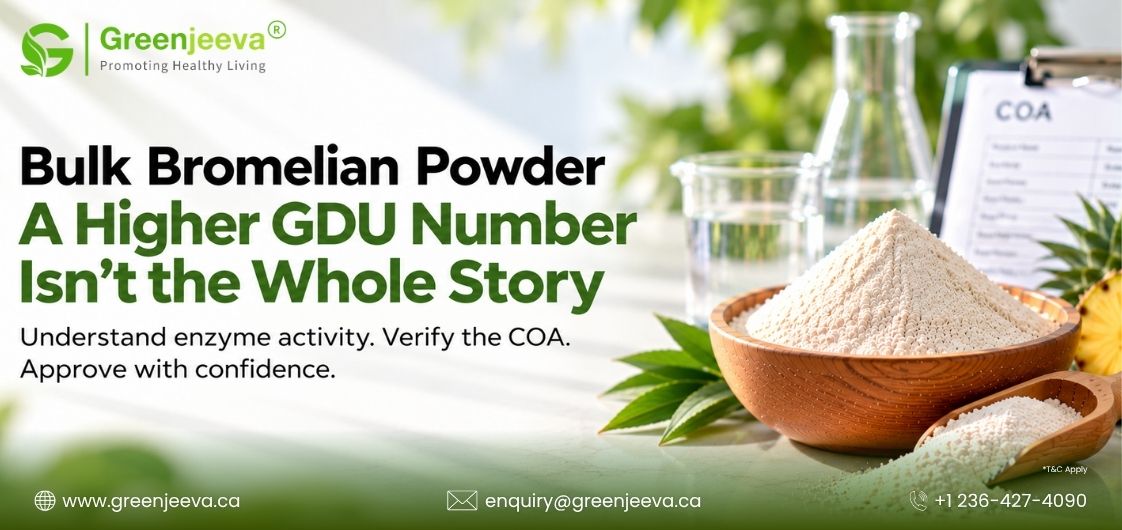
A technical buying guide for nutraceutical manufacturers, quality teams, and bulk ingredient buyers in Canada
Two suppliers quote bromelain powder. Both describe it as a pineapple-derived enzyme. Both provide a potency figure. Yet one specification may not tell you exactly what you need to know about the ingredient you are buying.
The question is not simply whether one product has a higher GDU number than another. It is whether the activity is measured on a comparable basis, whether the documentation supports the declared specification, and whether the ingredient meets your formulation requirements.
For procurement and quality teams sourcing bromelain powder, these details can influence supplier comparisons, sample approval, incoming quality checks, and decisions about repeat orders.
Before committing to a bulk purchase, here is how to assess enzyme activity and the specifications behind it.
Why Bromelain Powder Specifications Matter in Bulk Purchasing
Bromelain is a group of proteolytic enzymes associated with pineapple (Ananas comosus). Proteolytic enzymes break down proteins, a property that makes bromelain relevant to certain food-processing applications and enzyme-based formulations.
However, the ingredient name alone does not establish its activity, composition, or suitability for a particular application.
A specification should define the product's relevant quality parameters, while a Certificate of Analysis (COA) provides analytical results for a particular batch. Together, these documents help buyers establish whether the ingredient meets the agreed requirements.
When evaluating bromelain enzyme powder, start by identifying the parameters that matter to your product:
- Declared enzyme activity and the applicable unit basis.
- Analytical method used to determine activity.
- Ingredient identity and relevant compositional information.
- Microbiological and chemical contaminant results, where applicable.
- Storage, packaging, shelf-life, and handling requirements.
- Batch traceability and documentation availability.
These details provide a stronger basis for comparing suppliers than a product name or headline potency figure alone.
What Does GDU Activity Tell You and What Doesn't It?
GDU stands for gelatin digesting units. It is a measure of proteolytic enzyme activity based on the breakdown of gelatin under defined test conditions.
For manufacturers, GDU provides a way to specify and evaluate bromelain activity. But the number needs context before it can support a purchasing decision.
Start with the unit basis
A product described as bromelain 2400 GDU powder has a stated activity value of 2,400 GDU. Buyers should check the controlled product specification to establish exactly how that value is expressed—for example, whether it is stated per gram or on another defined basis.
Do not assume that two suppliers use identical reporting conventions simply because their product listings show similar numbers.
Confirm the analytical method
Ask which method is used to determine enzyme activity and whether the results are comparable across the products being evaluated.
Differences in test conditions, methodology, sample preparation, or reporting conventions can affect comparisons. If two COAs use different methods, ask the technical or quality team whether the results can be compared directly.
Separate activity from overall quality
GDU does not independently establish ingredient identity, microbiological quality, contaminant levels, or performance in every finished formulation.
A product with a higher declared activity is not automatically the better choice. The appropriate grade depends on the required activity, formulation design, intended use, and validated manufacturing process.
The purchasing principle: Treat GDU as one important specification parameter not a complete quality assessment.
1200 vs. 2400 GDU Bromelain Powder: What Should Buyers Compare?
The difference between 1,200 and 2,400 GDU may look straightforward, but a meaningful comparison requires more than comparing the numbers.
If both values use the same activity unit, reporting basis, and comparable analytical method, 2,400 GDU represents twice the stated activity relative to 1,200 GDU. If those conditions are not equivalent, the numerical comparison may be misleading. If those conditions are not equivalent, the numerical comparison may be misleading.
Before selecting a grade, work through four questions.
Are the activity values expressed on the same basis?
Confirm the unit definition, reporting basis, and test method for both products. Resolve any differences before treating the values as directly comparable.
What activity does the formulation require?
Begin with the technical requirements of the finished product. The required activity should be established through formulation development and appropriate testing, not selected solely because a supplier offers a higher number.
Has the intended use level been validated?
Evaluate the chosen ingredient in the actual formulation and processing conditions. Do not assume that activity figures alone predict finished-product performance.
What does the commercial specification guarantee?
Check the declared activity target, applicable acceptance limits, and batch-specific results. Establish how incoming batches will be evaluated against the approved specification.
A higher-activity grade may be suitable for one formulation but unnecessary for another. The objective is to select a grade that meets the documented requirements not to buy the largest number available.

How to Read a Bromelain Powder COA
A COA should help your quality team answer a practical question: does this batch meet the requirements agreed with the supplier?
When reviewing documentation from a bromelain powder supplier, pay particular attention to the following.
Not every application requires an identical testing panel. Requirements should reflect the intended use, applicable regulations, customer standards, and risk assessment.
If a specification lists an activity value but the COA does not make the batch result or test basis clear, ask for clarification before approval.
What to Confirm Before Approving a Bulk Bromelain Powder Order
A sample that performs well in a laboratory trial is an important starting point. It does not, on its own, establish that every future commercial batch will meet the same requirements.
For bromelain powder bulk purchasing, build the approval process around documented criteria.
Define acceptance criteria before ordering
Agree on the required activity, applicable test method, relevant quality parameters, and documentation expectations. Record these requirements in the approved specification rather than relying on informal discussions.
Evaluate the ingredient in the intended application
Test the sample under representative formulation and processing conditions. Consider the intended use level, compatibility with other ingredients, and the performance criteria relevant to the finished product.
Establish incoming quality checks
Define how the receiving team will review batch documentation and determine whether a delivered lot meets the approved specification. Additional testing may be appropriate depending on the material, application, and quality risk.
Confirm commercial and storage requirements
Clarify packaging, storage conditions, shelf life, order quantities, lead times, and supply arrangements. These details matter when planning repeat production or qualifying an ingredient for ongoing manufacturing.
This process helps procurement, formulation, and quality teams work from the same acceptance criteria when evaluating bromelain powder wholesale options.
Is Bromelain Powder Suitable for Food and Dietary Supplement Formulations?
Bromelain's proteolytic activity makes it relevant to several ingredient applications. However, suitability depends on the documented grade, intended use, and applicable regulatory requirements.
Dietary supplement ingredients and enzyme blends
Bromelain may be incorporated into dietary supplement ingredients and digestive enzyme blends, depending on the formulation's design and the manufacturer's requirements.
For supplement development, buyers should establish the required activity, review the ingredient documentation, and validate the ingredient within the intended formulation. Any finished-product claims must be independently substantiated and comply with applicable regulations.
Food processing and other industrial applications
Bromelain's protein-breaking activity is used in certain food-processing applications, including protein hydrolysis and meat tenderization. Its suitability for a specific process depends on the intended function, operating conditions, and relevant ingredient-grade requirements.
If sourcing food-grade bromelain powder, verify the grade and supporting documentation rather than inferring food-grade suitability from the ingredient name alone.
Likewise, buyers evaluating bromelain powder for industrial use should specify the process requirements, activity target, and applicable quality standards before selecting a product.
For a broader introduction to bromelain and its relationship to pineapple and papaya ingredients, see Green Jeeva Canada's guide to Green Jeeva Canada’s guide to pineapple, papaya, and bromelain ingredients.
How to Choose a Bromelain Enzyme Powder Supplier
A qualified supplier should be able to explain the declared specification, identify the applicable testing basis, and provide documentation that supports the material being offered.
When evaluating a bromelain enzyme powder supplier, ask:
- Can you provide the current product specification and a batch-specific COA?
- How is enzyme activity measured and reported?
- What activity acceptance criteria apply to commercial batches?
- Which microbiological and contaminant tests are performed?
- What information is available on ingredient identity, origin, and traceability?
- Can the quality team review the relevant documentation before approving the ingredient?
- How are specification changes and out-of-specification results handled?
- What packaging, storage, shelf-life, and supply arrangements apply?
These questions help buyers compare suppliers using consistent criteria rather than relying on sales descriptions alone.
When comparing bromelain powder bulk options evaluate the total suitability of the ingredient and its supporting quality system not simply the stated GDU value. A reliable purchasing decision connects the technical specification, sample evaluation, batch documentation, and commercial supply requirements.
Before You Approve Your Next Bromelain Order
A GDU value is useful only when buyers understand what it measures, how it was determined, and whether it aligns with the formulation’s requirements.
Before purchasing in wholesale bromelain powder, confirm the activity basis, review the COA, define acceptance criteria, and validate the ingredient under representative processing conditions. These steps help procurement and quality teams compare suppliers on a consistent, documented basis.