Sweet Potato Flour vs Sweet Potato Powder and What Food Formulators Need to Know
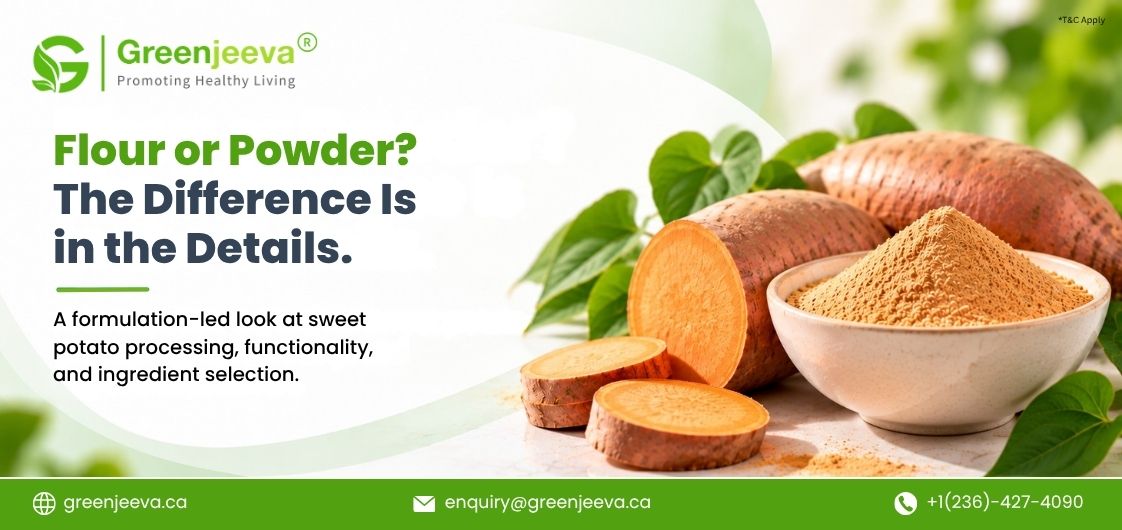
Two sweet potato ingredients can look nearly identical in a specification sheet but behave differently in a formulation. The difference may come down to processing, particle size, moisture, or starch characteristics rather than the name printed on the bag.
For food manufacturers, choosing between sweet potato flour and sweet potato powder requires more than a terminology check. The ingredient must deliver the right colour, flavour, texture, and processing behaviour in the finished product.
Understanding these differences helps R&D teams select the right format, test it effectively, and make more informed bulk purchasing decisions.
Sweet Potato Flour and Powder Are Not Always Different Ingredients
Sweet potato flour and sweet potato powder are sometimes used interchangeably in commercial ingredient descriptions. Neither term alone guarantees a specific processing method, particle size, or functional profile.
Both can be produced by drying sweet potato and milling it into a powdered ingredient. However, the raw material preparation and processing method can influence the resulting properties.
For example, some ingredients may be produced from raw dried sweet potato, while others may undergo cooking or other pretreatment before drying. These differences can affect starch behaviour, colour, flavour, and water absorption.
A study examining sweet potato flour found that variety, pretreatment, and drying method influenced several functional properties, including water absorption, swelling, and pasting behaviour. This makes the actual specification more informative than the product name alone.
For manufacturers comparing sweet potato flour vs sweet potato powder, the first step is to establish what each ingredient contains and how it was processed.
The Specifications That Matter Beyond the Product Name
The most useful comparison starts with the properties that affect the intended food application.
Processing method and starch behaviour
Sweet potato contains starch, but its behaviour depends partly on how the ingredient was processed.
Raw and cooked sweet potato materials may behave differently when exposed to heat and water. Cooking can gelatinise starch, while drying conditions and subsequent processing can influence the structure and functional properties of the resulting powder.
This distinction matters when a manufacturer needs predictable thickening, water absorption, or texture development. A powder intended for a ready-to-mix product may not perform the same way as one developed for a baked or cooked application.
Ask suppliers about the processing method and evaluate the material under the actual conditions of use.
Particle size and moisture
Particle size influences how a powder disperses, blends, and feels in a finished product. A finer powder may distribute more evenly in some systems, while coarser particles can affect texture or require different processing conditions.
Moisture content also matters. It can influence storage stability, powder handling, and the amount of water introduced into a formulation.
Neither finer particles nor lower moisture automatically make an ingredient better. The appropriate specification depends on the product, process, and required performance.
Colour, flavour, and water interaction
Sweet potato powders can contribute characteristic colour and a mild, naturally sweet, earthy flavour. The intensity varies with the sweet potato variety and processing conditions.
These properties can influence product appearance and taste, particularly in formulations where the ingredient is present at a noticeable inclusion level.
Water interaction deserves equal attention. Water absorption, swelling, and pasting properties can affect viscosity, texture, and processing behaviour. Manufacturers should test these properties rather than assume that two ingredients with similar labels will perform identically.

Where Organic Sweet Potato Powder Fits in Food Formulation
Organic sweet potato powder can serve different purposes depending on the food matrix and the ingredient specification. Its role should be defined before choosing an inclusion level.
Bakery and gluten-free products
Sweet potato powder can contribute vegetable content, colour, flavour, and solids to selected bakery formulations. However, it should not automatically be treated as a one-to-one replacement for wheat flour.
Wheat flour contributes gluten-forming proteins that help establish structure in many baked products. Sweet potato powder does not provide the same gluten network, so substantial substitutions may require changes to water levels, binders, starches, and processing conditions.
Snacks and savoury products
In snack formulations, sweet potato powder may contribute colour and flavour to doughs, coatings, seasonings, or vegetable-based blends. Particle size, moisture, and distribution can influence consistency across the batch.
For extruded or heat-processed snacks, manufacturers should assess the powder's starch characteristics and its interaction with the other ingredients.
Soups, sauces, and dry mixes
Sweet potato powder can contribute solids, colour, and body to selected soup, sauce, and dry-mix formulations. Its suitability depends on the required texture and how the ingredient behaves during hydration and heating.
Formulators should distinguish between a powder that disperses readily and one that dissolves. Vegetable powders contain insoluble material, so complete dissolution should not be assumed.
Nutrition and meal-replacement blends
Sweet potato powder may be included in selected nutritional blends where its ingredient profile and sensory characteristics fit the product brief.
Manufacturers should evaluate flavour compatibility, moisture contribution, particle-size distribution, and blending uniformity. Nutritional composition and any finished-product claims must be supported by appropriate product-specific evidence.
What to Test Before Moving From R&D to Production
A successful laboratory sample does not automatically guarantee consistent performance at commercial scale. Larger batches introduce additional considerations, including mixing efficiency, handling, and ingredient distribution.
Before approving an organic sweet potato powder for production, evaluate:
- Water absorption: Determine how much water the ingredient takes up under the intended processing conditions.
- Texture and particle size: Check for grittiness, uneven distribution, or unwanted changes in mouthfeel.
- Colour and flavour: Compare the ingredient and finished product against approved sensory targets.
- Thermal behaviour: Assess changes during the actual heating, baking, cooking, or extrusion process.
- Batch consistency: Compare representative samples against the agreed ingredient specification.
- Storage performance: Confirm suitable packaging and storage conditions based on the product's documented requirements.
Record the inclusion level, hydration conditions, processing temperature, mixing time, and finished-product results during trials. These details help the R&D team identify which ingredient characteristics matter most before commercial scale-up.
What to Confirm When Sourcing Organic Sweet Potato Powder in Bulk
Once the formulation requirements are established, procurement can evaluate suppliers against a defined specification rather than a product name alone.
When comparing an organic sweet potato powder supplier, confirm the botanical identity, plant part, processing description, physical specifications, and relevant quality parameters.
Organic status also needs appropriate documentation. Verify that the certification and supporting records apply to the ingredient and intended transaction.
For bulk purchasing, review the certificate of analysis, microbiological testing, applicable contaminant screening, packaging, minimum order quantity, availability, and lead times.
Food manufacturers sourcing from a sweet potato powder supplier in Canada should also confirm that the documentation and ingredient specifications meet their internal quality requirements and applicable Canadian requirements.
Green Jeeva Canada lists Organic Sweet Potato Powder as a bulk ingredient for commercial manufacturing. Buyers can review the Organic Sweet Potato Powder product page for product-specific details and confirm current availability, specifications, and purchasing requirements.
Choose the Ingredient That Fits the Formulation
Sweet potato flour and sweet potato powder may share a botanical source, but their processing and functional properties can influence how they perform in food manufacturing.
For formulators, the better choice is the ingredient whose documented characteristics match the intended application. Testing the actual material under production-relevant conditions helps turn a promising ingredient into a more predictable formulation choice.
For commercial sourcing, explore Green Jeeva Canada's Organic Sweet Potato Powder and review the product specifications before selecting it for your next formulation.