
Formulating Cocoa Beverages with Organic Alkalized Cocoa Powder
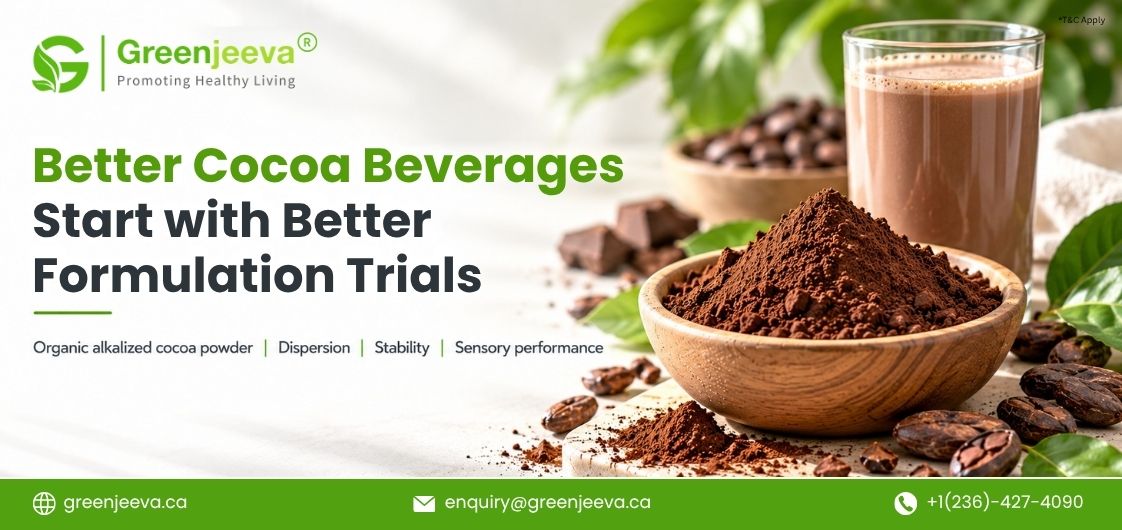
A cocoa beverage can look perfect in the mixing tank and still disappoint in the cup. Powder may form lumps during reconstitution, particles may settle during storage, or the chocolate profile may become muted once sweeteners, proteins, and stabilizers enter the formula.
For beverage manufacturers, choosing the right cocoa powder is only the starting point. The next challenge is understanding how it behaves within the complete formulation.
Organic Cocoa Powder 10–12% Alkalized is one option for manufacturers developing cocoa drink mixes, chocolate beverages, and other cocoa-based products. Its performance, however, depends on more than the ingredient name or fat specification. Mixing conditions, particle suspension, flavor balance, and the surrounding ingredients all influence the final result.
A good cocoa powder does not guarantee a stable beverage.
Alkalized cocoa powder, also called Dutch-process cocoa, is treated to reduce its natural acidity. This processing changes its color, flavor, and functional characteristics.
Compared with natural cocoa, alkalized cocoa often offers a darker appearance, a smoother flavor profile, and improved dispersibility in beverage systems. However, dispersibility does not mean complete dissolution. Cocoa powder contains insoluble particles that can remain suspended for a time before settling.
A study published in the Journal of Food Science and Technology found better suspension stability with alkalized cocoa than with natural cocoa in a cinnamon-cocoa drink. The research also showed that stabilizer selection influenced sedimentation. These results demonstrate why the cocoa grade and the overall beverage formula need to be evaluated together.
Five variables worth testing before scaling up
Wetting and lump formation
Cocoa powder can resist wetting when added directly to liquid. Poor wetting may leave dry pockets or lumps that are difficult to disperse with ordinary mixing.
Evaluate the powder under the actual process conditions planned for production. Record how quickly it wets, whether visible lumps remain and how much mixing is required to achieve a uniform blend.
For powdered beverages, also compare dry blending with any proposed wet-mixing or pre-dispersion step. Research published in 2025 found that wet-mixing improved the wettability and reconstitution of a powdered cocoa beverage while also increasing sedimentation under the tested conditions. Better initial mixing does not automatically mean better stability during storage.
Sedimentation during storage
Cocoa particles may gradually settle in ready-to-drink beverages or reconstituted cocoa drinks. A formula that looks uniform immediately after mixing may develop a visible layer at the bottom of the container.
Test the beverage immediately after preparation and at defined intervals during storage. Observe sediment formation, the ease of redispersion, and any changes in appearance.\If settling is excessive, evaluate the stabilizer system and viscosity alongside the cocoa grade. Hydrocolloids such as xanthan gum may help suspend particles in some formulations, but the appropriate choice and concentration depend on the complete recipe and desired texture.
Fat content and mouthfeel
The 10–12% fat specification describes the residual cocoa butter content of the powder. It does not, by itself, predict the finished beverage's creaminess or stability.
A lower-fat cocoa powder may suit formulations where cocoa flavor, color, and powder handling are priorities. The final mouthfeel will still depend on the levels of milk solids, plant proteins, fats, sweeteners, and other ingredients.
Compare samples using the same cocoa dosage and mixing conditions. Assess body, smoothness, flavor release, and any oily or chalky sensations. This helps distinguish the effect of the cocoa ingredient from the effect of the wider formula.

Flavor balance and color
Alkalization affects both the appearance and sensory profile of cocoa powder. The degree of processing can influence how dark the powder appears and how its flavor develops in a beverage.
A darker color is not necessarily evidence of stronger chocolate flavor. Sweeteners, dairy ingredients, plant-based proteins, and flavor systems may also change the final sensory impression.
During trials, evaluate color and flavor separately. Check the prepared beverage under consistent lighting, then assess chocolate intensity, bitterness, acidity, and aftertaste. A sample that meets the desired color target may still require flavor adjustments.
Mixing sequence and processing conditions
Ingredient order can affect how powders hydrate, disperse, and interact. Adding cocoa
directly to a liquid containing several other ingredients may produce a different result from dispersing the cocoa separately.
Compare practical process options, including direct addition, pre-dispersion, and different mixing speeds. Where relevant, test the effects of temperature and holding time.
Keep the remaining conditions consistent between trials. This makes it easier to identify which processing change actually improves the result, rather than attributing every difference to the cocoa powder.
Build a useful cocoa beverage trial
A controlled trial does not need to begin with a complicated design. Start with the target beverage and identify its main performance requirement: rapid reconstitution, reduced sedimentation, a darker appearance, or a specific chocolate flavor profile.
Then establish a baseline formula and change one variable at a time.
Record the ingredient lot, preparation conditions and evaluation time for each sample. Once a suitable formula is identified, repeat the trial to check consistency before moving toward pilot-scale production.
Qualifying the cocoa ingredient for repeat production
Successful bench trials are only part of ingredient qualification. Manufacturers also need to confirm that the selected grade and its supporting documentation fit the product requirements.
When evaluating a bulk organic cocoa powder supplier in Canada, review the product specification, batch-specific Certificate of Analysis (COA), organic certification, and relevant quality documentation. Confirm the stated fat content and any additional parameters required by your formula.
For a product such as Organic Cocoa Powder 10–12% Alkalized, buyers should also confirm availability, commercial packaging, and the documentation supplied for the relevant lot. Green Jeeva Canada lists this ingredient for bulk food and beverage applications. View product details.
The right qualification process connects the sample that performs well in development with an ingredient that can be assessed consistently across production batches.