
Tapioca Maltodextrin vs. Corn Maltodextrin: What Changes in a Food Formulation?
Two maltodextrins can serve similar functions in a food product, yet that does not automatically make them interchangeable in every formulation.
For food manufacturers, the choice between tapioca maltodextrin and corn maltodextrin often begins with ingredient sourcing. A product may need a specific starch origin to meet its ingredient declaration, customer requirements, or sourcing policy. But the decision should not end there. Dextrose equivalent (DE), powder characteristics, processing conditions, and finished-product performance all deserve attention before a manufacturer approves a new ingredient.
Understanding these variables helps R&D teams evaluate alternatives more confidently and gives procurement teams a clearer basis for comparing suppliers.
The Starch Source Is Only the First Difference
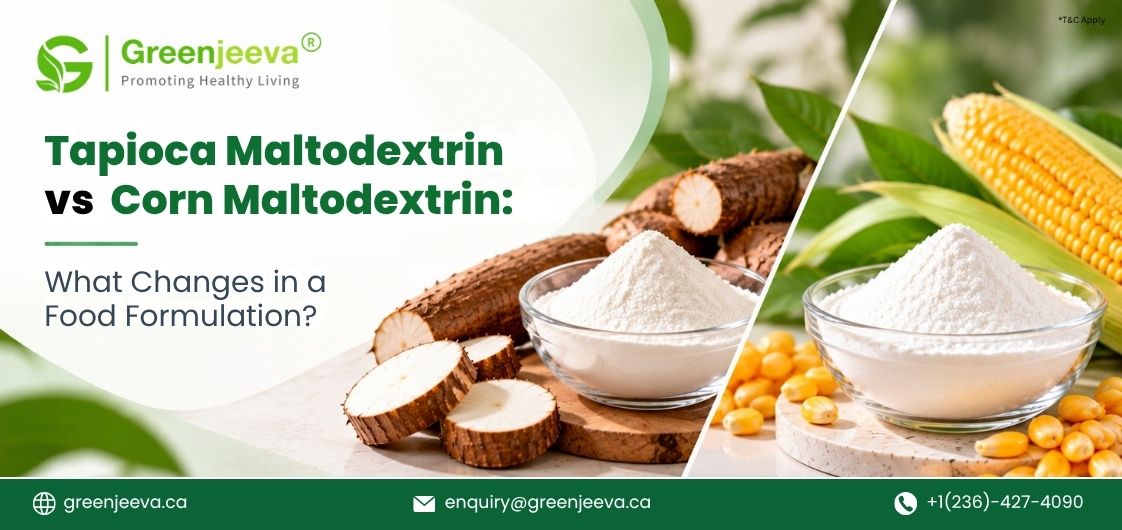
Tapioca maltodextrin is produced from tapioca starch, which comes from cassava roots. Corn maltodextrin starts with starch extracted from corn. Both undergo partial hydrolysis, a process that breaks some of the starch's larger carbohydrate chains into shorter ones.
The resulting ingredient is commonly used as a carbohydrate source and as a functional component in food formulations. Depending on its grade and application, maltodextrin can contribute to bulk, texture, powder handling, and the delivery of flavours or other ingredients.
The key distinction is that starch origin identifies the starting material, but it does not fully predict the finished maltodextrin's performance.
The extent of hydrolysis and the manufacturing process influence the resulting carbohydrate profile and functional characteristics. For this reason, manufacturers should compare the specifications of the actual grades under consideration instead of assuming that every tapioca-derived product behaves alike.
Tapioca Maltodextrin vs. Corn Maltodextrin: What Should Formulators Compare?
The most useful comparison is not simply which source is better. It is which ingredient meets the requirements of a particular product.

These factors are interrelated. Two products derived from different starch sources may perform similarly when their relevant properties are comparable. Conversely, two products made from the same source may behave differently because their grades and manufacturing characteristics differ.
Why dextrose equivalent matters
Dextrose equivalent measures the reducing power of starch hydrolysates relative to dextrose on a dry-solids basis. It provides an indication of the extent of starch hydrolysis, but it is not a complete description of the ingredient.
DE can help formulators compare grades, particularly when evaluating carbohydrate profiles and related functional properties. However, it should not be used alone to predict sweetness, solubility, viscosity, or performance in a finished food.
A formulation team should therefore review the DE alongside the complete product specification and, where necessary, conduct application-specific trials.
Four Formulation Decisions That May Favour Tapioca Maltodextrin
1. The ingredient declaration specifies tapioca
A manufacturer may choose tapioca maltodextrin because the product brief calls for a cassava-derived ingredient. This can be relevant when developing products around a defined starch source or meeting customer-specific ingredient requirements.
However, tapioca origin does not automatically establish organic certification, non-GMO status, or any particular clean-label claim. Those requirements need to be verified separately through appropriate supplier documentation.
2. The sensory profile needs to remain consistent
Maltodextrin can contribute to the body and texture of a food system. Its influence depends on the grade, concentration, other ingredients, and processing conditions.
When replacing corn maltodextrin with tapioca maltodextrin, formulators should evaluate the complete product rather than relying on the ingredient name alone. Taste, mouthfeel, dispersion, and overall sensory acceptance may need to be checked, particularly in products with tightly defined specifications.
3. The manufacturing process imposes specific requirements
An ingredient that works well in a laboratory blend may not behave identically during commercial production. Mixing time, temperature, moisture exposure, drying conditions, and equipment can affect processing performance.
For powdered products, manufacturers should assess whether the selected grade can be incorporated consistently and whether it meets the required handling and filling characteristics. The appropriate tests will depend on the product and production process.
4. Procurement requirements influence ingredient selection
Starch origin may be one of several sourcing criteria. Buyers may also need to consider approved specifications, documentation, order quantities, packaging, supplier consistency, and the availability of the required grade.
A tapioca-based alternative is worth evaluating when it meets these requirements without compromising the formulation's functional or commercial objectives.
Tapioca Maltodextrin Powder Applications: What Needs Testing?
Tapioca maltodextrin can be considered for several food-manufacturing applications. The appropriate grade and inclusion level depend on the intended function and the overall formulation.
Instant beverages and powdered drink mixes
In dry beverage systems, formulators should assess dispersion, mixing behaviour, flavour compatibility, and the characteristics of the reconstituted drink. Solubility and mouthfeel requirements may vary depending on the beverage.
Seasonings, dry soups, and savoury blends
Maltodextrin may contribute bulk and help distribute flavours across a dry blend. Manufacturers should evaluate blend uniformity, powder flow, moisture sensitivity, and consistency during filling.
Spray-dried flavour preparations
Maltodextrin can serve as a carrier in certain spray-dried systems. Its suitability depends on the flavour material, the composition of the feed, drying conditions, and the desired properties of the resulting powder. Carrier selection should be validated for the specific process.
Nutritional powder blends
In nutritional and other dry-mix products, maltodextrin may contribute carbohydrate solids and formulation bulk. The selected grade must fit the intended composition, sensory targets, processing requirements, and applicable product specifications.
Across these applications, the same principle applies: the ingredient's suitability depends on the function it needs to perform. A grade selected for one powder system should not automatically be assumed to deliver the same results in another.

Switching Starch Sources? Validate Before Scaling Up
Replacing corn maltodextrin with tapioca maltodextrin is a formulation change, even when both ingredients perform similar roles. A structured evaluation helps identify differences before the new ingredient reaches commercial production.
Step 1: Define the requirement. Establish why the source is changing. The reason could be a customer specification, a sourcing policy, a label requirement, or a supply consideration.
Step 2: Compare specifications. Review DE, moisture, relevant physical and chemical parameters, and other requirements applicable to the product. Confirm that the proposed ingredient meets the manufacturer's acceptance criteria.
Step 3: Test representative samples. Evaluate the ingredient in the intended formulation. Observe dispersion, blend uniformity, texture, flavour, and any other properties that matter to the finished product.
Step 4: Run a production-relevant trial. Where appropriate, test the ingredient under representative processing conditions. Laboratory compatibility alone may not establish suitability for the full manufacturing process.
Step 5: Confirm finished-product performance. Assess the finished product against established quality criteria. Depending on the application, this may include moisture stability, powder flow, sensory properties, or shelf-life performance.
Step 6: Approve the supply specification. Once the ingredient is validated, document the accepted specification and confirm the supplier's ability to meet recurring requirements.
This process helps manufacturers distinguish between a source change that works on paper and one that performs reliably in production.
Finding a Tapioca Maltodextrin Supplier in Canada
Selecting a tapioca maltodextrin supplier involves more than confirming the ingredient's starch origin. Food manufacturers need a grade that fits their application, documentation that supports their quality process, and a supply arrangement that matches their production schedule.
Before placing a bulk order, procurement teams should clarify:
- Product specifications: Confirm the grade, DE, and relevant quality parameters against the approved formulation.
- Quality documentation: Request the applicable specification sheet, certificate of analysis (COA), and other documentation required by the company's quality procedures.
- Packaging and order quantities: Check the available commercial pack size and minimum order quantity against storage capacity and production needs.
- Supply continuity: Discuss availability, replenishment expectations, and the requirements for maintaining consistency between incoming batches.
- Application suitability: Obtain samples when available and complete the necessary formulation and quality checks before approving the ingredient for routine use.
Green Jeeva Canada offers a route for businesses sourcing food ingredients in commercial quantities. Manufacturers evaluating bulk tapioca maltodextrin powder should review the current product specifications and ordering details before confirming that the ingredient fits their requirements.
For buyers comparing a tapioca maltodextrin supplier with an existing corn maltodextrin source, the objective is straightforward: select the ingredient that meets the formulation specification, performs under the intended processing conditions, and can be sourced consistently.
Make the Ingredient Choice Work for Your Formulation
Choosing between tapioca and corn maltodextrin is not about declaring one source universally better. It is about understanding what the formulation requires and verifying that the selected grade delivers the necessary performance.
For Canadian food manufacturers, a clear specification, application testing, and reliable supplier documentation provide a stronger foundation for ingredient selection than starch origin alone.
Looking for bulk tapioca maltodextrin powder for your next formulation?
Review the available product specifications and connect with Green Jeeva Canada to evaluate whether the ingredient meets your sourcing and application requirements.