Choosing a Sustainable Slippery Elm Bark Powder Supplier: What Matters for Bulk Buyers
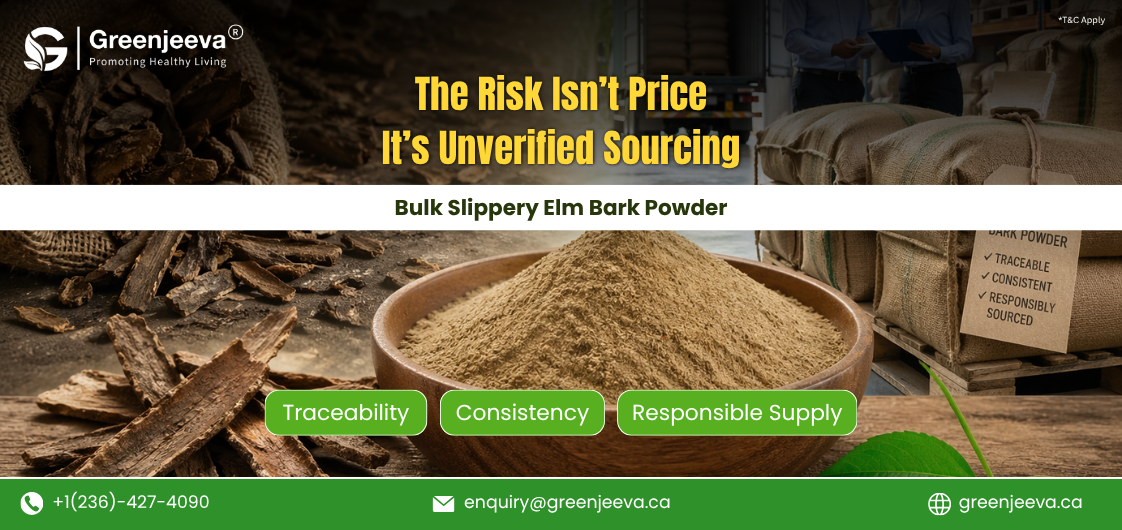
Most bulk botanicals are harvested from leaves, roots, seeds, or fruit, parts a plant can regenerate. Slippery elm bark powder is different. The ingredient comes from the inner bark of Ulmus rubra, and stripping that bark, if done carelessly, can kill the tree outright.
Combined with decades of pressure from Dutch elm disease on wild populations, this makes slippery elm one of the few botanicals in a typical B2B catalog where sourcing method matters as much as certification status. This guide covers what slippery elm bark powder actually is, why organic certification alone doesn't answer the sustainability question for this ingredient, and what Canadian buyers should ask a supplier before committing to volume.
What Slippery Elm Bark Powder Actually Is
Slippery Elm Bark Powder is produced from the dried, milled inner bark of Ulmus rubra (also referenced under the synonym Ulmus fulva), a member of the Ulmaceae family native to eastern North America. The bark is prized for its mucilage content, a soluble fiber that forms a gel-like consistency when mixed with water.
It has a long history of traditional use as a soothing agent for the digestive tract and throat. Any specific health claim tied to that traditional use should be substantiated independently against current Health Canada guidance rather than assumed.
Green Jeeva supplies this ingredient as two distinct SKUs. Slippery Elm Bark Powderis sourced from China, while Organic Slippery Elm Bark Powder (Ulmus rubra) is sourced from certified organic farms in China and North America. Both carry Halal and Kosher certification and ship in 25 kg commercial packaging.

Why Sustainability Is a Different Question for Bark Ingredients
What bark harvesting actually involves
Harvesting bark for this ingredient means removing a layer of living tissue from the tree. If the bark is stripped in a full ring around the trunk, a practice called girdling, it cuts off the tree's nutrient flow and typically kills it.
This is fundamentally different from harvesting a leaf, root, or seed crop, where the plant survives the harvest by design.
Added pressure from disease and wild harvest
Slippery elm carries a pressure that most bark botanicals don't. Dutch elm disease has already reduced the number of mature, healthy trees remaining in wild North American stands.
United Plant Savers, a nonprofit focused on native plant conservation, lists slippery elm on its At-Risk list specifically because of the combination of harvest demand and disease pressure on an already-shrinking wild population. It's worth noting the species is not globally endangered; the IUCN Red List classifies Ulmus rubraas Least Concern overall, so the concern is regional and harvest-specific rather than a species-wide crisis.
How Green Jeeva's own sourcing has responded
Green Jeeva's own documentation illustrates the industry response to this pressure directly. Sourcing notes for the concentrated extract format elsewhere in Green Jeeva's slippery elm line state that supply has shifted toward sustainable farms in the United States and Canada specifically because of historical overharvesting.
That's a meaningful signal. It means Green Jeeva's own supply chain commentary acknowledges the wild-harvest problem as real enough to actively source around it, at least for that format.
Organic Certification Doesn't Automatically Answer the Sustainability Question
A sourcing inconsistency worth flagging
Green Jeeva's own materials describe the organic bark powder as coming from certified organic farms, while separate Green Jeeva sourcing content describes slippery elm generally as harvested from wild-stand trees, primarily in the Appalachian and Great Lakes regions of North America. Those are two different sourcing stories, and a buyer shouldn't have to guess which one applies to the batch they're actually purchasing.
What Canada's organic standard actually covers
Canada's organic standard, CAN/CGSB-32.310, includes provisions specifically for wild-harvested crops, meaning a wild-collected botanical can carry organic certification if the harvest practice meets the standard's requirements. This is the nuance behind the inconsistency above: organic certification and sustainable harvest method are two separate questions for an ingredient like slippery elm, not one and the same.
An organic certificate confirms a certification body reviewed the sourcing method. It doesn't automatically tell a buyer whether that method was farm-cultivated or wild-collected, or what harvest technique was used if it was wild-collected.
Two questions every buyer should ask
A buyer evaluating a slippery elm supplier should ask two things independently, rather than assume either sourcing story applies by default. First, is this specific batch from cultivated farms or wild-collected stands.
Second, if wild-collected, what harvest method was used. Partial bark removal or bark sourced from already-felled or disease-killed trees avoids killing additional healthy trees, while full-girdle stripping of live trees does not.

What Botanical Traceability Should Look Like for This Ingredient
Traceability beyond country of origin
Traceability for slippery elm bark should go beyond a country of origin listed on a spec sheet. A supplier with genuine traceability can identify the harvest region, whether the material came from cultivated or wild-collected sources, and, for wild-collected material, some indication of harvest method.
This level of detail is what actually supportsa sustainability claim, rather than an organic label standing in for it.
Why identity testing matters
Dried, milled bark from different tree species can be difficult to distinguish visually once processed. Green Jeeva's own COA documentation for this product line references TLC (Thin-Layer Chromatography) as the identity-testing method used.
That's a reasonable baseline. Buyers running nutraceutical-grade formulations may want to confirm whether HPTLC, a higher-resolution version of the same method, is available for tighter identity confirmation.
Specification Benchmarks and Documentation to Request
A complete slippery elm bark powder COA should include:
Botanical identity confirmed by TLC or, ideally, HPTLC, referencing Ulmus rubraor its accepted synonym Ulmus fulva
Moisture content, generally expected at or below 10 percent for stability
Heavy metals screening
Microbiological testing
Current certification status specific to the SKU being quoted, including whether wild-harvest provisions were reviewed as part of that certification, or confirmation that the material is farm-cultivated
Country and, ideally, region of origin, along with harvest method for any wild-collected material
Choosing Between Green Jeeva's Two Slippery Elm Formats
Neither SKU is automatically the more sustainable choice by default. The right answer depends on what the buyer can confirm about each specific batch.
Buyers considering the standard Slippery Elm Bark Powder should ask directly whether the China-sourced material is cultivated or wild-collected. Buyers considering the Organic Slippery Elm Bark Powder should confirm, batch by batch, whether "certified organic farms" means cultivated production or an organically reviewed wild-harvest operation, and which portion traces to China versus North America.
Either way, the certification label alone isn't the full answer, especially given the sourcing inconsistencies across Green Jeeva's own materials noted above.