
Organic Cucumber Powder Supplier Guide: Bulk Sourcing, Quality Standards, Certifications & Applications for Brands
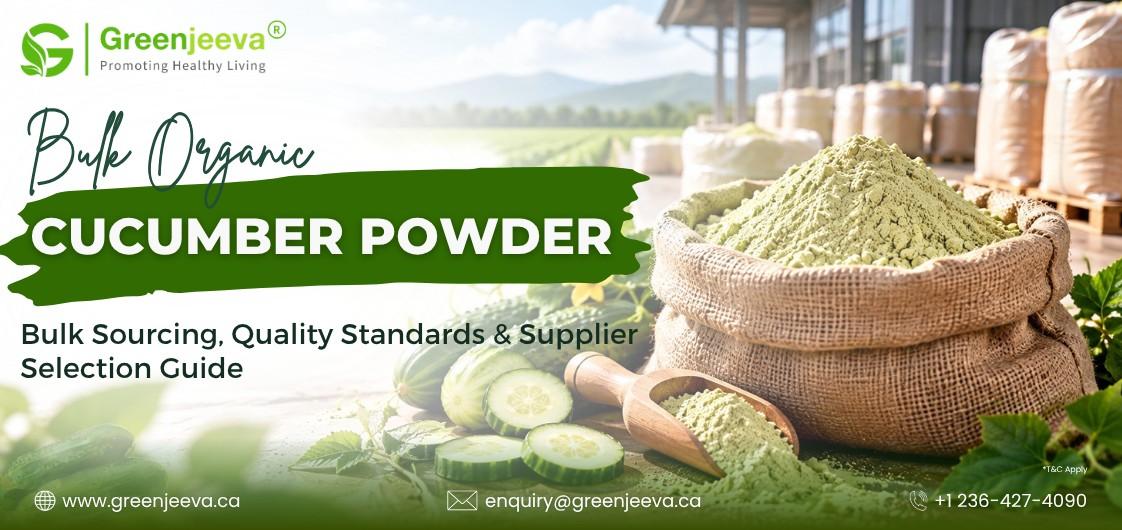
When a product development team starts evaluating a new botanical ingredient, the first question is rarely whether the ingredient sounds interesting. The more important questions come later: Where does the raw material come from? How is it processed? Can the supplier maintain the same specification across commercial batches? And will the documentation stand up to the requirements of the market where the finished product will be sold?
These questions matter even more when you are working with plant-based ingredients. Fresh cucumber is widely used and easy to recognize, but making cucumber powder for commercial use requires careful attention at every stage. The process includes choosing suitable cucumbers, removing their moisture, grinding them into a uniform powder, checking the quality, and storing the finished product correctly.
Cucumber, or Cucumis sativus, is grown in many parts of the world. It is commonly used in food products as well as skincare and other personal-care formulations. Since fresh cucumber contains a high amount of water, it is not always suitable for dry products. Drying it and converting it into powder makes it easier to use, store, and add to different formulations.
Today, buyers can find several variations, including organic cucumber powder, dehydrated cucumber powder, dried cucumber powder, freeze-dried material, and cucumber seed powder. These names should not automatically be treated as interchangeable.
For brands sourcing this ingredient in bulk, understanding the story behind the product name can foster trust and confidence in the supplier's transparency.
What Is Organic Cucumber Powder?
Organic cucumber powder is a dried and milled ingredient made from organically cultivated Cucumis sativus. Buyers should verify the plant part, processing method, particle size, moisture specification, testing, and organic certification before approving the material for commercial use.
The botanical identity of cucumber is Cucumis sativus. Including the botanical name in technical documentation helps buyers establish exactly what material they are purchasing.
The term "cucumber powder" is fairly broad. A supplier may be referring to dried whole cucumber material, while another may specifically offer a powder produced from cucumber seeds.
For this reason, buyers should confirm the following attributes of the raw material in question:
• Botanical identity
• Plant part
• Country of origin
• Processing method
• Particle size
• Moisture specification
• Testing requirements
• Organic certification
The specification sheet is ultimately more useful than the product name, helping buyers feel confident in quality control.
What Is the Difference Between Cucumber Powder and Dehydrated Cucumber Powder?
In everyday ingredient purchasing, cucumber powder, dried cucumber powder, and dehydrated cucumber powder may be used to describe essentially the same general format: cucumber that has had moisture removed and has subsequently been milled.
However, the terminology alone does not tell you how the ingredient was manufactured.
A buyer should ask the supplier to explain the drying technology and provide the relevant product specification, which helps them feel assured about the manufacturing process and its suitability for their needs.
Product Description What It Generally Indicates What to Confirm
Cucumber powder: General powdered cucumber ingredient Raw material and process
Dried cucumber powder: Dried and milled cucumber Drying method
Dehydrated cucumber powder: Cucumber processed to reduce moisture Final moisture and process
Freeze-dried cucumber powder: Cucumber processed using freeze-drying Processing conditions
Organic cucumber seed powder: Powder made from cucumber seeds. Plant part and certification
This distinction becomes particularly important when comparing quotations from different manufacturers.
How Is Organic Cucumber Powder Manufactured?
The production process generally includes raw material selection, cleaning, preparation, drying, milling, sieving, quality testing, and packaging. Each stage can influence the physical and technical characteristics of the finished powder.
1. Raw Material Selection
The process starts with the cucumber itself.
For an organic specification, the supplier should have documentation supporting the organic status of the agricultural material and its handling through the relevant supply chain.
The manufacturer should also be able to establish the botanical identity as Cucumis sativus.
Stress that traceability connects the finished ingredient to its agricultural source, aiding buyers in verifying supplier claims and ensuring ingredient authenticity, which is critical for quality assurance.
2. Cleaning and Preparation
The raw material is sorted and cleaned before processing.
Depending on the manufacturing process, this can include:
• Sorting
• Washing
• Removal of unsuitable material
• Cutting or size reduction
The purpose is to create a consistent starting material for drying.
3. Drying
Drying is arguably the most important processing stage because cucumber contains a substantial amount of water.
Conventional dehydration can be used for scalable commercial production, while freeze-drying is a more specialized approach.
The drying method can influence the following attributes of the ingredient:
Colour
Aroma
Texture
Moisture
Processing cost
Final powder characteristics
There is no universally "best" drying method. The appropriate choice depends on the customer's specification and intended application.
4. Milling and Sieving
After drying, the material is milled and, where required, sieved to achieve a defined particle size.
Particle size can adversely affect the:
Powder flow
Blending
Dispersion
Texture
Handling
For commercial orders, buyers should establish the desired specification before production rather than assuming that every supplier's "fine powder" will perform identically.
5. Testing and Release
Depending on the specification, quality testing may include:
Identity
Moisture
Microbiological parameters
Heavy metals
Pesticide residues
Physical characteristics
A batch-specific Certificate of Analysis gives the buyer a documented reference for the material being supplied.
What Quality Specifications Should Buyers Check?
A reliable supplier should be able to provide a technical specification that goes beyond appearance and colour.
Parameter Why It Matters
Botanical identity Confirms the source material
Plant part Distinguishes fruit material from seed material
Moisture Important for handling and storage
Particle size: Influences formulation behaviour
Microbiological testing Supports quality control
Heavy-metal testing Important for raw-material assessment
Pesticide testing Relevant to agricultural ingredients
Organic certification: Verifies applicable organic status
COA Provides batch-specific results
Traceability Links the material to production records
The exact specification should be agreed upon according to the intended application.
Providing current organic certificates and traceability details is essential because different markets, such as Canada and the U.S.A., have specific certification standards. Clarifying these requirements helps QA professionals verify compliance and reduces supplier risk.
The word "organic" should never be treated as a substitute for certification documentation because verifying the certification confirms compliance and reduces supplier risk.
For products making applicable organic claims in Canada, the Canada Organic Regime establishes certification and labeling requirements. Imported organic products must meet applicable import requirements, including submission of the appropriate organic certificate.
The U.S. also has defined USDA organic labeling categories and certification requirements. USDA guidance states that organic claims on applicable products must comply with the National Organic Program requirements.
For buyers, useful documentation may include:
• Current organic certificate (COR)
• Certificate of Analysis
• Product specification
• Country-of-origin information
• Allergen statement
• Non-GMO documentation, where applicable
• Microbiological testing
• Heavy-metal testing
• Pesticide-residue testing
• Traceability documentation
For Canadian imports, buyers should also ensure that the certificate is valid and that the product is correctly identified in the certification documentation. CFIA guidance specifically notes that the product name on the certificate should correspond with relevant shipping and import documentation.
How Do You Choose an Organic Cucumber Powder Supplier?
Choosing a supplier is about more than finding the lowest price per kilogram.
A useful evaluation should cover:
Raw Material
Ask where the cucumber comes from and how the supplier maintains traceability, because robust traceability systems support quality assurance and regulatory compliance.
Manufacturing
Understand the drying and milling process and whether the supplier can consistently reproduce the agreed specification.
Documentation
Request a specification sheet and representative COA before commercial approval.
Certification
Verify the certification body, certificate validity, scope, and products covered.
Production Capacity
A supplier that can provide samples may not necessarily be equipped for long-term commercial supply. Discuss production capacity and lead times before committing to a larger program.
Packaging
Confirm the available bulk packaging and whether it is suitable for the expected storage and transportation conditions.
Communication
Technical communication matters. A supplier should be able to answer questions about specifications, testing, processing, and documentation without relying solely on generic product descriptions.

What Are the Applications of Organic Cucumber Powder?
The appropriate application depends on the grade and specification of the ingredient.
Food Applications
Cucumber powder can be incorporated into selected dry food formulations, vegetable blends, seasoning systems, and other products where a dry cucumber ingredient is more practical than fresh produce.
Beverage Formulations
Powdered cucumber can also be considered for dry beverage and blend applications. Here, formulators should evaluate particle size, dispersion behaviour, flavour, colour, moisture, and compatibility with other ingredients.
Cosmetic Formulations
Cucumber-derived ingredients are familiar in cosmetic development. Powdered formats can be considered for selected botanical and personal-care formulations, although the appropriate grade and documentation should be established according to the intended cosmetic application.
Botanical Blends
Cucumber powder may also be combined with other plant-based powders. In these applications, consistency in particle size, moisture, colour, and bulk density becomes particularly important because differences between ingredients can affect the behaviour of the finished blend.
Is Organic Cucumber Seed Powder the Same as Cucumber Powder?
No. Organic cucumber seed powder refers specifically to material produced from cucumber seeds, whereas a general cucumber powder may be produced from the fruit or another defined portion of the plant.
This difference matters because the plant part affects the identity and specification of the ingredient.
Before purchasing in bulk, please ask the supplier to confirm:
• Plant part
• Botanical identity
• Processing method
• Composition
• Organic certification
• Particle size
• Testing parameters
Never assume that two products with "cucumber powder" in their names are equivalent.
Organic Cucumber Powder vs Cucumber Extract: What Is the Difference?
Cucumber powder and cucumber extract are produced differently and should be evaluated according to the intended application.
A powder generally represents dried plant material that has been milled, while an extract involves an extraction process designed to obtain a more concentrated fraction or selected constituents.
This can create differences in:
• Processing
• Composition
• Specification
• Solubility
• Application
• Cost
Your existing content on cucumber fruit extract for sensitive skin care can provide a useful complementary resource for readers interested specifically in cucumber extract and cosmetic formulation.
This new article should remain focused on the sourcing and commercial use of cucumber powder rather than repeating the skincare discussion.
What Should Buyers Consider When Purchasing in Bulk?
Before placing a commercial order, establish the technical specifications first and the price second.
A useful checklist includes:
Product: botanical identity, plant part, processing method, and particle size.
Quality: moisture, microbiological requirements, heavy metals, pesticide residues and other agreed parameters.
Documentation: organic certificate, COA, specification sheet and traceability information.
Commercial: MOQ, packaging, lead time, production capacity and shipping requirements.
For Canadian buyers, imported organic products also require attention to the applicable certification and import documentation. The CFIA requires an organic product certificate to be submitted as part of the import declaration for applicable organic imports.
For U.S.-bound products, the organic claim and labeling category should likewise be confirmed against USDA requirements before the finished product is marketed.
Final Thoughts
Cucumber is a familiar raw material, but sourcing it as a commercial powdered ingredient requires more attention than its simplicity might suggest.
For a product developer or procurement team, the important question is not simply whether a supplier sells cucumber powder. The better question is whether the supplier can consistently provide the right raw material, the right processing specification, the right documentation, and the right level of supply reliability for the intended product.
That is where a well-defined specification becomes valuable.
Whether the requirement is conventional dried cucumber powder, an organic specification, or a more specialized freeze-dried format, the strongest purchasing decisions begin with understanding exactly what is being supplied and why it is suitable for the application.