Vitamin K2 MK-7 0.1% Powder: What Does the Specification Really Tell You?
A specification sheet can look deceptively simple. For a buyer reviewing a Vitamin K2 ingredient, one number may immediately attract attention: 0.1%. But what does that percentage actually tell you about the material, and what remains unanswered?
For procurement teams, Vitamin K2 Powder, MK-7 0.1% is more than a concentration statement. It is one part of a broader specification that may include identity, assay, carrier system, physical characteristics, microbiological limits, contaminants, storage conditions, packaging, and documentation.
For Canadian manufacturers and formulators, reading these details carefully can make supplier comparisons more meaningful. The objective is not simply to find a higher or lower number. It is to understand what the specification represents and whether the ingredient is suitable for the intended manufacturing process.
Why the 0.1% Number Needs Context
MK-7 refers to menaquinone-7, a specific form of vitamin K2. When a powder is described as 0.1% MK-7, the percentage generally communicates the declared concentration of the specified active component in the ingredient.
That sounds straightforward, but concentration alone does not describe the complete powder.
Consider two hypothetical suppliers:
- Supplier A provides a powder with a declared MK-7 concentration of 0.1%.
- Supplier B also provides a powder with a declared MK-7 concentration of 0.1%.
At first glance, the materials appear equivalent. However, their carriers, particle-size profiles, moisture specifications, testing methods, packaging, shelf life, and documentation could differ.
This is why B2B buyers should treat the assay value as a starting point rather than the entire quality assessment.
What Does the Specification Actually Tell You?
A well-prepared specification should answer several practical questions.
What is the carrier system?
A 0.1% active concentration means that most of the finished powder consists of other material. That makes the carrier system an important procurement consideration.
The carrier can influence the powder's physical characteristics, handling, dispersion, and suitability for a particular formulation process. Buyers should therefore request the complete ingredient composition rather than evaluating the active concentration in isolation.
This becomes especially relevant when a formulation has restrictions on certain excipients or requires a specific label declaration.
What does the physical specification reveal?
Appearance, colour, odour, moisture, bulk density, and particle-size information can provide useful clues about how an ingredient may behave during handling and manufacturing.
For example, a powder intended for capsule production may be assessed differently from an ingredient going into a premix. Flowability, blending behaviour, and uniform distribution can become practical considerations even when the active concentration is identical.
A specification does not guarantee performance in every formulation. Instead, it helps the technical team identify what should be evaluated during trials.
The Canadian Context: Documentation Matters
Canadian buyers also need to consider the regulatory framework surrounding the intended finished product.
Health Canada regulates natural health products under the Natural Health Products Regulations. Companies involved in manufacturing, packaging, labelling, or importing NHPs for commercial sale must meet applicable licensing and GMP requirements.
An important 2026 development is that Health Canada no longer expects finished product specifications to be submitted with Class II and III product licence applications and amendments beginning June 15, 2026. However, licence holders still need to establish and maintain finished product specifications and provide them to Health Canada when requested.
For ingredient buyers, this reinforces a practical point: documentation should remain part of supplier qualification even when a particular document is not routinely submitted with an application.
A Canadian sourcing team may therefore want to request:
- Certificate of Analysis (COA)
- Product specification
- Ingredient statement
- Analytical method or testing information
- Microbiological results
- Heavy-metal or contaminant testing where applicable
- Allergen information
- Country of origin
- Storage requirements
- Shelf-life information
- Manufacturing and quality certifications
- Batch or lot traceability documentation
What Should Bulk Vitamin K2 Powder Buyers Compare?
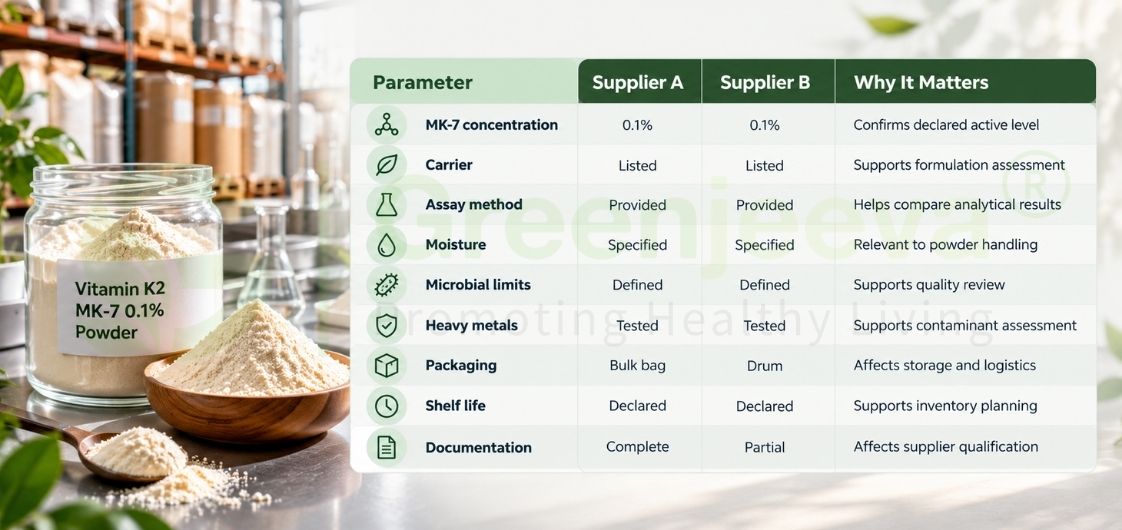
When evaluating Bulk Vitamin K2 Powder, avoid comparing suppliers using price per kilogram alone.
A more useful comparison can look like this:

This approach turns a supplier comparison into a technical exercise rather than a simple price comparison.
A Practical Example: When Two Specifications Look Identical
Imagine a Canadian supplement manufacturer is qualifying two ingredients.
Both suppliers offer MK-7 at 0.1%. Supplier A provides a detailed specification, batch-specific COA, testing information, storage conditions, and packaging details. Supplier B provides only a one-page product description showing the 0.1% concentration.
The 0.1% figure has not changed. What has changed is the amount of information available for technical and procurement review.
This distinction is particularly useful during commercial scale-up. A specification that appears sufficient during initial sampling may leave unanswered questions when the buyer moves to regular production.
Where Supplier Evaluation Becomes More Important
Search behaviour can also reveal how buyers approach this category. Terms such as Vitamin K2 Powder supplier, wholesale Vitamin K2 Powder, and Bulk Vitamin K2 Powder in Canada indicate different stages of commercial intent.
A sourcing manager may be looking for a supplier capable of providing consistent documentation and repeatable specifications. A formulator may be more focused on carrier composition, assay, and physical characteristics. A distributor may place greater emphasis on packaging, lead times, country of origin, and export documentation.
The same ingredient therefore needs to be evaluated from several perspectives.
For Canadian businesses sourcing internationally, Vitamin K2 Powder export documentation can also become relevant. Depending on the transaction and destination, buyers may need commercial invoices, packing lists, certificates of origin, product documentation, and other shipment-related records.
Don't Ignore the Specification's Test Methods
One of the more overlooked details is how a parameter was tested.
Suppose two COAs report different assay results. Before concluding that one batch is better, check:
- What analytical method was used?
- Was the result reported on the same basis?
- Were the samples tested by the manufacturer or an independent laboratory?
- Are the units identical?
- Is the specification value a target, minimum, range, or typical result?
- These questions can prevent misleading comparisons.
The same principle applies to microbiological and contaminant specifications. A number without its testing context does not always provide enough information for a technical comparison.
What About the Search Term “Vitamin K2 Powder- 10”?
Buyers may encounter broad or incomplete search phrases such as Vitamin K2 Powder- 10 while researching ingredient suppliers online. Such terminology should not automatically be treated as a technical specification.
For procurement purposes, the product name should always be matched against the supplier's formal specification sheet. The technical document should establish the actual MK-7 concentration, composition, analytical parameters, and quality requirements.
In other words, search terminology can help you find products; specifications help you qualify them.
A Better Way to Read the Specification
The most useful way to interpret an MK-7 powder specification is to read it in layers.
Start with identity: What exactly is the ingredient?
Move to concentration: What does 0.1% represent?
Then examine composition: What else is present in the powder?
Next review quality parameters: What are the limits for moisture, microbiology, contaminants, and physical properties?
Finally, review documentation and logistics: Can the supplier support repeat orders, batch traceability, packaging, storage, and Canadian procurement requirements?
This layered approach creates a much clearer picture than focusing on a single percentage.
Actionable Takeaway for Canadian Buyers
A Vitamin K2 specification should answer more than one question. The 0.1% figure tells you about the declared MK-7 concentration, but it does not tell the entire story about the powder.
Before approving a supplier, build a comparison sheet covering identity, assay, carrier, physical properties, microbiological limits, contaminants, analytical methods, documentation, packaging, MOQ, shelf life, storage, and logistics.
For Canadian manufacturers and distributors, this creates a more structured way to evaluate Bulk Vitamin K2 Powder in Canada and international supply options. It also helps technical and procurement teams ask better questions before a sample becomes a commercial purchase order.
The most useful specification is not necessarily the one with the most numbers. It is the one that gives your team enough relevant information to understand what you are.