Moringa Powder in Canada: Market, Bulk Sourcing and Supplier Selection
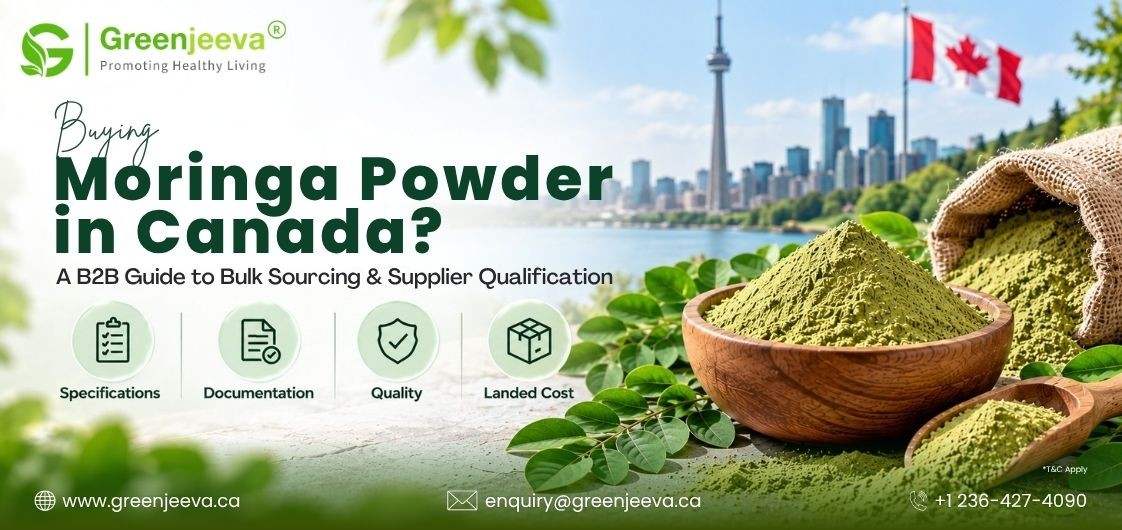
Canadian manufacturers sourcing moringa powder typically evaluate more than price. Product form, botanical identity, organic certification, microbiological specifications, heavy-metal limits, documentation, MOQ, country of origin, and delivery capability can all affect whether a raw material is suitable for commercial production.
For buyers comparing a moringa powder supplier in Canada, the most practical approach is to define the required specification first and then compare suppliers against the same criteria.
What does the moringa powder market in Canada look like?
Moringa is available in Canada through several sourcing channels, including Canadian ingredient distributors, direct importers, specialty botanical suppliers, and international suppliers serving Canadian manufacturers.
The market is broader than a single product category. Buyers may encounter conventional or organic moringa leaf powder, different mesh sizes, varying country-of-origin profiles, and products intended for food, beverage, nutraceutical, or other formulations.
Canada also has a significant natural health products and natural/organic health food sector. A 2025 CHFA/MNP study estimated approximately $26 billion in sales across Canadian natural health products and natural/organic health foods, demonstrating the scale of the broader category in which botanical ingredients such as moringa may be used.
Why are Canadian manufacturers sourcing moringa leaf powder?
Moringa leaf powder is generally purchased as a botanical raw material for formulation rather than as a finished consumer product.
Depending on the manufacturer's product portfolio, it may be considered for:
- Functional food and beverage blends
- Powdered nutritional products
- Herbal and botanical formulations
- Nutraceutical products
- Plant-based formulations
- Smoothie and greens blends
- Private-label products
The intended application matters because food ingredients and natural health products can fall under different Canadian regulatory requirements.
What should buyers specify when purchasing moringa powder?
A supplier comparison becomes much easier when procurement teams establish a technical specification before requesting quotations.

A clear specification reduces the risk of comparing products that appear similar but are technically different.
Is moringa leaf powder the same as moringa extract powder?
No. Moringa leaf powder and moringa extract are different raw materials and should not be treated as interchangeable.

For manufacturers developing a product around whole-leaf material, purchasing an extract can create unnecessary formulation and cost differences.
Where can I buy moringa powder in Canada?
Canadian buyers can generally source moringa powder through three models: domestic ingredient distributors, Canadian-based specialty suppliers, or direct international sourcing.
A Canadian supplier can simplify communication, documentation, samples, and delivery. Direct international sourcing may provide greater access to origin-based supply and larger production volumes, but the buyer must account for freight, customs, import documentation, lead times, and quality verification.
For example, Green Jeeva Canada currently lists organic moringa leaf powder in 25 kg commercial packaging, with Moringa oleifera leaf identification and supplier documentation including COA and organic certification.
Should Canadian companies buy locally or import directly?
The cheapest quoted ingredient price is not necessarily the lowest total procurement cost.
Sourcing model | Main advantage | Main consideration |
Canadian supplier | Easier local fulfillment | Unit price may be higher |
International supplier | Direct access to origin supply | Freight, customs and lead time |
Distributor | Simplified purchasing | Additional supply-chain margin |
Contract/large-volume sourcing | Potentially better economics | Higher commitment and planning |
A useful comparison is:
Landed cost = ingredient price + freight + insurance + duties/taxes + customs/brokerage + handling
For recurring production, buyers should compare landed cost rather than supplier quotation alone.
What should I look for in a moringa powder supplier?
A reliable supplier should be able to provide enough information for technical and procurement teams to qualify the material.
Request:
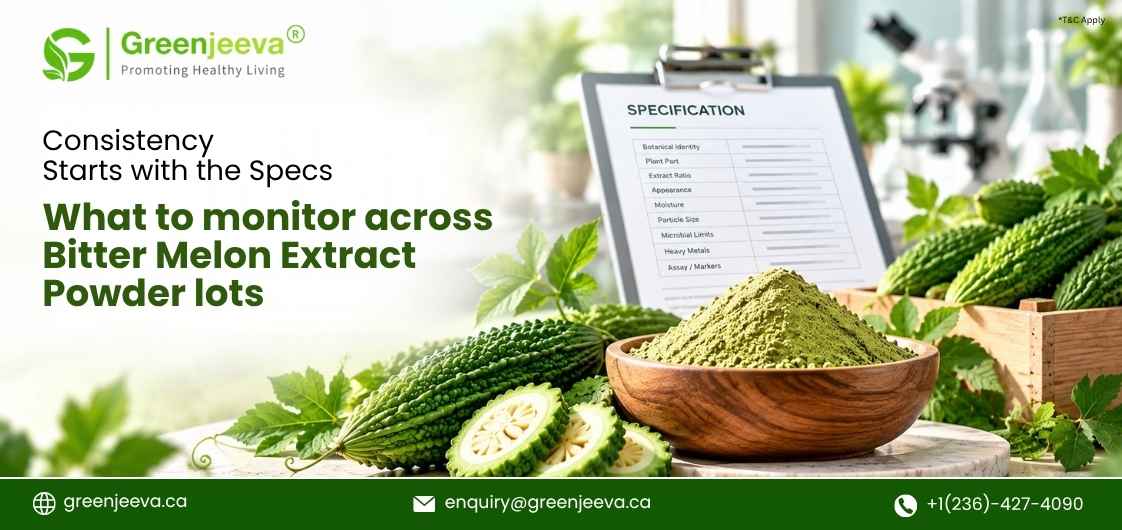
- Product specification
- Recent lot-specific COA
- Microbiological results
- Heavy-metal results
- Organic certificate, if applicable
- Non-GMO declaration where required
- Country-of-origin information
- Packaging details
- MOQ and lead time
- Sample availability
One important distinction is between a generic specification sheet and a lot-specific COA. The specification describes the product requirements; the COA provides test results associated with a particular production lot.
Does organic moringa powder meet Canadian requirements?
Organic status and product regulatory status are separate questions.
Under Canada's Organic Regime, organic products marketed as organic must meet applicable requirements, and imported organic products require appropriate documentation and import declarations. The Canadian Organic Regime covers organic food, seed and feed, but certain categories including Natural Health Products are outside its scope.
Therefore, a buyer should not assume that an “organic” certificate by itself determines whether a finished product is compliant for its intended Canadian market.
How does the intended product change the requirements?
The final application can significantly change the regulatory pathway.
Natural Health Products sold in Canada require product licensing, and licensed products receive an NPN (Natural Product Number). Health Canada considers information such as medicinal and non-medicinal ingredients, source, potency, dosage form, and recommended use during product licensing.
This means a raw-material buyer should tell the supplier whether the ingredient is intended for food, beverage, or a natural health product. The same botanical ingredient can require different documentation depending on how it enters the finished product.
What determines the price of bulk moringa powder?
Bulk pricing depends on several variables rather than simply the botanical name.
Key factors include:
- Organic versus conventional status
- Country of origin
- Processing and milling requirements
- Order volume
- Packaging format
- Testing requirements
- Certification requirements
- Freight and delivery location
- Contract duration
- Availability and production season
For manufacturers, a supplier offering a slightly higher unit price may still be commercially competitive if it provides consistent specifications, reliable documentation, predictable lead times, and fewer quality issues.
What are common mistakes when sourcing moringa powder?
The most common procurement problems occur when buyers focus on price before defining the raw-material specification.
Avoid:
- Comparing leaf powder with extract products
- Accepting a generic COA without checking the lot
- Assuming “organic” automatically covers every regulatory requirement
- Ignoring heavy-metal and microbiological testing
- Failing to confirm botanical identity and plant part
- Comparing unit price instead of landed cost
- Choosing an MOQ that does not match production requirements
- Ordering commercial quantities before evaluating a sample
A structured supplier qualification process reduces these risks.
How should a Canadian company qualify a new supplier?
A practical qualification workflow is:
Define specification → Request documentation → Review COA → Evaluate sample → Confirm commercial terms → Place initial order → Monitor incoming lot → Approve supplier
For the first commercial order, procurement should verify that the delivered material matches the approved sample and specification. Subsequent lots should continue to be checked against the agreed quality requirements.
What MOQ should manufacturers expect?
MOQ varies by supplier, packaging format, certification requirements, and production scale. Commercial botanical suppliers may offer smaller evaluation quantities for sampling while maintaining larger minimums for regular bulk orders.
For example, a 25 kg MOQ can be practical for smaller formulation projects, pilot production, and initial commercial evaluation, while larger manufacturers may negotiate pallet or multi-pallet volumes.
The appropriate MOQ is therefore the quantity that fits the manufacturer's production schedule and inventory strategy—not simply the lowest available quantity.
Where can manufacturers buy organic moringa powder in bulk in Canada?
Manufacturers can evaluate Canadian ingredient suppliers, distributors, or international suppliers offering commercial delivery into Canada.
For a sourcing decision, the supplier should be evaluated on more than availability. Buyers should compare botanical identity, organic status, testing, documentation, MOQ, packaging, lead time, and landed cost.
For Canadian procurement teams, the strongest supplier relationship is generally one where specifications remain consistent from sample approval through repeat commercial lots.
What MOQ should manufacturers expect?
MOQ varies by supplier, packaging format, certification requirements, and production scale. Commercial botanical suppliers may offer smaller evaluation quantities for sampling while maintaining larger minimums for regular bulk orders.For example, a 25 kg MOQ can be practical for smaller formulation projects, pilot production, and initial commercial evaluation, while larger manufacturers may negotiate pallet or multi-pallet volumes.
The appropriate MOQ is therefore the quantity that fits the manufacturer's production schedule and inventory strategy not simply the lowest available quantity.
Where can manufacturers buy organic moringa powder in bulk in Canada?
Manufacturers can evaluate Canadian ingredient suppliers, distributors, or international suppliers offering commercial delivery into Canada.
For a sourcing decision, the supplier should be evaluated on more than availability. Buyers should compare botanical identity, organic status, testing, documentation, MOQ, packaging, lead time, and landed cost.
For Canadian procurement teams, the strongest supplier relationship is generally one where specifications remain consistent from sample approval through repeat commercial lots.