
Sucralose Powder: Where to Buy Bulk Sucralose Powder for Food and Supplement Manufacturing
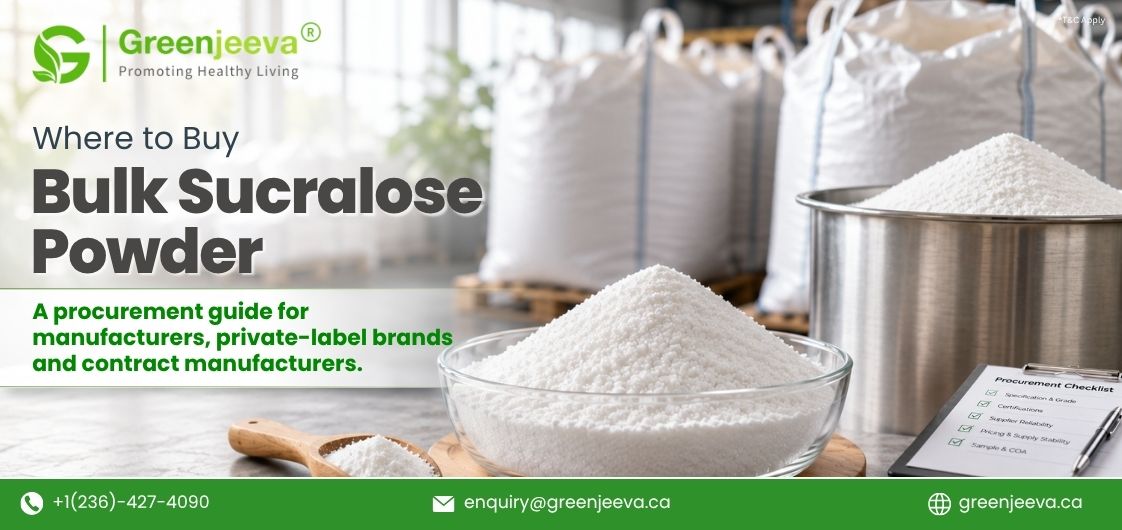
Why Sucralose Procurement Differs From Buying a Standard Ingredient
Sucralose procurement requires more than comparing quoted prices, because the ingredient is used at very low inclusion levels and must perform consistently in the finished product. Assess purity, specifications, documentation, regulatory suitability, MOQ, packaging, and batch consistency before approving a supplier.
A few dollars per kilogram looks significant on an RFQ. But when an ingredient is dosed in grams per batch, price matters far less than consistency and supply reliability. If 1 kg of sucralose covers thousands of finished units, a marginally cheaper supplier delivers marginally cheaper savings, while a delayed CoA, an unexplained specification change, or moisture-damaged packaging can halt a production run.
Five variables should be weighed together: ingredient quality, technical and regulatory documentation, supply continuity, MOQ and inventory exposure, and total landed cost.
What Is a Typical MOQ for Bulk Sucralose Powder?
Minimum order quantities vary widely. Large commodity suppliers commonly structure pricing around multi-hundred-kilogram or tonne-level volumes, while specialist ingredient suppliers may offer entry points as low as 25 kg.
MOQ matters most during formulation development. A multinational beverage manufacturer absorbs several hundred kilograms easily; a supplement brand launching its first 5,000 to 10,000 units faces a different inventory reality. Over-buying ties up working capital, extends holding periods, and risks obsolete stock before product-market fit is established.
A lower MOQ is not universally better, since high-volume buyers earn better economics at scale. Its value is flexibility: qualify a supplier and run pilot production before committing capital, then negotiate volume pricing once demand is proven.
A 25 kg entry point is generally enough for pilot runs, private-label launches, and contract manufacturers carrying many formulations at once. Where a supplier applies the same tiering across its range, a whole formulation can be sourced without a separate volume commitment per ingredient.
Manufacturer or Distributor: Does It Matter?
Both models can serve a buyer well. The useful question is not which label the supplier carries, but: who can reliably provide the specification, documentation, quantity, and delivery schedule my product requires?

Traceability is the deciding factor. If a distributor cannot identify the manufacturing source, supply consistent batch documentation, or explain a specification change, the convenience of the model stops being an advantage. A third option sits between the two: vertically integrated suppliers holding upstream sourcing alongside blending or private-label operations, which can preserve traceability across a broader portfolio than a single-line producer offers.
What Determines the Bulk Sucralose Price Per Kg?
Bulk sucralose pricing depends on order volume, specification, origin, packaging, certifications, logistics, and market conditions. A quoted price per kilogram should be evaluated alongside freight, testing, documentation, and inventory cost rather than treated as the only metric.
This is why online price searches mislead: competing offers may represent different quantities, grades, origins, pack formats, shipping terms, certification scopes, and warehouse locations. A 25 kg order and a multi-tonne contract should not carry the same unit economics.
A quotation is only comparable if it specifies: price per kg, MOQ, available pack sizes, country of origin, warehouse location, lead time, freight terms, applicable certifications, CoA availability, shelf life, and payment terms.
What Does a Sucralose Certificate of Analysis Tell a Buyer?
A Certificate of Analysis confirms whether one specific production batch meets the supplier's defined quality specification. It is a batch document, not a marketing credential, so quality teams should read the actual test parameters and results, not simply confirm a CoA exists.
When reviewing a sucralose CoA, verify product identity, lot number, manufacturing date, retest or expiry information, assay, appearance, moisture or loss on drying, relevant purity parameters, microbiological limits and heavy metals where specified, test methods, and acceptance criteria. The document should correspond to the material actually shipping.
A common failure is approving a supplier on a sample CoA without establishing how future commercial batches will be controlled. Sound qualification links the approved specification to every subsequent lot.
Where the testing happens also matters. A supplier running analysis in-house rather than outsourcing it can usually resolve a specification query in days rather than weeks. Ask which methods sit behind the CoA figures, for example ICP-MS for elemental impurities or LC-MS/MS for residue screening, and whether that work is internal.
What Belongs on a Sucralose Specification Sheet?
A specification sheet should identify the ingredient, quality parameters, test methods, physical characteristics, storage conditions, and applicable food-grade requirements. For R&D and procurement it beats any product description, because it states what is being purchased, what range the supplier guarantees, which analytical methods apply, how the material must be stored, and what documentation accompanies each lot.
Two parameters are often overlooked and worth requesting explicitly: particle size distribution and mesh size. In dry blends such as protein powders and electrolyte sticks, mismatched particle size is a frequent cause of segregation and inconsistent sweetness between servings.
Health Canada requires that food additives meet applicable food-grade specifications; where specifications are not set out in Part B of the Food and Drug Regulations, recognised compendial specifications may apply. That makes specification control particularly important for products destined for the Canadian market, and worth confirming which certifications a supplier can issue against the finished-product claim.
Is Food Grade Sucralose Suitable for Canadian Products?
Food-grade sucralose can be used in Canadian food applications where the specific food category and level of use are permitted. Buyers should verify their finished-product application against the current List of Permitted Sweeteners rather than assuming that approval in one category permits unrestricted use in another.
Health Canada's List of Permitted Sweeteners identifies sucralose with permitted food categories and maximum levels of use and is amended periodically. Check the live list, not a secondary summary.
The practical lesson: ingredient approval does not replace finished-product compliance. Before commercialising in Canada, confirm the food category, the permitted sweetener, the maximum permitted level, any applicable conditions, labelling requirements, and whether the product falls under a separate regulatory framework such as the natural health product rules.
Is Sucralose Heat Stable Enough for Commercial Processing?
Sucralose is recognised as heat stable and is widely used in heat-processed applications, including baked goods. But "heat stable" does not mean unaffected by every thermal process, and manufacturers should validate the ingredient under the actual temperature, time, pH, and matrix conditions of the finished product.
Recent regulatory work illustrates why. EFSA's re-evaluation of sucralose (E 955), published in February 2026, concluded there was no need to revise the acceptable daily intake of 15 mg/kg body weight per day and found no safety concern at currently authorised uses. However, the Panel could not conclude on the safety of a proposed extension of use into fine bakery wares, citing uncertainties about the potential formation of chlorinated compounds across the wide range of baking processes that category permits. EFSA also recommended that the European Commission consider revising the EU specifications for sucralose, a point QA teams supplying the EU should track.
Positions differ by jurisdiction: the FDA applies an ADI of 5 mg/kg bw per day against EFSA and JECFA's 15 mg/kg, reflecting different study bases. The WHO's 2023 conditional recommendation against non-sugar sweeteners for weight control is not a restriction on approved use, but customers may raise it.
Does Sucralose Need Special Storage?
Store sucralose powder cool and dry in tightly closed packaging, protected from moisture and contamination. Refrigeration is not normally required.
Handling still matters keep containers sealed, protect from humidity, use clean dry dispensing equipment, maintain warehouse hygiene, and record lot numbers at dispensing. At 25 kg and above, packaging integrity is critical, because a compliant ingredient is still unusable if the pack was compromised in transit.
Sucralose vs. Stevia vs. Aspartame
Neither sucralose nor steviol glycosides is universally better. The choice depends on taste target, label positioning, cost, matrix, and consumer expectation, and is best settled by prototype trials rather than a "natural versus artificial" argument.

Aspartame is distinct again, at roughly 200 times sweeter than sucrose per FDA figures, with different stability and processing behaviour. None of the three are interchangeable commodities, and many formulations blend high-intensity sweeteners to build a more sugar-like profile.
How to Qualify a New Sucralose Supplier
• Define the requirement. Application, grade, quantity, packaging, destination market, certification needs.
• Request documents. Specification sheet, current CoA, SDS, allergen statement, non-GMO statement, country of origin, certifications, shelf life.
• Evaluate a sample. Test dissolution, sweetness intensity, taste profile, flavour compatibility, stability, and processing behaviour under intended conditions. Where the sweetener sits inside a multi-ingredient matrix, validating the whole blend rather than the sweetener alone shortens this stage.
• Compare commercial terms. MOQ, price, lead time, freight, payment terms, packaging, stock availability.
• Approve and lock the specification. Establish the documentation requirements that apply to every future order.
• Monitor commercial batches. Periodic CoA review, incoming inspection, and supplier performance tracking catch specification drift before it reaches production.
Questions to Ask Before Placing an Order
• What is the MOQ, and what is the price at 25 kg, 100 kg, 500 kg, and 1 MT?
• Where is the material manufactured, and where is current inventory held?
• Can you provide a current batch CoA and a full specification sheet?
• What is the shelf life, and what packaging formats are available?
• What is the particle size or mesh specification?
• Which certifications are available (Halal, Kosher, COR, non-GMO, food safety scheme)?
• What is the standard lead time, and can you supply samples?
• What happens if a delivered batch does not meet specification?
The last question is the most revealing: a professional supplier has a defined complaint and resolution process and will describe it without hesitation.
Common Procurement Mistakes
Choosing the cheapest quote without assessing landed cost. Over-buying. Treating all sucralose as identical despite differences in origin, specification, and controls. Relying on a generic "sucralose is approved" statement instead of checking the food category and permitted level. Skipping the CoA before qualification. Assuming a good sample guarantees every future batch.
Final Takeaway
The best source for bulk sucralose powder is a qualified ingredient supplier that can provide the right specification, batch-level CoA, regulatory documentation, certifications, reliable stock, and an MOQ matched to your production volume. For Canadian manufacturers, the supplier should also support verification against Health Canada's permitted food-use conditions.
Work in order: start from the formulation requirement, confirm the regulatory category, review the specification, request the CoA, test the sample, assess MOQ and logistics, then negotiate volume once the supplier has shown consistency across several orders.
About Green Jeeva
Green Jeeva Canada supplies bulk sucralose powder at a 25 kg MOQ, with COR, Halal and Kosher certification, batch-specific CoA, and a 24-month stated shelf life under cool, dry, airtight storage.
The wider operation is vertically integrated: partner and company-owned organic farms in India, an in-house analytical laboratory running HPTLC, ICP-MS, LC-MS/MS and GC-MS/MS and microbiology rather than outsourced testing, regional North American warehousing, and blending and private-label manufacturing in Surrey, British Columbia. Alongside the ingredient catalogue, the company offers custom premix and blending for formulations that need the full matrix validated rather than a single ingredient, and holds certification documentation for regulated food and supplement markets.
To evaluate the material, request the specification sheet, a current CoA, available certifications, packaging options, and tiered pricing. Request a sample or quote or book a demo.

.jpeg)