
Bulk Ascorbic Acid (Vitamin C): A Sourcing and Specification Guide
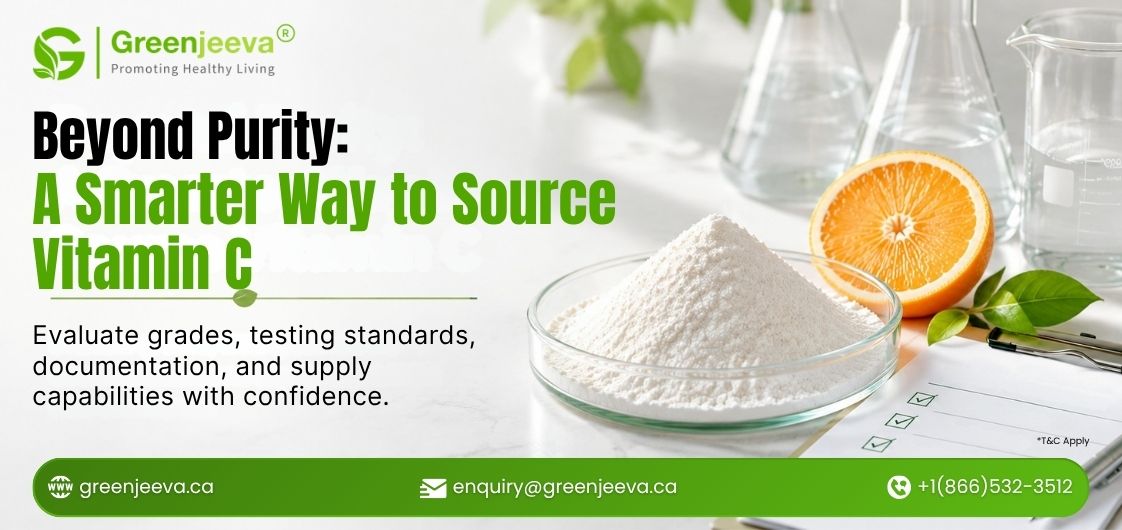
Sourcing ascorbic acid is not a matter of finding the lowest price per kilogram. The material has to meet the right specification, suit the dosage form, arrive with documentation your QA system will accept, and stay stable through processing and shelf life.
This guide is for procurement, QA, and R&D teams evaluating a bulk ascorbic acid supplier. It covers identity, grades, specifications, stability, COA content, and Canadian compliance pathways. For the chemistry behind what ascorbic acid does in a formula, including antioxidant action, browning inhibition, and dough conditioning, see Ascorbic Acid Powder for Clean Label Food and Beverage Manufacturing.
What ascorbic acid is, precisely
Vitamin C activity belongs specifically to the L-enantiomer. L-ascorbic acid, CAS 50-81-7, formula C₆H₈O₆, is the active form and the one used as a raw material. D-ascorbic acid is the same molecule mirrored and carries no meaningful vitamin C activity. That is why optical rotation appears as an identity test on compendial monographs, and why your specification should read L-ascorbic acid rather than just ascorbic acid. If a supplier's paperwork is vague on stereochemistry, ask.
Physically it is a white crystalline powder, highly water-soluble, and distinctly acidic, commonly pH 2.2 to 2.6 in solution. That acidity is central to how the ingredient behaves and shapes several decisions below.
Grades and physical forms
Two lots can both be 99.5 percent assay and behave completely differently in production. Assay describes purity, not processability.
Particle size. Fine powders dissolve fast, which suits beverage powders and drink mixes, but they flow poorly, dust during handling, and segregate in dry blends. Granular grades flow and compress far better. Running direct compression on a fine powder means fighting weight variation and content uniformity, and no COA warns you in advance.
Coated grades. For tablets, gummies, and multi-nutrient premixes, a lipid or cellulose coating lowers label assay to roughly 95 to 97 percent in exchange for three gains: reduced reactivity with other actives, better compression with less punch sticking, and slower moisture pickup. The trade-off is higher cost per unit of vitamin C, and overage must be calculated against actual ascorbic acid content rather than total weight.
Define the dosage form before requesting a quote. "Ascorbic acid powder" is not a specification. "L-ascorbic acid, fine powder, food grade, for a beverage powder blend" is.

Why copper and iron need their own line
Generic heavy-metals testing targets toxic elements. It says nothing about the two elements that will actually damage your product. Copper and iron catalyze ascorbic acid oxidation at trace levels, and this is the most common reason a manufacturer sees excellent incoming assay and still loses vitamin C in the finished good.
For any liquid or high-moisture product, ask for Cu and Fe limits explicitly, then check your process water and any mineral premix in the same formula. Our analytical lab runs trace-element analysis by ICP-MS, the method that makes limits at this level meaningful rather than nominal.
Stability: a good raw material is not enough
Ascorbic acid is a reducing agent. Its value as an antioxidant and its instability are the same property seen from two sides.
Five variables drive degradation, roughly in order of impact.
Trace metal catalysis. Copper and iron at parts-per-billion levels accelerate oxidation dramatically. Beverage formulators chelate, specify low-metal water, and audit mineral premixes for this reason. If you fix one thing on a failing vitamin C beverage, fix this first.
pH. Ascorbic acid is most stable around pH 2 to 4 and degrades faster as a system moves toward neutral. A citrus beverage holds label claim comfortably while a neutral-pH dairy or plant-milk product struggles. Ascorbic acid also lowers batch pH and can shift the sensory profile of a lightly buffered formula, worth working through early alongside your other functional and flavour ingredients.
Dissolved oxygen. Degradation runs far faster in solution than in dry powder. Deaeration, nitrogen sparging, headspace control, and barrier packaging are the levers. A stick pack and a ready-to-drink bottle at the same label claim are different problems.
Temperature. Hot-fill and retort cost vitamin C. Measure the loss on your own line rather than assuming it from literature.
Moisture. In solid dose forms, moisture opens the door to everything above. Desiccants, liner choice, and low-humidity filling are the controls, and this is where coated grades earn their premium.
Overage
Some loss over shelf life is expected, so beverage, gummy, and chewable manufacturers routinely overage vitamin C to hold label claim to expiry. The right level is not a rule of thumb. It comes from stability data on your formula, in your packaging, at your storage conditions. Build that study into the timeline rather than discovering the shortfall at month nine.

The logic in one line: choose ascorbic acid unless something in your product objects to acidity. If it does, you trade vitamin C density for pH and pick up either sodium or calcium on the nutrition panel, itself a labelling consideration.
Bakery: why levels under 100 ppm work
In dough, ascorbic acid oxidises gluten thiol groups. It converts in situ to dehydroascorbic acid, which promotes disulfide crosslinking between gluten proteins, producing a stronger network with better gas retention, improved loaf volume, and greater tolerance to mechanical handling. Because it works catalytically on the protein network rather than being consumed stoichiometrically, effective levels sit well under 100 ppm on flour basis, and CFIA guidance reflects that.
Two consequences for procurement. Nutritional and functional applications may need different particle sizes and carriers at identical chemical identity, and the intended function determines which regulatory pathway applies.
Canadian regulatory pathways: three routes, one molecule
Food and beverage products, including fortified drinks, bars, and bakery, fall under the Food and Drug Regulations, where additive use is governed by Canada's Lists of Permitted Food Additives. Ascorbic acid appears in more than one functional class, as a preservative or antioxidant and within the bleaching, maturing, and dough-conditioning class. Identify the class matching your function, then confirm permitted foods and maximum levels for your category.
Supplemented foods, meaning prepackaged foods and drinks with added vitamins, minerals, amino acids, or other permitted supplemental ingredients, fall under the Supplemented Foods framework. Vitamin C is among the permitted supplemental ingredients. The framework carries its own requirements for the Supplemented Food Facts table and for cautionary identifiers, depending on the ingredient and amount. Confirm current compliance dates before finalising artwork.
Tablets, capsules, and powder supplements are almost certainly under the Natural Health Products Regulations, a separate regime with product licensing (NPN), site licensing, and monograph-based requirements. The supplemented-foods rules do not apply. For general nutrient context the NIH Office of Dietary Supplements vitamin C fact sheet is useful, though Canadian requirements govern your product.
Same molecule, three documentation packages. Before approving a lot, be clear on which pathway applies, the permitted function and maximum level for your category, whether your grade claim matches what your QA system and customers require, and the labelling consequences of the amount you are adding. That last decision is far cheaper before the artwork than after.
What belongs on the COA
A Certificate of Analysis answers one question: does this lot meet the approved specification?
It should carry product name and batch number, manufacturing and retest or expiry dates, the reference specification, assay with method stated, identity confirmation, appearance, pH, trace-metal and heavy-metal results, microbiological results where your category requires them, specification limits printed beside actual results, and an authorised release signature.
Results without limits beside them are not much use, and limits without a named method are worse. Our certifications and lot documentation are available to registered buyers, including full physical and heavy-metal panels with methods.
Evaluating a supplier beyond the certificate
Certificates confirm a lot, not a supply relationship. It is worth thinking past the certificate when qualifying a partner.
On specification, can they hold your mesh spec consistently rather than on a single lot? On documentation, is batch-specific paperwork routine or produced only on request, and are country of origin, allergen status, and certification documents available without chasing? On supply, what are the MOQ and pack format, where does inventory physically sit, and can volume scale as your product does? On traceability, how are batches identified, deviations handled, and changes communicated?
An unexpected shortage costs more than a price difference ever saves. For a high-volume product, supply continuity deserves the same scrutiny as assay.
Final takeaway
Bulk ascorbic acid is a sourcing decision, not a commodity purchase. A supplier worth approving can demonstrate the full chain: correct specification, reliable testing, clear documentation, suitable packaging, stable supply, commercial capacity.
So define the specification your formulation actually requires before you compare prices. Then evaluate suppliers against it. That order is what moves a team from sample evaluation to repeatable commercial sourcing.
Whether you are developing a supplement, a functional beverage, a sports nutrition product, or a bakery formulation, we can help you match bulk Ascorbic Acid Powder to your application. Request a sample, download the documentation, or talk to our technical team about your required volume.

.jpeg)