Ceylon vs. Cassia cinnamon powder: the difference that actually matters isn't flavour
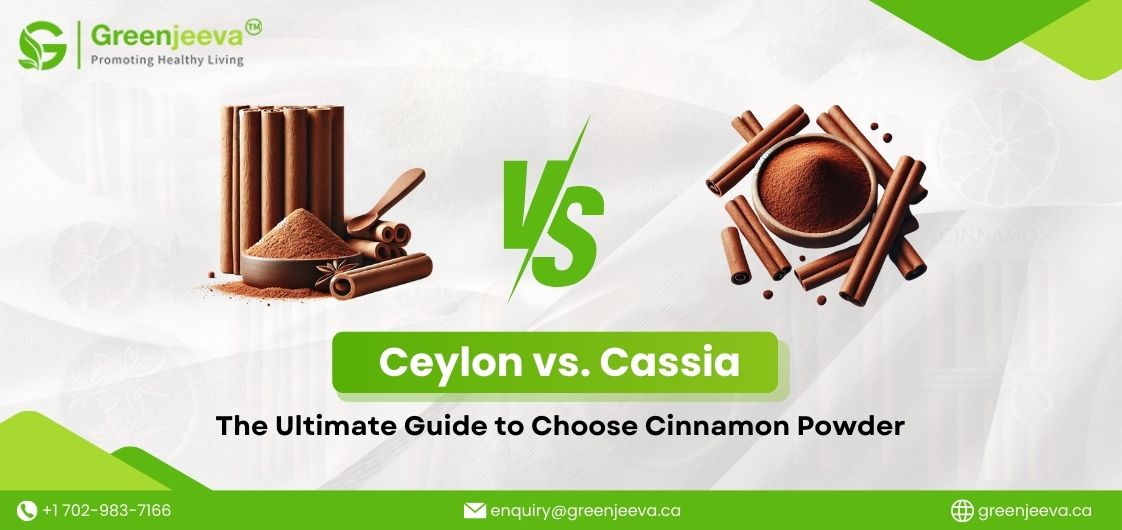
Ceylon and Cassia cinnamon get framed as a flavor and price decision: Ceylon the refined, premium option, Cassia the bold, budget-friendly one. That framing isn't wrong, but it skips past the one difference between the two species that has actual regulatory attention behind it, and it's not taste.
This guide covers what botanically separates the two species, why coumarin content is the distinction that actually drives sourcing decisions, what Health Canada's own monographs authorize for each, and the real testing specification behind Green Jeeva's Organic Cassia Cinnamon Powder.
WHAT SEPARATES CEYLON FROM CASSIA BOTANICALLY
Ceylon cinnamon comes from the inner bark of Cinnamomum verum, often called "true cinnamon," native to Sri Lanka. Cassia cinnamon comes from Cinnamomum cassia, also referenced in some regulatory documentation as Cinnamomum aromaticum, grown primarily in China and other parts of Southeast Asia.
The two aren't different grades of the same plant. They're different species entirely, and that distinction is why they behave differently on a compositional level, not just a flavor level.
THE COMPOUND THAT ACTUALLY DRIVES THE DIFFERENCE: COUMARIN
Coumarin is a naturally occurring compound found in both species, but at dramatically different concentrations. Ceylon cinnamon contains only trace levels, while Cassia cinnamon contains substantially more, commonly cited as roughly two orders of magnitude higher, though the exact figures vary meaningfully across studies and batches.
This isn't a fringe concern. The Canadian Food Inspection Agency has directly cited the European Food Safety Authority's tolerable daily intake of 0.1 mg of coumarin per kilogram of body weight per day, along with Germany's Federal Institute for RiskAssessment warning specifically against excessive Cassia cinnamon consumption due to its coumarin content, and Norway's food safety committee concluding that children and regular consumers of even moderate cinnamon amounts may be at risk of elevated coumarin intake. CFIA has run its own surveillance testing on cinnamon-containing foods sold in Canada specifically because of this concern.
WHAT THIS MEANS FOR FORMULATION DECISIONS
For occasional culinary use, this is a low-risk distinction; the coumarin load in a pinch of Cassia in a baked good is unlikely to approach the tolerable daily intake for most consumers. The calculation changes for products designed for regular, cumulative consumption, particularly high-dose supplement capsules, daily wellness beverages, or children's products, where Cassia's higher coumarin content becomes a genuine formulation consideration rather than a footnote.
For any product positioned around daily or high-volume cinnamon intake, Ceylon's negligible coumarin content removes this consideration almost entirely, which is a real functional advantage independent of flavor positioning. For products where cinnamon appears at lower, occasional-use levels, Cassia's stronger, more assertive flavor profile and lower cost remain legitimate reasons to choose it.
WHAT HEALTH CANADA ACTUALLY AUTHORIZES FOR EACH
Here's a piece of good news that's easy to miss: both species have their own dedicated Health Canada Natural Health Products monographs, which is a stronger regulatory position than a lot of trending botanicals currently have. Both the Cassia monograph and the Cinnamomum verum monograph authorize a source-of-antioxidants claim, along with traditional use in Ayurveda and Herbal Medicine as a carminative or digestive aid for complaints such as indigestion, bloating, and flatulence.
Both monographs also carry the same standard cautions: not for use during pregnancy and a recommendation to consult a healthcare practitioner before use while breastfeeding or if managing diabetes, since cinnamon can interact with blood glucose. Any Canadian NPN application referencing either species should confirm current monograph language directly rather than relying on a summary, since monograph wording is periodically revised.
IS ORGANIC CEYLON THE SAME AS "ORGANIC CINNAMON"?
No, and this is worth being precise about. "Organic" describes the farming and certification practice, not the species. A cinnamon product can be organic cassia or organic ceylon; organic certification says nothing about which species you're buying or its coumarin content.
If coumarin exposure matters for your specific product, species selection and organic certification are two separate decisions that both need to be made deliberately, not one decision that automatically covers the other.
WHAT GREEN JEEVA'S ORGANIC CASSIA CINNAMON POWDER IS ACTUALLY TESTED TO
Rather than describing quality in general terms, here's what's actually on Green Jeeva's certificate of analysis for Organic Cassia Cinnamon Powder, including the compendial method behind each result.
Attribute: Description / Color / Odor / Taste
Specification: Powder, brownish yellow, characteristic
Test Method: Organoleptic
Attribute: Mesh size
Specification: 100% passes through #80 mesh
Test Method: USP <786>
Attribute: Loss on drying
Specification: NMT 10% w/w
Test Method: USP <731>
Attribute: Total ash
Specification: NMT 10% w/w
Test Method: USP <561>
Attribute: Pesticide residue
Specification: Meets USP <561>
Test Method: USP <561>
Attribute: Total heavy metals
Specification: NMT 10 ppm
Test Method: USP <231>
Attribute: Lead
Specification: NMT 0.5 ppm
Test Method: USP <232>
Attribute: Arsenic
Specification: NMT 1 ppm
Test Method: USP <232>
Attribute: Mercury
Specification: NMT 0.1 ppm
Test Method: USP <232>
Attribute: Cadmium
Specification: NMT 1 ppm
Test Method: USP <232>
Attribute: Total plate count
Specification: NMT 100,000cfu/g
Test Method: USP <2021>
Attribute: Yeast and mold
Specification: NMT 1,000cfu/g
Test Method: USP <2021>
Attribute: E. coli, Salmonella, Staphylococcus
Specification: Negative
Test Method: USP <2022>
Attribute: Coliforms
Specification: Negative
Test Method: USP <2021>
Attribute: Country of origin
Specification: China
Attribute: Plant part used
Specification: Bark
This specification is worth noting for a reason beyond quality assurance: coumarin content isn't a standard line item on most commercial cinnamon spec sheets, this one included. If coumarin level matters for your specific product's daily-use profile, that's a test to request separately rather than assume it's already covered by a standard heavy metals and microbiology panel.
SOURCING CASSIA IN CANADA, WITH CEYLON ON REQUEST
Green Jeeva supplies organic cassia cinnamon powder, tested to the specification above, and supplied in 25 kg food-grade bulk packaging.
Organic Ceylon Cinnamon Powder, milled from Cinnamomum verum inner bark, is also part of Green Jeeva's catalogue, but its product page is not currently live on the website. If Ceylon's lower coumarin profile fits your formulation, contact the team directly to confirm current availability, specification, and documentation rather than expecting a public listing to find it.
Ready to source bulk organic cinnamon powder?
Request a certificate of analysis, a sample, and wholesale pricing for either the Ceylon or Cassia line.
Contact us: https://www.greenjeeva.ca/contact-us
DISCLAIMER
Organic Cassia Cinnamon Powder and Organic Ceylon Cinnamon Powder are supplied as raw ingredients for food, beverage, and dietary supplement manufacturing. Coumarin exposure from cinnamon-containing products should be evaluated by the manufacturer against applicable tolerable daily intake guidance, particularly for high-dose, high-frequency, or children's products. Health claims for finished natural health products should reference Health Canada's current monograph language directly, and finished-product claims should be substantiated by the manufacturer and comply with applicable regulations in the target market. This article is written by Green Jeeva's QA and RA team for sourcing and formulation guidance.