Flaxseed powder vs. Chia seeds powder: choosing the right one for your formulation
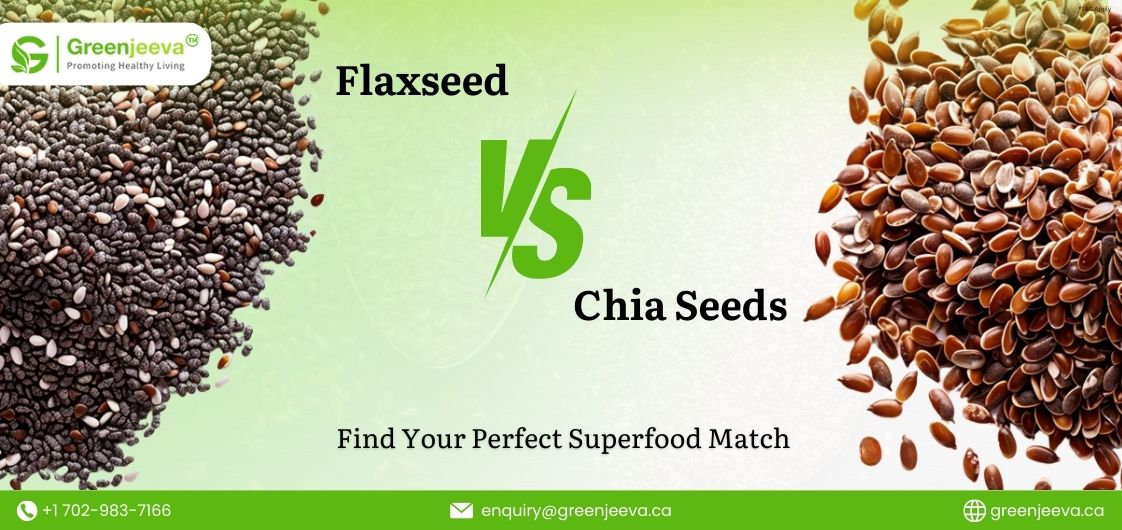
Flaxseed and chia seeds get bundled together in almost every "superfood" comparison, and most of those pieces end with the same shrug: eat both, cover your bases. That's fine advice for a consumer. It's not useful for a manufacturer deciding which ingredient to build a formulation around, because the two behave quite differently once they're milled, blended, and sitting on a shelf.
This guide covers the functional differences that actually matter for formulation, including oxidative stability, fiber type, gel-forming behavior, and a genuinely distinctive piece of Canadian regulatory history that most flaxseed marketing doesn't use.
WHAT ARE FLAXSEED POWDER AND CHIA SEED POWDER?
Flaxseed powder is ground from the seeds of Linumusitatissimum, commonly called flax or linseed. Canada is the world's largest producer of flaxseed, and the crop has centuries of established food and industrial use behind it.
Chia seed powder is ground from Salvia hispanica, a plant native to Mexico and Guatemala with a history of use dating back to the Aztec and Mayan civilizations. In Canada, chia seeds and chia oil are recognized as a natural health product ingredient, which is a slightly different regulatory lane than flax's long-standing food status.
Both are genuine sources of plant-based omega-3 ALA, fiber, and protein. Where they diverge is in how each one performs once it's actually in a formulation.
THE BIGGEST FUNCTIONAL DIFFERENCE: HOW EACH ONE HANDLES OXIDATION
This is the distinction that matters most for a manufacturer and least for a consumer buying a small bag at a time. Chia's natural antioxidant content, including chlorogenic acid, caffeic acid, and quercetin, gives it meaningfully better resistance to rancidity than flax. Peer-reviewed oxidative stability testing on the two seed oils backs this up directly, with flax oil showing faster peroxide value increases under accelerated storage conditions than chia oil.
Flaxseed's oil content is also simply higher, which is the main driver of its shorter usable shelf life once milled. Whole flaxseed is quite stable, since the seed coat protects the oil from oxygen and light. Once grounded, that protection is gone, and the clock starts running.
This means milling method and packaging matter more for flax than they do for almost any other seed powder in a typical B2B catalogue. Ask any flax supplier for the mill date, the packaging specification, and a current peroxide value on the certificate of analysis, since those three data points predict how much usable shelf lifeactually remainsonce the material reaches your facility. Chia is considerably more forgiving on this front, which is part of why it's positioned as a longer-shelf-life pantry ingredient in consumer markets.
FIBRE TYPE AND GEL-FORMING BEHAVIOUR IN FORMULATION
Flaxseed and chia are both fibre-rich, but the fibre types differ enough to change how each performs in a finished product. Flax leans toward insoluble fibre, supporting regularity, while chia carries a higher proportion of soluble fibre, which is part of why it forms a gel so readily in liquid.
That gel-forming behavior is Chia's most distinctive functional property. Mixed with liquid at roughly a one-to-three ratio by volume, chia forms a stable gel that holds structure through baking, which is why it shows up so often as a vegan egg replacer in baked goods. Ground flaxseed also forms a mucilage gel and can serve a similar binding role, but the resulting texture and set time differ enough from chia's gel that the two aren't always directly interchangeable in a recipe built around one or the other.
CANADA'S FLAXSEED HEALTH CLAIM: A REGULATORY ADVANTAGE MOST BRANDS AREN'T USING
This is worth knowing regardless of which ingredient you formulate with. In 2014, Health Canada's Food Directorate approved a specific health claim linking daily consumption of ground whole flaxseed to blood cholesterol reduction, making Canada the first country in the world to authorize a health claim of this kind for flaxseed. The authorized claim is tied to a specific intake level: 40 grams, or five tablespoons, of ground whole flaxseed per day, consumed across three separate eating occasions.
That's a rare thing in this industry: a single-ingredient, government-authorized cholesterol claim with a specific, usable dose attached to it. A finished product built around ground flaxseed at that intake level has a genuinely defensible claim to make, provided the formulation and labelling match the authorized conditions of use.
Chia doesn't currently have an equivalent Health Canada-authorized claim of its own. That's not a knock against chia, which is nutritionally strong on its own merits, but it does mean flax currently holds the stronger regulatory claim story of the two.
FLAXSEED POWDER VS. CHIA SEEDS POWDER AT A GLANCE
Attribute: Fibre type
Flaxseed Powder: Predominantly insoluble fibre
Chia Seeds Powder: Higher proportion of soluble fiber
Attribute: Oxidative stability once milled
Flaxseed Powder: Lower; requires careful packaging and cold-chain awareness
Chia Seeds Powder: Higher, due to natural antioxidant content
Attribute: Gel-forming behavior
Flaxseed Powder: Forms mucilage; usable as a binder
Chia Seeds Powder: Forms a firmer, more predictable gel; common egg replacer
Attribute: Canadian regulatory claim status
Flaxseed Powder: Health Canada-authorized cholesterol-reduction claim at a specific dose
Chia Seeds Powder: Recognized as a natural health product ingredient; no equivalent authorized claim
Attribute: Flavor profile
Flaxseed Powder: Mild, nutty
Chia Seeds Powder: Largely neutral
WHAT TO ASK YOUR SUPPLIER FOR EACH
The two ingredients warrant slightly different supplier questions, given where their real risks sit.
For flaxseed powder: request the mill date, the packaging specification (paper with a poly liner, vacuum-sealed, or nitrogen-flushed), and a current peroxide value on the certificate of analysis. These predict remaining usable shelf life far better than a generic best-by date.
For chia seeds powder: confirm moisture content and microbial testing results, since chia's oxidative stability advantage doesn't eliminate the standard biological quality risks common to any milled seed powder.
For both: confirm organic certification status against the certification body relevant to your target market, and request batch-specific documentation rather than a generic specification sheet.
APPLICATIONS ACROSS FOOD, BEVERAGE, AND SUPPLEMENT MANUFACTURING
Flaxseed powder is widely used in bakery products, cereals, and nutritional blends, and it functions as a natural binding ingredient in baked goods independent of its nutritional role.
Chia seed powder fits smoothies, functional beverages, and bakery inclusions, and its gel-forming property makes it a common choice for vegan formulations needing an egg replacer.
Both are used across dietary supplement and nutraceutical formulations as sources of plant-based omega-3 ALA, fiber, and protein, subject to the claim distinctions above.
SOURCE BULK FLAXSEED AND CHIA SEED POWDER IN CANADA
Green Jeeva supplies bulk organic flax seed powder and organic black chia seed powder to Canadian food, beverage, and supplement manufacturers, with 25 kg commercial packaging as the standard pack size for flax. Certificate of analysis and compliance documentation are available on request for both ingredients.
Ready to source bulk flaxseed or chia seed powder?
Request a certificate of analysis, a sample, and wholesale pricing for food-grade Organic Flax Seed Powder or Organic Black Chia Seeds Powder.
Contact us: https://www.greenjeeva.ca/contact-us
Organic flax seed powder and organic black chia seed powder are supplied as raw ingredients for food, beverage, and dietary supplement manufacturing. Canada's authorized health claim for ground whole flaxseed and blood cholesterol reduction applies to a specific intake level and formulation context; manufacturers should confirm their finished product matches the authorized conditions of use before referencing this claim on a label. Beyond that specific authorized claim, other finished-product claims should be substantiated by the manufacturer and comply with applicable regulations in the target market. This article is written by Green Jeeva's QA and RA team for sourcing and formulation guidance.