Garlic powder vs. Granulated garlic: one ingredient, one variable, very different performance
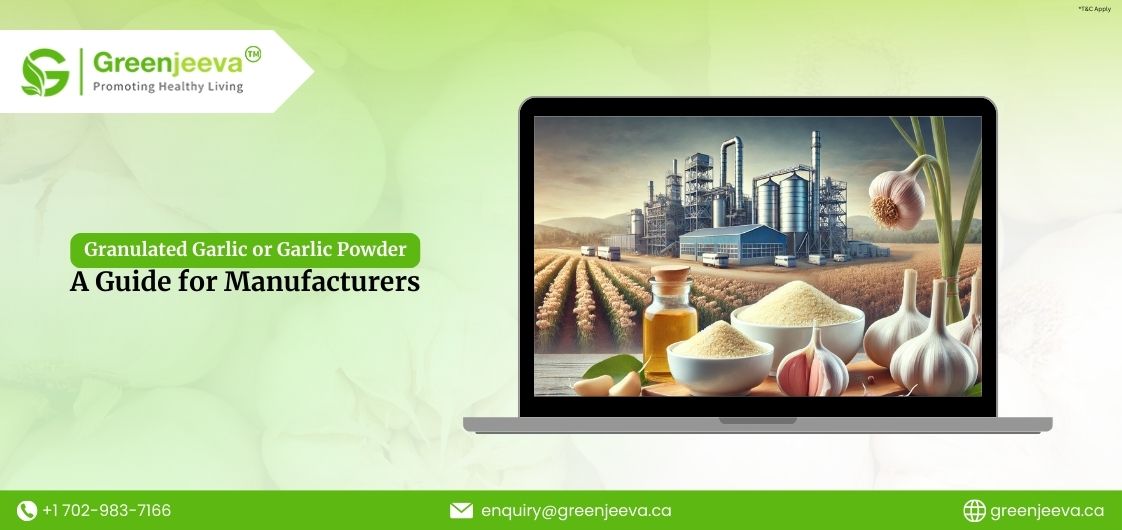
Most comparisons of garlic powder and granulated garlic list them out like two different ingredients with their own separate characteristics: one has "intense flavor," the other has "visual texture," and so on. That framing makes the decision harder than it needs to be, because both start as the exact same dehydrated Allium sativum. The entire difference comes down to one variable applied after drying: how fine the material is milled.
This guide covers what mesh size actually changes in a food formulation, where each format genuinely performs better, the substitution ratio manufacturers commonly get wrong, and the real testing specification behind Green Jeeva's Organic Garlic Powder.
THE ONLY REAL DIFFERENCE: MESH SIZE
Both garlic powder and granulated garlic begin as peeled, dehydrated garlic bulbs. Granulated garlic is milled to a coarser grind, commonly described in the spice industry as passing a 20-mesh sieve while being retained on a 40-mesh screen. Garlic powder goes through additional milling to a much finer, flour-like consistency, typically passing a considerably finer mesh.
That's the whole distinction. It isn't a different variety of garlic, a different growing region, or a different processing philosophy. It's the same raw material carried one or two extra milling steps further.
WHAT MESH SIZE ACTUALLY CHANGES IN A FORMULATION
Particle size determines surface area, and surface area is what drives almost every practical difference between the two formats. A finer powder has dramatically more surface area exposed per gram than a coarse granule, which means it dissolves faster in liquid, releases its flavor compounds more quickly, and disperses invisibly into a smooth base.
That same increased surface area cuts both ways. Finer powder also absorbs ambient moisture faster, which is why it's more prone to caking in humid environments than the coarser granulated form. It also means a finer powder oxidizes and loses potency somewhat faster once a package is opened and exposed to air, compared to a coarser granule with less exposed surface.
Granulated garlic's coarser structure means slower hydration and a more gradual flavor release. In a liquid application, those larger particles also stay visibly present rather than disappearing into the base, which is either a benefit or a problem depending entirely on whether the finished product is supposed to look smooth.
WHERE EACH ONE ACTUALLY WINS
Garlic powder is the better fit anywhere a smooth, uniform appearance matters: sauces, dips, dressings, powdered soup and gravy mixes, and snack seasoning coatings that need even distribution without visible flecks. Its faster dissolution also suits instant or reconstituted products where there's limited time or agitation to work with.
Granulated garlic performs better anywhere texture or slow release is actually the goal. Dry rubs and spice blends benefit from granules that adhere to a moist meat surface rather than dusting off, and marinades benefit from a slower, more gradual flavor release during a longer soak or cook time. Visible garlic flecks in a rub or a baked good are often a deliberate visual cue of "real garlic," which is a marketing consideration as much as a functional one.
THE SUBSTITUTION RATIO MOST FORMULAS GET WRONG
Because garlic powder has more surface area per gram, it's commonly treated as roughly twice as potent by volume compared to granulated garlic, which is why a widely used rule of thumb calls for about half as much powder as granulated garlic when substituting between the two. That's a reasonable starting point for a first trial batch, not a guaranteed constant.
The exact ratio depends on the specific mesh size and bulk density of the two materials you're actually sourcing, which can vary between suppliers. Treat any published substitution ratio as a starting point for pilot testing, not a fixed conversion to build a production formula around without verification.
WHAT GREEN JEEVA'S ORGANIC GARLIC POWDER IS ACTUALLY TESTED TO
Most garlic powder content online describes quality in adjectives: "premium," "high-quality," "rigorously tested." None of that is verifiable. Here's what's actually on Green Jeeva's certificate of analysis for Organic Garlic Powder, including the compendial method used to verify each result.
Attribute: Description / Color / Odor / Taste
Specification: Powder, yellowish, characteristic
Test Method: Organoleptic
Attribute: Mesh size
Specification: 100% passes through #40 mesh
Test Method: USP <786>
Attribute: Loss on drying
Specification: NMT 10%
Test Method: USP <731>
Attribute: Pesticide residue
Specification: Meets USP <561>
Test Method: USP <561>
Attribute: Total heavy metals
Specification: NMT 10 ppm
Test Method: USP <231>
Attribute: Lead
Specification: NMT 0.5 ppm
Test Method: USP <232>
Attribute: Arsenic
Specification: NMT 0.5 ppm
Test Method: USP <232>
Attribute: Mercury
Specification: NMT 0.01 ppm
Test Method: USP <232>
Attribute: Cadmium
Specification: NMT 1 ppm
Test Method: USP <232>
Attribute: Total plate count
Specification: NMT 100,000cfu/g
Test Method: USP <2021>
Attribute: Yeast and mold
Specification: NMT 1,000cfu/g
Test Method: USP <2021>
Attribute: Coliforms
Specification: NMT 300cfu/g
Test Method: USP <2021>
Attribute: E. coli
Specification: NMT 10cfu/g
Test Method: USP <2022>
Attribute: Salmonella, Shigellacastellani, Staphylococcus aureus
Specification: Negative
Test Method: USP <2022>
Attribute: Shelf life
Specification: 24 months
Attribute: Country of origin
Specification: China
Note on this specific product's mesh spec: 100 percent through a #40 mesh sits at the coarser end of what the spice industry commonly defines as "granulated garlic," rather than the finer mesh usually associated with a flour-like "garlic powder" format. That's worth knowing before assuming this specific product will behave like an ultra-fine, instantly dissolving powder in a smooth sauce or beverage application.
SOURCING GARLIC POWDER IN CANADA: TWO FORMATS
Green Jeeva supplies two distinct garlic powder products, and it's worth sourcing the right one rather than assuming they're interchangeable on spec.
Organic Garlic Powder is the certified organic line, tested to the full specification detailed above. Confirm current batch documentation and organic certification directly through the product page.
Garlic powder is supplied in 25 kg food-grade bulk packaging with a 25 kg MOQ, supporting food processing, seasoning blends, nutraceutical formulations, and functional food products. Shelf life and country of origin for this line are documented as batch-specific rather than fixed values, so confirm both on the certificate of analysis for the lot you're sourcing.
Ready to source bulk garlic powder?
Request a certificate of analysis, a sample, and wholesale pricing for either the organic or conventional line.
Contact us: https://www.greenjeeva.ca/contact-us
DISCLAIMER
Organic Garlic Powder and Garlic Powder are supplied as food-grade raw ingredients for food and beverage manufacturing. Specification values referenced in this article reflect Green Jeeva's current sample product specification for Organic Garlic Powder and should be confirmed against the certificate of analysis for the specific batch supplied. This article is written by Green Jeeva's QA and RA team for sourcing and formulation guidance.