Organic Ginger Root Powder vs. Ginger Extract Powder: A B2B Format Guide
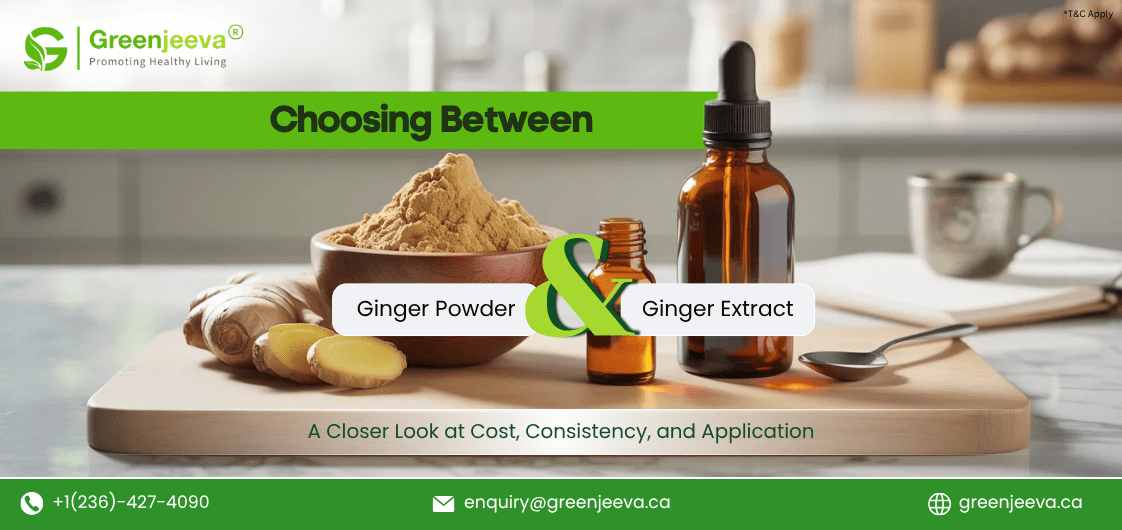
Buyers often default to whichever ginger format they've used before or whichever quote comes back lowest, without asking the one question that actually determines fit: does this formulation need a guaranteed potency, or does it need the whole rhizome? Organic Ginger Root Powder and Ginger Extract Powder 5% Gingerol, HPLC are not interchangeable, and choosing the wrong one shows up later as inconsistent dosing, unexpected flavor intensity, or a formulation that tests differently between batches.
This guide breaks down what separates the two formats technically, when each one is the right call, and what documentation Canadian manufacturers should request regardless of which they choose.
What Organic Ginger Root Powder Is
Organic ginger root powder is the dried, finely milled rhizome of Zingiber officinale, sourced from growing regions including India and China. The rhizomes are harvested, cleaned, sliced, dried under controlled conditions, and milled to preserve the ingredient's natural aroma and flavor profile. Green Jeeva's Organic Ginger Root Powder retains the full botanical matrix, including gingerols, shogaols, fiber, and volatile oils, in their naturally occurring ratios.
Because nothing is concentrated or standardized, gingerol content in whole ginger powder varies with cultivar, growing conditions, and drying method, generally landing in a range of roughly 1 to 3 percent. That variability isn't a defect. For culinary, functional food, and whole-botanical applications, the intact matrix and characteristic ginger flavor are exactly what a formulator wants.
For applications closer to a whole-rhizome format but at a coarser cut, Green Jeeva also supplies Organic Ginger C/S, a cut-and-sifted format suited to teas, decoctions, and infusions where a fine powder isn't required.
What Ginger Extract Powder 5% Gingerol, HPLC Is
Ginger Extract Powder 5% Gingerol, HPLC, is a concentrated botanical extract produced through a controlled extraction process, then dried and milled into a fine, free-flowing powder. Unlike whole ginger powder, this format carries a declared minimum: a guaranteed 5 percent gingerol content, verified by High-Performance Liquid Chromatography (HPLC) rather than estimated. Green Jeeva's Ginger Extract Powder 5% Gingerol, HPLC, is supplied as a conventional ingredient by default, with organic sourcing available upon request for buyers who need Canada Organic Regime certification tied to this specific format.
This is the format formulators reach for when a finished product needs to declare a specific active compound level per serving, since standardization removes the batch-to-batch swing that comes with using whole powder alone.

The Real Difference: Guaranteed Potency vs. Natural Variability
The comparison that actually matters isn't "powder versus extract" in the abstract, it's guaranteed minimum potency versus a naturally occurring, variable one. Whole ginger powder's gingerol content shifts with growing season and processing, which independent HPLC profiling of commercial dried ginger has repeatedly shown across different growers and harvest years. A formulator relying on whole powder to hit a specific active-compound target per serving is working against that natural variability, not with it.
Extract powder solves this by starting from the same rhizome but concentrating and testing to a fixed floor, in this case a minimum of 5 percent gingerol confirmed by HPLC on every batch. That number means something specific: it's not a marketing claim, it's an analytical result tied to a recognized testing method, and it's the reason an extract can support a declared potency claim on a finished label in a way whole powder generally cannot.

Choosing Between Formats by Application
The right format depends on what the finished product needs to do, not on price alone.
Dietary supplement capsules, tablets, and any formulation making a declared active-compound claim generally call for the standardized extract, since dosing consistency depends on a verified minimum.
Culinary seasoning blends, sauces, and traditional spice applications are usually better served by whole ginger powder, where the full flavor matrix and natural aroma matter more than a potency figure.
Functional beverages and wellness drink mixes can use either, depending on whether the brief prioritizes measurable potency or a more traditional whole-ingredient positioning.
Teas, decoctions, and infusions are often better suited to Organic Ginger C/S, since the coarser cut behaves differently in steeping than a fine powder.
Animal nutrition formulations typically use whole powder or C/S rather than the standardized extract, unless a specific potency target is part of the feed specification.
Documentation to Request for Either Format
Regardless of which format a formulation calls for, the underlying documentation expectations don't change. For Organic Ginger Root Powder, that means a certificate of analysis covering heavy metal screening (lead, arsenic, mercury, and cadmium), microbiological testing, and current organic certification tied to the specific batch. For the extract, the same heavy metal and microbiological panel applies, alongside the HPLC test report confirming the declared gingerol percentage for that lot.
Buyers switching between suppliers, or qualifying a new one, should request a sample lot of whichever format they need and compare its COA against a second, later shipment before committing to volume. This confirms the supplier's documented specifications hold up in practice, not just on paper. Buyers specifically requiring organic certification on the extract format should confirm this at the order stage, since it is supplied on request rather than as the standard catalog SKU.