Standardized Extract or Botanical Powder? How to Choose Between Bulk Green Coffee Bean Extract and Green Tea Powder
Two botanical ingredients can sit on the same purchase order, in the same 25 kg bags, from the same supplier, and belong to fundamentally different categories.
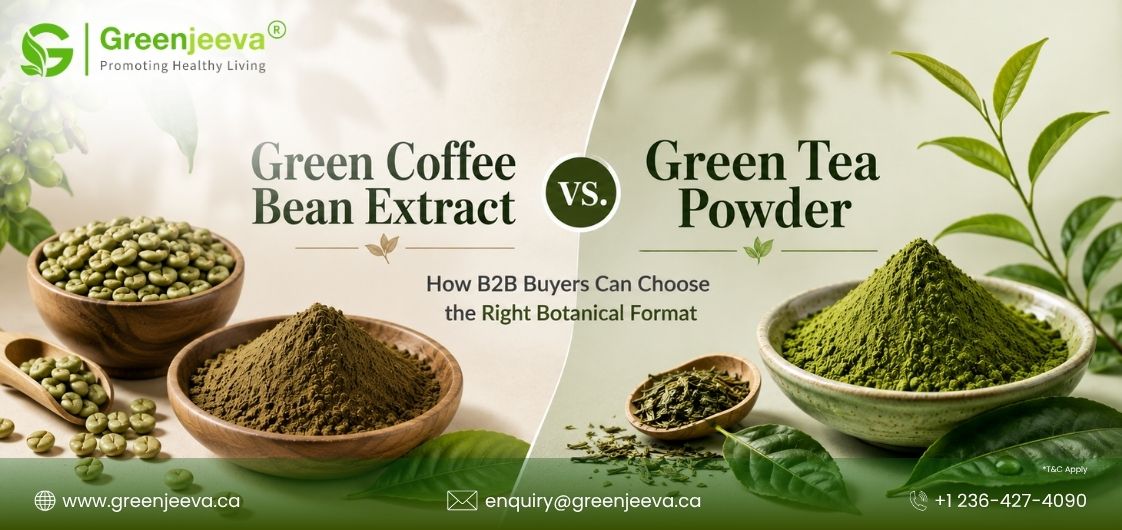
Green coffee bean extract standardized to chlorogenic acids is a standardized extract. Green tea powder is milled whole leaf. Both are legitimate commercial ingredients. Both have real applications. But they answer different formulation questions, they carry different documentation, they are dosed differently, and they cannot be compared on the same terms.
Buyers collapse this distinction more often than any other in botanical sourcing, usually because both arrive as a beige-to-green powder in a food-grade bag. The consequences show up later, in a formulation that cannot be dosed to a target, or a claims review that cannot be supported.
This guide sets out the difference and gives you a way to decide which category your brief actually needs.
Standardized Extract vs. Botanical Powder: The Core Difference
A standardized extract is produced by extracting a botanical, concentrating the fraction of interest, and controlling the finished material to a defined concentration of a named marker compound. Our green coffee bean extract standardized to chlorogenic acids is an example. The specification names the marker, and the batch documentation reports a result against it.
A botanical powder is the plant material itself, cleaned, dried and milled to a consistent particle size. Our green tea powder is produced from Camellia sinensis leaf by controlled harvesting, gentle drying and milling. It is specified on identity, plant part, format, colour, particle consistency, purity and microbiological parameters, not on a marker concentration.
That is the whole difference, and everything practical follows from it.
An extract lets you dose to a defined quantity of a specific compound. A powder gives you the whole botanical, in a form suitable for commercial blending, without a marker figure to dose against.
Neither is a superior ingredient. They are different tools, and the mistake is asking one to do the other's job.
Dosing a Standardized Extract vs. a Bulk Botanical Powder
This is where the distinction becomes concrete.
With a standardized extract, your R&D team can work backwards from a target. If the formulation calls for a defined quantity of the marker compound, the standardization figure lets you calculate the inclusion weight, and the batch CoA lets QA confirm the material actually delivered it.
With a botanical powder, there is no marker figure to work backwards from. You specify an inclusion level of the botanical itself. That is entirely appropriate for many products, but it is a different kind of formulation decision, and it will not support a label declaration expressed as a quantity of a specific constituent.
The sourcing implication is straightforward. Decide what your label and your formulation brief need to state before you choose the category. If the brief specifies a quantity of a named compound, you need a standardized extract. If it specifies an amount of the botanical, a powder may be the better and more economical choice.
Getting this backwards is expensive, because discovering it after sampling means restarting ingredient qualification.

CoA and Documentation Requirements for Extracts and Powders
Both categories come with a proper document package. The contents differ in one important respect.
For a standardized extract, the Certificate of Analysis should let you connect a marker result to the specific lot arriving on your dock, and the specification should name the analytical method behind that result. That method statement matters, because a percentage without an analytical basis cannot be verified.
For a botanical powder, the CoA covers identity verification, microbiological testing, heavy metal screening and moisture analysis. There is no marker result to check, because the material is not standardized to one. What you are verifying is that the botanical is what it claims to be, from the correct plant part, and clean.
Request the same core package for either category:
• Product specification sheet
• Current lot-specific Certificate of Analysis
• Safety and quality documentation
• Botanical identity and plant part
• Microbiological and heavy metal testing
• Country of origin
• Lot traceability
• Shelf life
For a standardized extract, add the marker specification with the analytical method named, and the caffeine specification where relevant.
One rule applies to both. A generic document with no batch number cannot be tied to your shipment. Request CoAs from several recent lots rather than one, because a single passing document proves a single batch passed.
How to Compare Botanical Ingredient Cost Beyond Price Per Kilogram
You cannot compare an extract and a powder on price per kilogram, because they are not delivering the same thing.
A standardized extract carries the cost of extraction, concentration and marker control. It will price above a milled powder of the same botanical. That is not a premium to negotiate away, it is the cost of the standardization you are buying.
The useful comparison depends on which question you are asking:
Comparing two standardized extracts. Calculate cost per unit of the marker compound, using your own target dose and current quotes, then add freight, duty, incoming testing and inventory carrying cost. The material that looks expensive per kilogram is sometimes cheaper per unit of active.
Comparing an extract against a powder. This is not a price comparison at all. It is a formulation decision. Establish which category the brief requires first. Only then does price become a relevant input, and only within that category.
Comparing two powders. Compare on identity, purity, particle consistency, origin, documentation quality and supply reliability, since there is no marker figure to differentiate them.
Formulation Fit: Inclusion Weight, Sensory Profile and Dosage Form
Both categories are used across capsules, tablets, powder blends and beverages, but they behave differently in practice.
Inclusion weight. A concentrated extract needs less mass to deliver a given quantity of marker compound, which matters in a multi-botanical capsule where fill volume is already committed. A whole-leaf powder is typically included at higher levels, which needs planning for in the dosage form.
Sensory profile. Both contribute colour and flavour, and a whole-leaf powder contributes more of the botanical's natural character. Green tea powder is light green to green, which will influence the appearance of a finished blend or beverage. Neither category's sensory behaviour can be predicted from a specification sheet. It has to be evaluated in the actual matrix.
Application breadth. Whole-leaf powders often have wider application. Green tea powder is used in beverage and instant drink manufacturing, dietary supplements, functional foods, bakery and snack formulations, and personal care products. A standardized extract tends to be specified more narrowly, into products built around the marker compound.
Compatibility. Test in the intended blend, whichever category you choose. Theoretical compatibility is not a substitute, and this step gets skipped most often when a buyer switches between categories mid-development.
Natural Health Product Claims and Regulatory Responsibility in Canada
The regulatory position is identical for both categories, and worth stating plainly.
A raw ingredient is not a licensed finished product. The supplier provides material with defined identity, specifications, purity, traceability and documentation. As the finished-product manufacturer, you decide how it is used and remain responsible for the compliance and licensing of the final formulation, including any claims on the label.
The category does affect what you can practically support. A claim expressed as a quantity of a named constituent needs a standardized extract behind it and analytical documentation to evidence it. A whole-botanical ingredient supports a different kind of statement.
Health Canada's Quality of Natural Health Products Guide sets out the tools and approaches licence holders use to establish product specifications and evidence quality, and is worth reading alongside your own internal specification before an ingredient is locked in. Note that a revised version is currently open for consultation, so check for updates before relying on the 2015 text.
Treat raw-material qualification and finished-product compliance as two separate exercises, and involve your regulatory reviewer before the ingredient is locked, not after.
Questions to Ask a Bulk Botanical Ingredient Supplier
On the material Is this a standardized extract or a botanical powder? What is the botanical name and plant part? For an extract, what is the marker specification and by which analytical method? Is every commercial lot tested?
On documentation Can you provide a lot-specific CoA now? Can you provide CoAs from several recent lots? What certifications are available?
On supply What is the MOQ and packaging format? Is inventory held in Canada? What is the realistic lead time? What is the shelf life? Is the material currently in stock?
On scale Can you support sample and pilot quantities? What changes commercially as volume grows? What notice do you need for a step change in demand? How are quality complaints handled?
That last group matters more than most enquiry forms suggest. A supplier who can send a sample but has no answer for commercial volume becomes a bottleneck the moment your product works.

Common Mistakes When Sourcing Botanical Extracts and Powders
Treating the two categories as substitutes. They answer different formulation questions. Switching between them is a requalification, not a line-item swap.
Expecting a marker result on a powder CoA. A botanical powder is not standardized to a marker. The CoA verifies identity and purity instead.
Comparing extract and powder on price per kilogram. Establish the required category first. Price is only comparable within a category.
Choosing the category after the label is drafted. If the label states a quantity of a named compound, that decision was already made for you.
Qualifying on a single batch. One passing CoA proves one batch passed, in either category.
Skipping bench evaluation. Colour, flavour and blend behaviour do not appear on a specification sheet.
Decision Framework: Which Botanical Ingredient Category Do You Need?
Work through these in order. The category usually resolves by the second question.
• Does the brief or label specify a quantity of a named compound? If yes, you need a standardized extract. If it specifies an amount of the botanical, a powder is likely appropriate.
• What does your regulatory reviewer need to support the intended claims? Settle this before sampling.
• What inclusion weight can the dosage form accommodate? Concentrated extracts need less mass. Whole-leaf powders need more.
• What are the sensory constraints? Particularly relevant in beverages, bakery and anything where colour matters.
• Which supplier can evidence consistency and hold supply? Compare documentation turnaround, lot-to-lot CoA history, Canadian inventory, MOQ and lead time.
• Have you tested it in the actual formulation? Always the last gate before approval.
Sourcing Standardized Extracts and Bulk Botanical Powders in Canada
Most formulation programmes need both over time, and there is a practical case for consolidating. One qualified supplier means a single documentation standard, one set of lead times to plan against, consolidated freight, and the ability to move between an extract and a powder for a reformulation without restarting supplier qualification.
Green Jeeva Canada Inc. supplies both standardized botanical extracts and bulk botanical powders from our Surrey, BC facility, in 25 kg commercial packaging with a 25 kg MOQ, batch-level documentation, sample support for evaluation, and COR, Halal and Kosher certification where applicable. Where you need method-level technical detail on a specific grade, we source it directly from the manufacturer rather than approximating it.
• Green Coffee Beans Extract Powder, standardized to chlorogenic acids
• Green Tea Powder, Camellia sinensis leaf
For a closer look at why green coffee extract is produced from unroasted beans and what that means for sourcing, see Green Coffee Bean Extract vs. Traditional Coffee: A B2B Guide.
Key Takeaways for Botanical Ingredient Procurement Teams
A standardized extract and a botanical powder are not competing grades of the same thing. One is controlled to a defined concentration of a named marker and lets you dose against it. The other is the milled botanical, specified on identity and purity, suited to a broad range of applications where a marker figure is not the point.
The sourcing question is not which is better. It is which category your formulation brief and your label actually require, established before you request samples rather than after.
Get the specification sheet, a recent lot-specific CoA, the documentation package and the current stock position for whichever category you need. Then run it on the bench.
Request a specification sheet and sample: enquiry@greenjeeva.ca | Green Jeeva Canada Inc., Surrey, BC