
What Makes Black Pepper Extract Powder 95% Piperine Different From Raw Black Pepper
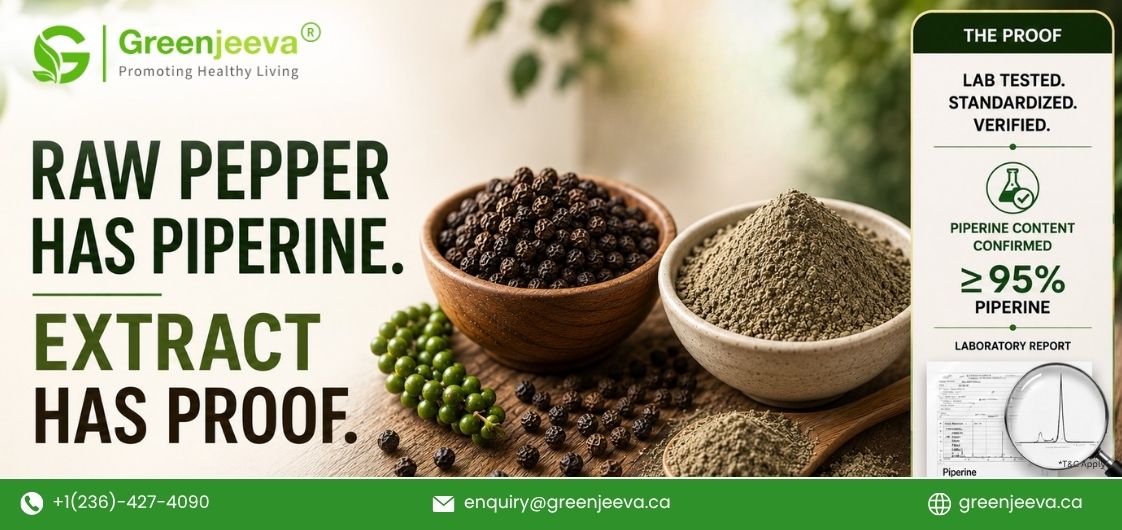
Ground black pepper and black pepper extract powder 95% piperine come from the same fruit, but they are not interchangeable ingredients. Raw black pepper naturally contains piperine, the compound responsible for its pungency, but at a low and inconsistent level. Black pepper extract powder is processed specifically to concentrate and standardize that compound to a guaranteed minimum, verified by lab testing on every batch.
For formulators, that difference is not academic. It is the reason a spec sheet, not a spice jar label, is the correct reference point when sourcing piperine as a functional ingredient.
Raw Black Pepper vs. Standardized Piperine Extract
Whole or ground black pepper (Piper nigrum) typically contains somewhere in the range of 2% to 7% piperine by weight, and that figure varies significantly depending on growing region, harvest conditions, and processing. There is no guarantee attached to a bag of culinary black pepper. It was never intended to be standardized.
Black pepper extract 95% piperine is a different category of product entirely. It starts with the same fruit but goes through an extraction and concentration process designed to isolate piperine and remove the bulk of the surrounding plant material, fiber, and volatile oils. The result is a standardized piperine extract with a defined, tested minimum, in this case NLT 95% w/w, confirmed by HPLC on each lot rather than assumed from the raw material.
This is the core distinction buyers need to understand: raw black pepper gives you piperine incidentally, standardized extract gives you piperine by design.

What the 95% Piperine HPLC Assay Confirms
A "95% piperine HPLC" spec is not a single number, it is a documented test result with a defined method behind it.
- Assay method. Piperine content should be reported as NLT 95.0% w/w, tested by HPLC (high-performance liquid chromatography). HPLC is the correct method for piperine specifically because it separates and quantifies the compound directly, rather than estimating total alkaloid content through a less specific assay.
- Identification testing. A complete spec sheet lists piperine identification as its own line item, confirmed by HPLC, separate from the percentage assay. This confirms the compound present is piperine itself, not a related alkaloid being reported under the same number.
- NLT as a floor. "Not less than 95%" sets the guaranteed minimum for that lot. Buyers should expect results at or slightly above this threshold, not treat 95% as an exact fixed figure.
If a supplier lists "95% piperine" without naming HPLC as the test method, or without a separate identification result, that is worth a direct question before ordering.
Reading the Rest of the Spec Sheet
Beyond the piperine assay, a complete spec sheet for black pepper extract powder should cover three additional categories.
Physical analysis
- Description, color, odor, and taste. Confirmed through organoleptic testing. Standardized piperine extract typically presents as a powder ranging from light greenish to creamy white, a useful visual reference for consistency checks between lots.
- Mesh size. Look for a defined figure, such as NLT 95% passing through an 80-mesh screen, rather than a general "fine powder" description.
- Loss on drying. Reported as a maximum percentage, commonly NMT 10%. Controls moisture-related clumping and supports shelf stability.
Heavy metals Total heavy metals should be reported against a defined ceiling (commonly NMT 10 ppm), broken down individually for lead, arsenic, mercury, and cadmium, each against its own specific limit, rather than a single bundled result.
Microbiology A complete panel lists total plate count, yeast and mold, E. coli, Salmonella, Staphylococcus aureus, and coliforms as separate line items, each with a numeric limit or a clear absent result, not folded into one generic "microbial testing: pass."
Shelf life A defined shelf life, commonly 36 months for black pepper extract powder when stored correctly, should be stated directly on the spec sheet.
At Green Jeeva, every lot of black pepper extract powder is backed by full lot-level traceability, so the documentation you review before ordering reflects the specific batch you receive, not a general product average.
Why Extraction Standardization Matters for Formulators
For a piperine ingredient supplier, standardization is not a marketing distinction, it is what makes a formulation repeatable. A supplement or functional food product built around raw black pepper would carry piperine content that shifts with every new batch of raw material, making consistent dosing across production runs effectively impossible.

Black pepper extract for supplements solves this by fixing piperine content to a tested, documented minimum. That consistency is what allows a formulator to set a dose, submit it for label claims, and reproduce it reliably across every subsequent production run, without re-testing raw material variability into the finished product.
Sourcing Black Pepper Extract Powder in Bulk
For buyers evaluating a bulk black pepper extract supplier, sourcing decisions typically come down to documentation, MOQ, and how easily a batch can be trialed before scaling.
Green Jeeva Canada supplies black pepper extract powder with an MOQ starting at 25kg, making it practical for formulators to trial a batch against their own specifications before committing to a larger production run. Product ships from warehouses in Surrey and Pantos, with same-day dispatch on in-stock inventory and free samples available on request.
As a 95% piperine powder supplier serving manufacturers across supplement, functional food, and nutraceutical applications, Green Jeeva provides full batch documentation, including HPLC assay results, with every quote. For buyers sourcing piperine extract wholesale or comparing multiple black pepper extract supplier Canada options, that level of documentation upfront removes most of the back-and-forth that typically slows down a first order. Registered buyers can also review live inventory and pricing directly through our B2B platform.
Conclusion
Piperine content is not a fixed property of black pepper; it is a processed and tested specification. Before sourcing black pepper extract powder 95% piperine in bulk, confirm the assay method is HPLC, request a batch-specific spec sheet, and verify identification testing is listed separately from the percentage result. That documentation is what separates a standardized ingredient from a raw material assumption.