How to Read a Spec Sheet for Chaga Mushroom Extract Powder 50% Polysaccharide
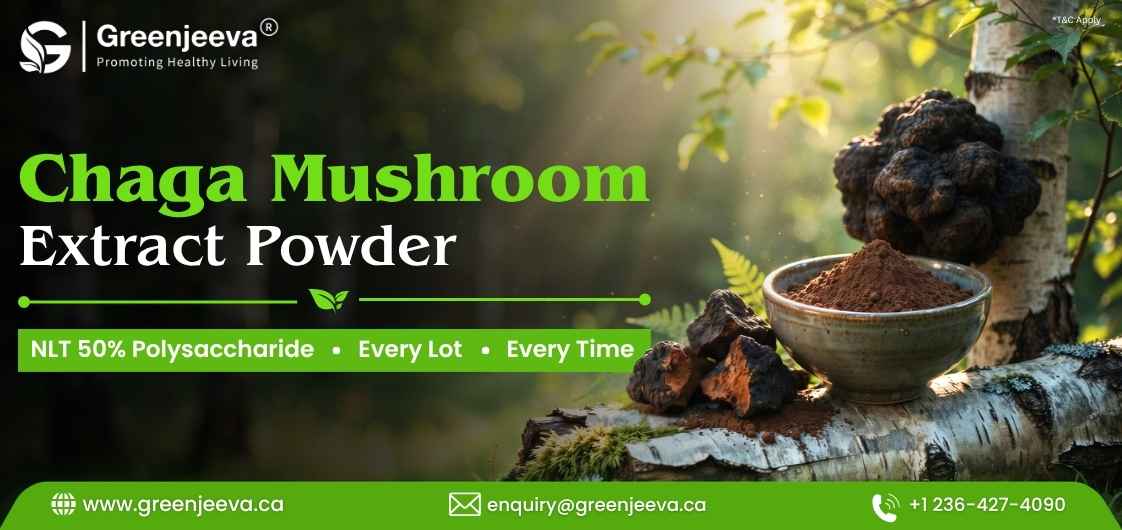
Most buyers evaluating Chaga Mushroom Extract Powder 50% Polysaccharide start in the wrong place. They compare price per kilogram first and read the spec sheet second, if at all. That order causes problems. A spec sheet is the only document that tells you what you are buying: how the polysaccharide content was measured, what part of the mushroom was extracted, and whether the batch you receive will match the batch you tested.
This guide walks through a Chaga extract spec sheet section by section, so you know what each number means and which ones deserve a follow-up question before you place an order.
What Is Chaga Mushroom Extract Powder 50% Polysaccharide?
Chaga mushroom extract powder is produced from Inonotus obliquus, a fungus that grows on birch trees in cold climates. Unlike raw Chaga mushroom powder, which is simply the dried and milled fruiting body, Chaga fruiting body extract goes through a concentration process. The goal is to isolate and increase the proportion of specific compounds, primarily polysaccharides, relative to the fiber and inert material present in the whole mushroom.
A "50% polysaccharide" designation means the finished powder has been tested to contain approximately 50% polysaccharide content by weight, using a defined assay method. This is a specification, not a marketing figure, and it should be traceable to a certificate of analysis (COA) for the specific lot you are purchasing.

Why Is Polysaccharide Percentage the First Number to Check
The polysaccharide percentage is the headline spec on nearly every Chaga extract listing, but it is also the number most often misunderstood.
A few things buyers should confirm before treating "50%" as a fixed guarantee:
- Test method matters. Polysaccharide content can be measured using different assay methods, and results vary depending on which method a supplier uses. On a properly documented spec sheet, the assay is listed as NLT 50% (not less than 50%), tested by UV spectrophotometry, not just stated as a flat number with no method attached.
- Polysaccharides are not the same as beta glucans. Chaga beta glucan content is a subset of total polysaccharide content, not a synonym for it. If your formulation requires a specific beta glucan level, request that figure separately rather than assuming it is included in the polysaccharide percentage.
- NLT means a floor, not a fixed number. "Not less than 50%" tells you the minimum guaranteed potency for that lot. It is normal and expected for actual tested results to run at or slightly above this threshold, not exactly at it.
If a spec sheet lists a polysaccharide percentage with no test method and no COA reference, that is a gap worth asking about before you commit to a purchase order.
Extraction Ratio and Extract Type
The extraction ratio, commonly listed as 10:1 on a Chaga extract spec sheet, tells you how much raw Chaga fruiting body was used to produce one unit of finished extract and is typically confirmed through TLC (thin-layer chromatography) testing. A higher ratio generally indicates a more concentrated starting process, but ratio alone does not confirm potency. Two suppliers can list the same 10:1 ratio and produce Chaga mushroom powder extract with meaningfully different polysaccharide readings, depending on extraction method and raw material quality, which is exactly why the ratio and the polysaccharide assay need to be read together, not in isolation.
Two extraction approaches are common in the market:
- Water extraction, which pulls out water-soluble polysaccharides and is the more common method for food and supplement-grade Chaga extract.
- Water-ethanol or dual extraction, which targets a broader range of bioactive compounds, including some that are not water-soluble.
Neither method is inherently better. What matters is that the method matches your intended application and that the supplier can explain which one was used and why. A spec sheet that only lists "extract" without specifying method or ratio is incomplete for sourcing purposes.
Reading the Rest of the Spec Sheet
Beyond polysaccharide percentage and extraction ratio, a complete spec sheet for a functional mushroom ingredient should cover four categories.
Physical analysis
- Description, color, odor, and taste. Typically confirmed through organoleptic testing. A Chaga extract powder should present as a brown powder with a characteristic odor and taste, tested consistently between lots.
- Mesh size. Look for a defined figure, such as 95% passing through an 80-mesh screen, rather than a vague "fine powder" description. This determines how the powder behaves in your specific formulation, whether that is a capsule, powder blend, or beverage application.
- Loss on drying. Reported as a maximum percentage, commonly NMT 10% (not more than 10%). Higher moisture content increases the risk of clumping and reduces shelf stability.
- Total ash. Also typically capped at NMT 10%, an indicator of mineral residue and processing consistency.
Heavy metals: A complete spec sheet reports total heavy metals against a defined ceiling (commonly NMT 10 ppm), then breaks that figure down individually for lead, arsenic, mercury, and cadmium, each with its own limit, rather than a single combined "pass" result.
Microbiology: Total plate count, yeast and mold, E. coli, and Salmonella should each appear as separate line items with numeric limits or a clear negative result, not bundled into one generic "microbial testing: pass" line.
Shelf life and storage A defined shelf life, commonly 36 months for Chaga extract powder when stored correctly, should be listed alongside recommended storage conditions.
At Green Jeeva, every lot of Chaga mushroom extract powder is backed by full lot-level traceability, so the COA you review before ordering reflects the actual batch you receive, not a general product average. That consistency is what allows buyers to build repeatable formulations without re-testing every incoming shipment from scratch.
Common Spec Sheet Red Flags for Buyers
A spec sheet does not need to be long to be useful, but it does need to be specific. Watch for:
- A polysaccharide percentage with no test method listed, instead of a clear NLT figure backed by UV assay
- No COA available on request, or a COA that is not batch-specific
- Extraction ratio listed without a confirming test method such as TLC
- Heavy metals reported as one combined "pass" instead of broken down by lead, arsenic, mercury, and cadmium
- Microbiology results bundled together instead of listed individually (total plate count, yeast and mold, E. coli, Salmonella)
- No mesh size, loss on drying, or total ash figures included
- Inconsistent terminology between the spec sheet and the product label, such as switching between "extract" and "powder" without clarification
Any one of these on its own is not necessarily disqualifying, but a spec sheet with several of these gaps is worth a direct conversation with the supplier before purchase.

Sourcing Chaga Mushroom Extract Powder in Bulk
For buyers looking for a bulk Chaga mushroom extract supplier, sourcing decisions usually come down to three factors beyond the spec sheet itself: minimum order quantity, sample availability, and how quickly a supplier can confirm lot-specific documentation.
Green Jeeva Canada supplies wholesale Chaga mushroom extract powder from warehouses in Surrey and Pantos, with same-day dispatch on in-stock inventory. Free samples are available so you can verify polysaccharide content, solubility, and appearance against your own specifications before committing to a bulk order. Low MOQ options make it practical to test a lot before scaling into a full production run.
As a Chaga mushroom extract powder supplier for manufacturers across food, beverage, and supplement applications, Green Jeeva provides full documentation, including COAs, with every quote, so buyers can evaluate a batch on paper before it ships. Registered buyers can also review live inventory and pricing directly through our B2B platform, which simplifies how to source Chaga mushroom extract powder in bulk without repeated back-and-forth over documentation.
The Bottom Line
A spec sheet is a starting point for a conversation, not a substitute for one. Before ordering Chaga Mushroom Extract Powder 50% Polysaccharide in bulk, confirm the test method behind the polysaccharide figure, understand the extraction method used, and request a batch-specific COA. Suppliers who provide that documentation without hesitation are generally the ones worth building a long-term sourcing relationship with.