Sourcing Standardized Green Tea Extract Powder: A B2B Buyer's Guide for Canadian Manufacturers
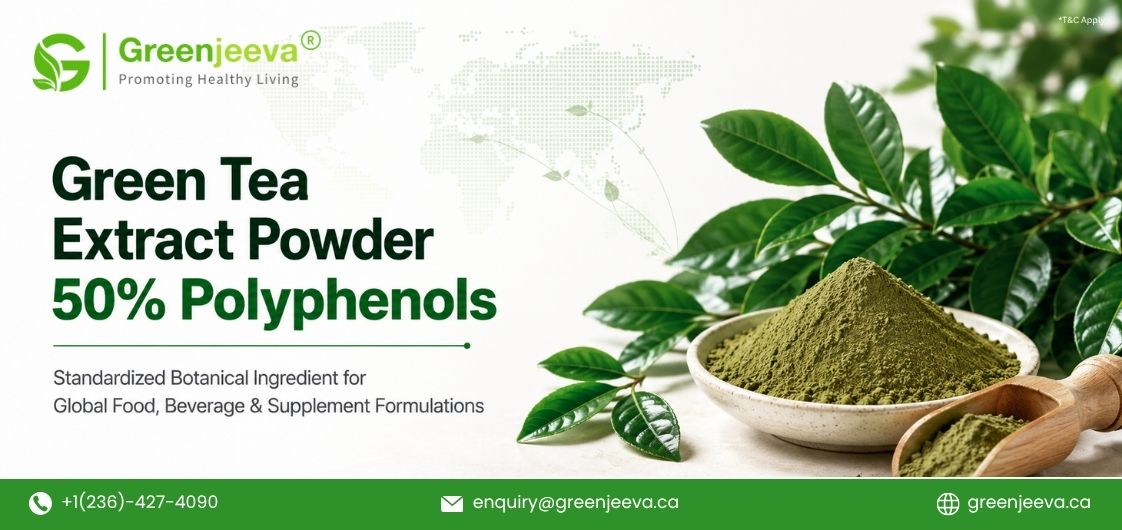
Green Tea Extract Powder 50% Polyphenols is a standardized botanical ingredient derived from the leaves of Camellia sinensis, designed for manufacturers seeking consistent polyphenol content across commercial formulations. With a defined 50% polyphenol standardization, this fine powder provides a practical alternative to working with unstandardized green tea leaf materials, where natural composition can vary by cultivar, harvest, origin, and processing conditions.
For manufacturers sourcing bulk green tea extract powder in Canada, Green Jeeva Inc. supports commercial procurement with a 25 kg MOQ, 25 kg food-grade bulk packaging, batch-level quality documentation, and sourcing support. The product is positioned for formulation-driven applications across nutraceuticals, functional foods and beverages, dietary supplement systems, botanical blends, and other ingredient-based product categories.
Why Standardization Matters in Green Tea Extract Powder
Green tea is a globally sourced botanical, and its composition can be influenced by cultivation environment, harvest timing, processing, and storage. For industrial buyers, simply purchasing dried tea leaves does not necessarily provide the compositional consistency required for repeatable manufacturing.
A 50% polyphenol specification gives formulation and procurement teams a defined quality benchmark. Instead of relying only on raw-material identity, buyers can evaluate each lot against a measurable specification.
This is particularly useful when a finished product needs to maintain a consistent ingredient profile across multiple production runs. Standardization can also simplify formulation calculations, supplier qualification, incoming quality checks, and batch-to-batch comparison.
Green Jeeva's product is derived from Camellia sinensis leaves and supplied as a fine food-grade powder standardized to 50% polyphenols.

Global Sourcing: Why Origin and Climate Matter
Green tea is cultivated across different climatic zones, particularly in Asian tea-producing regions. Climate has an important role in agricultural consistency because temperature, rainfall, sunlight exposure, elevation, soil conditions, and seasonal changes can influence plant growth and harvesting patterns.
For international procurement teams, this makes supplier traceability and specification control particularly important.
For example, a manufacturer sourcing green tea extract for a Canadian beverage powder may prioritize:
Consistent polyphenol specification
Reliable year-round availability
Batch-specific Certificate of Analysis
Microbiological and heavy-metal testing
Documented botanical identity
Suitable bulk packaging
Import and regulatory documentation
A buyer in a humid tropical region may place greater emphasis on moisture control and packaging integrity, while a manufacturer operating in a cold, dry climate may focus more heavily on warehouse temperature transitions and condensation during transportation.
The practical lesson is that sourcing should not stop at the country of origin. Climate exposure, processing controls, transportation conditions, storage, and lot documentation all contribute to ingredient consistency.

Applications Across Food, Beverage, and Ingredient Industries
Green Tea Extract Powder 50% Polyphenols can be incorporated into a range of formulation systems where standardized botanical ingredients are required.
Functional Beverage Formulations
Green tea extract can be evaluated for powdered drink mixes, tea-based beverage systems, ready-to-mix formulations, and other beverage concepts. Formulators should assess dispersion, taste profile, colour, pH compatibility, and processing conditions during pilot trials.
For example, a beverage manufacturer developing a green tea powder blend may first test several inclusion rates and then evaluate the final product after processing and storage rather than relying only on the raw ingredient specification.
Nutraceutical and Dietary Supplement Formulations
The standardized powder format can be considered for capsules, tablets, sachets, powder blends, and other ingredient systems. Manufacturers should select the appropriate specification based on the finished product's formulation, regulatory category, serving size, and required analytical parameters.
Green tea supplements are a broad product category, but the extract specification should always be matched to the finished formulation rather than selected solely because of its botanical name.
Clean-Label Ingredient Systems
For brands developing recognizable botanical ingredient systems, green tea extract provides a concentrated Camellia sinensis ingredient in a convenient powder format.
Buyers interested in organic green tea extract powder should verify that the specific lot and certification meet the requirements of their intended application rather than assuming that all green tea extracts carry the same certification status.
Botanical Blends
Green tea extract can also be evaluated alongside other botanical extracts in powdered formulations. Standardized ingredients can help R&D teams establish clearer formulation benchmarks when multiple botanical components are combined.
Practical Sourcing Checklist for Canadian Buyers
When evaluating a green tea extract powder supplier, procurement teams should request more than a price quotation.
Before approving a supplier, consider requesting:
Certificate of Analysis (CoA): Confirm the stated polyphenol specification and applicable batch results.
Botanical identification: Verify Camellia sinensis and the plant part used.
Microbiological testing: Review applicable microbial parameters.
Heavy-metal testing: Confirm testing requirements for the target market and application.
Allergen and non-GMO documentation: Obtain declarations where relevant.
Extraction information: Understand the extraction process and any applicable solvent documentation.
Country of origin: Confirm the source and traceability requirements.
Packaging specification: Evaluate packaging against transportation and warehouse conditions.
Shelf-life information: Review the applicable batch specification and storage conditions.
Sample evaluation: Test the material in the actual formulation before committing to larger volumes.
Green Jeeva's Canadian product listing indicates availability of batch-specific CoAs, product specifications, allergen documentation, and quality screening information.
Bulk Green Tea Extract Powder in Canada
For Canadian manufacturers, buying green tea extract powder wholesale can provide a more practical procurement route than repeatedly purchasing small quantities for production.
Green Jeeva currently lists this ingredient with a 25 kg MOQ and 25 kg commercial food-grade packaging, making it suitable for both formulation trials and larger B2B procurement requirements.
For recurring production, buyers should compare suppliers on more than unit price. Total sourcing value can include documentation availability, consistency between lots, lead time, packaging, sample support, technical communication, and the ability to support future volume requirements.
For companies planning to export green tea extract powder, the required documentation should also be evaluated against the destination market before shipment. Import requirements can differ significantly between Canada, the United States, Europe, Asia-Pacific, and other markets.
Regulatory Considerations for Canadian Formulators
Canadian manufacturers should determine whether their finished product is regulated as a food, supplemented food, natural health product, or another category before making product representations.
Health Canada has established specific requirements for green tea extract when used as a supplemental ingredient in certain supplemented foods, including conditions related to EGCG, total catechins, caffeine, and required cautionary statements.
This is important because a raw-material specification such as “50% polyphenols” should not automatically be interpreted as authorization for a particular finished-product claim or use.
For NHPs, Health Canada's current guidance also emphasizes compliant labeling and authorized uses, while Canadian food claims are subject to applicable regulatory requirements.
Therefore, manufacturers should validate the finished formulation, dosage, intended representation, and market-specific requirements with their regulatory team before commercialization.
Why Choose Green Jeeva for Bulk Green Tea Extract Powder?
Green Jeeva Inc. supports Canadian buyers looking for a structured B2B supply option for standardized botanical ingredients. The current product specification identifies 50% polyphenols, food-grade powder, 25 kg packaging, and a 25 kg MOQ, with documentation and procurement support available.
For R&D teams, requesting a sample before commercial purchasing can help verify color, taste, dispersion, processing compatibility, and finished-product performance under actual manufacturing conditions.
For procurement teams, establishing specification requirements before requesting quotations can also make supplier comparisons more meaningful.
Actionable Takeaway
For manufacturers sourcing bulk green tea extract powder in Canada, the most important decision is not simply choosing the lowest-cost supplier. Start with a defined specification, confirm the 50% polyphenol standardization, review batch documentation, evaluate climate and transportation considerations, test a sample in the intended formulation, and confirm the regulatory requirements of the destination market.
For commercial sourcing, Green Jeeva's Green Tea Extract Powder 50% Polyphenols provides a standardized Camellia sinensis ingredient in a 25 kg commercial format with a 25 kg MOQ and documentation support.
Request a sample or bulk quotation from Green Jeeva to evaluate Green Tea Extract Powder 50% Polyphenols for your next formulation or commercial production requirement.