Organic Superfood Powders: A Buyer's Guide to Canada's Top 5 and How to Choose a Supplier
"Superfood" isn't a regulated term. It's a marketing category that groups together nutrient-dense fruits, leaves, algae, and roots based on consumer demand, not a scientific or legal classification.
That matters for bulk buyers, because two suppliers can both call something a "superfood powder" while differing significantly in species, processing method, and documentation. This guide covers five of the most established organic superfood powders in the Canadian market and what to check before qualifying a supplier for any of them.
What Makes a Powder a "Superfood"
The term generally applies to nutrient-dense plant or algae ingredients marketed around antioxidant, vitamin, or mineral density. There's no Health Canada category called "superfood," so any specific health claim on a finished product still needs to trace back to that ingredient's own Natural Health Products Ingredients Database (NHPID) monograph, not the general "superfood" label.
That's the same principle covered in our adaptogen guide: the category name is a useful shorthand for buyers, but it isn't a compliance claim on its own.

Canada's Top 5 Organic Superfood Powders
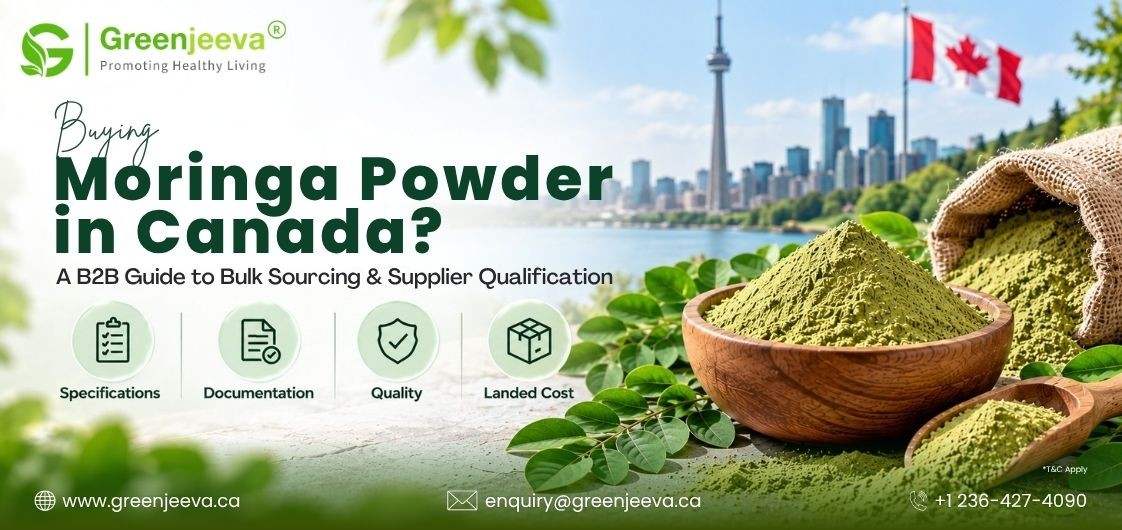
Organic Moringa Leaf Powder
Moringa (Moringa oleifera) is one of the most recognized superfood powders in the Canadian market, valued for its dense vitamin, mineral, and protein content relative to its weight. Green Jeeva's Organic Moringa Leaf Powder is produced from the dried, milled leaf of the plant.
It's commonly used in green smoothie blends, functional beverages, and encapsulated supplements.
Organic Matcha Tea Powder
Matcha is stone-ground green tea leaf (Camellia sinensis), consumed whole rather than steeped and discarded like standard tea. Green Jeeva's Organic Matcha Tea Powder supports this whole-leaf consumption, which is why matcha delivers a higher concentration of tea polyphenols than an equivalent cup of steeped green tea.
Color is a genuine quality indicator here: a vivid, uniform green suggests good shading and processing during cultivation, while a dull or yellowish tone often signals lower-grade leaf or oxidation.
Organic Spirulina Powder
Spirulina is a blue-green algae (Arthrospira platensis) valued for its plant-based protein and phycocyanin content, the pigment-protein compound responsible for its color and much of its antioxidant reputation. Green Jeeva's Organic Spirulina Powder is cultivated and dried into a fine powder for food, beverage, and supplement use.
Spirulina is grown in controlled aquaculture systems rather than harvested from open water, which is a meaningful traceability point, since cultivation conditions directly affect contaminant risk.
Organic Maca Root Powder
Maca (Lepidium meyenii) is a root vegetable native to the high-altitude Andes region of Peru, traditionally used for energy and vitality support. Green Jeeva's Organic Maca Root Powder is produced from the dried, milled root.
Maca comes in yellow, red, and black varieties, which some research associates with slightly different compound profiles; buyers should confirm which variety, or blend, a given batch represents rather than assuming they're interchangeable.
Organic Acai Berry Powder
Acai (Euterpe oleracea) is a Brazilian palm berry prized for its anthocyanin content and antioxidant reputation, commonly used in smoothie bowls and functional beverages. Green Jeeva's Organic Acai Berry Powder is produced from the dried fruit pulp.
Acai is highly perishable fresh, so drying method and speed from harvest to processing affect how much of its natural pigment and nutrient content survives into the powder, similar to the drying sensitivity we've covered for other pigmented fruit powders.

A Sixth Worth Mentioning: Organic Chlorella Powder
Chlorella is a single-celled green algae, related to spirulina in reputation but a genuinely different organism with a tougher cell wall that requires specific processing to make its nutrients bioavailable. Green Jeeva's Organic Chlorella Powder rounds out Green Jeeva's algae-based superfood offering alongside spirulina.
Buyers should confirm whether the chlorella has been cell-wall broken (cracked) during processing, since unbroken chlorella is poorly digested regardless of its nutrient content on paper.
What to Check Before Choosing a Superfood Powder Supplier
A few checks apply across this entire category, regardless of which specific powder you're sourcing:
- Species confirmed by Latin binomial, not just the common marketing name
- Current organic certification specific to the batch, aligned with the Canada Organic Regime
- Heavy metals screening, particularly relevant for algae-based powders like spirulina and chlorella, which can concentrate contaminants from their growing environment
- Microbiological testing results
- Moisture content and particle size or mesh specification
- For pigmented powders like matcha and acai, some indication of drying method or processing speed, since color and pigment retention are genuine quality signals, not just cosmetic ones