Organic Cauliflower Powder for Clean-Label and Gluten-Free Food Manufacturing in Canada
Summary, the quick version
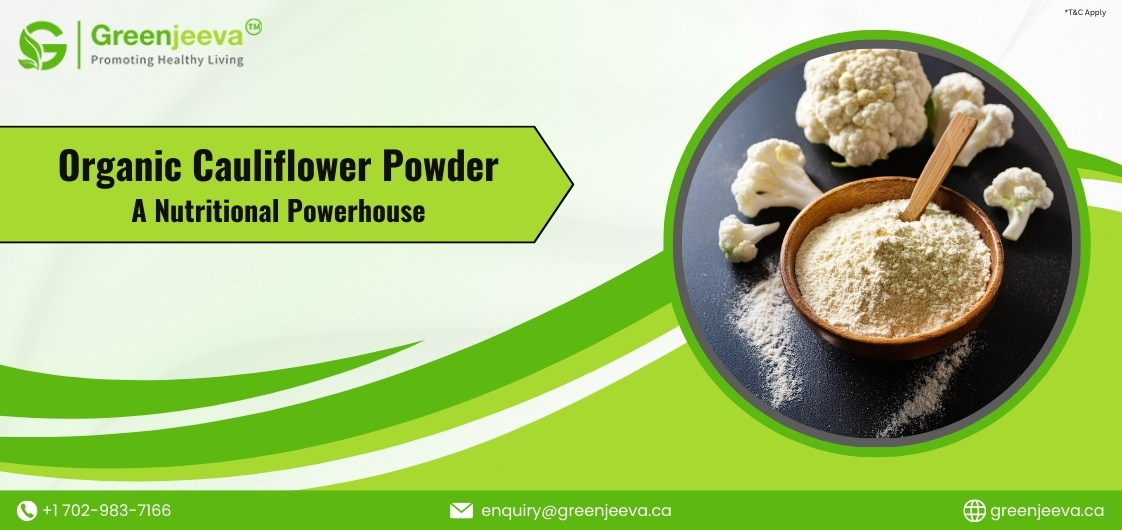
Organic cauliflower powder is dehydrated cauliflower, Brassica oleracea, milled into a fine, single-ingredient vegetable powder.
Manufacturers use it to add real vegetable content in a clean-label, shelf-stable form and as a gluten-free and grain-free ingredient.
Compared with fresh cauliflower, the powder is consistent, available year-round, and free of prep and waste.
It blends into gluten-free baking, snacks, soups, sauces, seasonings, and plant-based products.
Green Jeeva Canada supplies it in bulk with certification and documentation. Request a free sample and place a bulk order quotation on the website, with same-day dispatch from the Surrey and Pantos warehouses in Canada.
Cauliflower has moved from a side dish to a formulation tool, and in powder form it gives food manufacturers a clean-label way to build vegetables into a product. This guide is written for food and bakery manufacturers, product developers, and procurement teams in Canada. It focuses on the formulation and supply benefits of organic cauliflower powder, how it compares with fresh cauliflower, where it fits, and how to source it, rather than on nutrition claims, which belong to the finished product and its maker.
What Organic Cauliflower Powder Is
Organic cauliflower powder is made by dehydrating cauliflower, Brassica oleracea, and milling it into a fine powder. It is a single-ingredient vegetable powder with a mild flavor and a pale color. Dehydration makes it shelf-stable and consistent, so a manufacturer can use real cauliflower in a dry, easy-to-handle form all year round.
Cauliflower is a cruciferous vegetable, and the powder is simply the whole vegetable in a dried, milled form. Because it is a single ingredient with no additives, it fits a clean-label ingredient list where a short, recognizable declaration matters. It sits in the wider category of organic vegetable powders, alongside other dehydrated vegetables that manufacturers use to add color, flavor, and vegetable content to a formula.
Why Food Manufacturers Use Cauliflower Powder
Manufacturers use cauliflower powder to add real vegetable content in a clean-label, shelf-stable form. It works as a gluten-free and grain-free ingredient, blends into many formats, and brings a mild flavor and a pale color. It also removes the prep, waste, and seasonality of fresh cauliflower, which simplifies production and supply.
The benefits that matter to a food manufacturer are practical and commercial rather than nutritional.
Real vegetable content in a product, supporting a veggie-forward positioning.
A clean-label, single-ingredient declaration with no additives.
Gluten-free and grain-free, useful as a flour alternative and in grain-free formats.
A mild flavor and a pale color that blend into many products without dominating.
Shelf-stable and consistent, so it stores and doses predictably.
Plant-based and vegan-friendly, matching modern product ranges.
Convenient handling, with no washing, cutting, or cooking and far less waste than fresh.
In other words, cauliflower powder lets a brand put vegetables into a product while keeping the label clean and the supply chain simple. That combination is why dehydrated vegetable powders have become a standard tool in modern food development.
Dehydrated Powder vs Fresh Cauliflower for Manufacturing
For a manufacturer, dehydrated cauliflower powder solves problems that fresh cauliflower creates. The powder is shelf-stable, available year-round, and free of prep and waste, and it doses by weight for repeatable results. Fresh cauliflower is perishable, seasonal, and variable, which makes it harder to run at production scale.
None of this makes fresh cauliflower worse as a food. It simply means that for a manufacturer running the same product repeatedly, a dried powder is far easier to source, store, and formulate with. The powder turns a seasonal vegetable into a stable ingredient.

Where Cauliflower Powder Fits in a Formulation
Cauliflower powder is versatile, appearing across gluten-free baking, snacks, savory products, and plant-based ranges. Its mild flavor and pale color let it add vegetable content without taking over a recipe, which is why it shows up in so many formats.
Gluten-Free Baking and Flour Blends
In gluten-free and grain-free baking, cauliflower powder is blended with flours and starches to add vegetable content and a soft color. It pairs naturally with a grain-free base such as organic cassava flour in flour blends.
Snacks, Crackers, and Extruded Products
Cauliflower powder suits crackers, baked chips, and extruded snacks, where it adds a vegetable identity and a clean-label story. It carries seasonings well and blends evenly into a dry snack base.
Soups, Sauces, and Seasonings
This is a natural home for cauliflower powder. It dissolves into soups, sauces, and dry seasoning blends, adding body, a mild flavor, and vegetable content without the prep of fresh cauliflower.
Plant-Based and Veggie-Forward Products
In plant-based and veggie-forward products, cauliflower powder helps a brand build vegetables into the formula and the label. Its mild profile blends with other vegetable powders, such as organic beetroot powder, for color and variety.
How Cauliflower Powder Behaves in a Formula
Cauliflower powder is easy to work with, but it does have a few behaviors to plan for. It absorbs liquid, carries a mild flavor and a pale color, and blends cleanly into dry systems. Getting the inclusion level and the hydration right is the main tasks when you formulate with it.
- It absorbs liquid, so hydration may need adjusting when you add it to a batter or dough.
- Its flavor is mild, so it adds a gentle savory note rather than dominating a recipe.
- Its color is pale, so it blends without strongly changing the look of most products.
- It blends cleanly into dry premixes and flour blends.
- Start at a low inclusion, test, and build up to the level your product needs.
In savory applications, the powder can also be rehydrated back toward a soft, puree-like texture, which suits soups, sauces, and fillings. In dry applications it stays a free-flowing powder that blends with flours and seasonings. Knowing which behavior you want, a dry blend or a rehydrated paste, helps you decide where to add it in the process and how much liquid to allow. As a rule, add it early where you want it fully hydrated and later where you want it to keep a drier, more textured character.
Because performance depends on the format, treat any starting level as a trial point. A little bench work on inclusion and hydration is the fastest route to a result you can repeat at production scale.
What to Look for When Sourcing Organic Cauliflower Powder
A clear specification makes cauliflower powder easy to qualify. For a food manufacturer, the points that matter are the organic status, the single-ingredient nature, the particle size, and the safety and quality panels. Confirm each on the specification and the certificate of analysis before you approve a supplier.
Organic certification, matched to the claim you plan to make.
A single-ingredient powder with no additives or fillers.
A consistent particle size, since it affects blending and texture.
Moisture, since it affects both shelf life and handling.
Allergen and gluten status, documented for your label.
Heavy metal and microbiological limits with USP test methods.
Traceability to the source, so the paperwork ties to the lot.
Writing these into the purchase specification gives your QA team a clear pass or fail at goods-in and shortens supplier validation.
Sourcing Organic Cauliflower Powder from Green Jeeva Canada
Green Jeeva Canada supplies organic cauliflower powder for clean-label and gluten-free food manufacturing, backed by certification and documentation. You can qualify a sample, then scale to a bulk order, with logistics built for both. Here is what a procurement team needs to know.
A single-ingredient organic cauliflower powder made from Brassica oleracea, naturally gluten-free and grain-free.
Green Jeeva Canada is COR, FDA, Halal, Kosher, GMA, and CFIA certified, and the material is fully traceable.
Heavy metals and microbiology are tested by USP methods, with a certificate of analysis for each lot.
Available in bulk pack sizes suited to both pilot batches and production runs.
A free sample is available, and a bulk order quotation can be placed on the website.
A zero-questions-asked return policy backs your first order.
Stock ships same day from the Surrey and Pantos warehouses in Canada.
Documents and certificates download after registration.
Review the certificate of analysis for the specific lot before you formulate, and confirm the organic, allergen, and gluten documentation against the claims you intend to make on the finished product.
Ready to source bulk organic cauliflower powder in Canada?
View stock, the pricing structure, compliance documents, MOQ, and pack size on the website, request a free sample, and place a bulk order quotation with Green Jeeva Canada.
Organic cauliflower powder is supplied by Green Jeeva Canada as a raw ingredient for food and beverage manufacturing. Finished-product claims, including any nutrition or gluten-free label claim, should be verified and substantiated by the manufacturer and comply with applicable regulations in the target market. This article is written by the Green Jeeva Canada QA and RA team for sourcing and formulation guidance.