
Certified Organic Chickweed Powder for Tea, Food, and Beverage Formulation in Canada
Summary, the quick version
Chickweed shows up in more herbal tea blends than most people realize, usually without any fanfare.
Because chickweed, Stellaria media, is traditionally a wild-foraged plant, an organic certification for it means something specific and worth understanding before you rely on the claim.
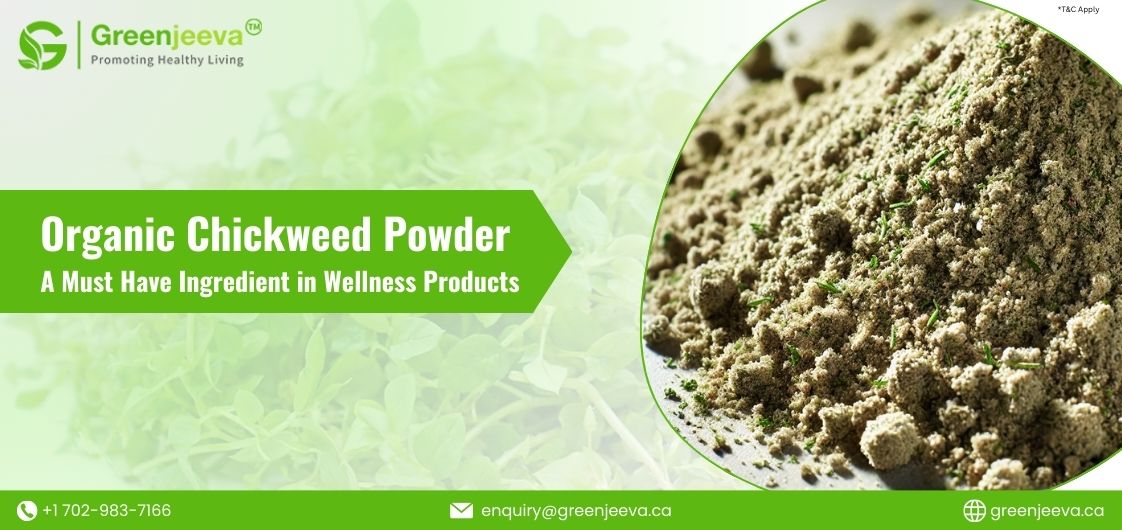
Organic chickweed powder is milled from the dried aerial parts of the plant and works well across tea, food, beverage, and supplement formats thanks to its mild flavor.
Green Jeeva Canada sources certified organic chickweed powder under the same documentation standard applied across its full ingredient portfolio.
Request a free sample and place a bulk order quotation on the website, with dispatch from the Surrey and Pantos warehouses in Canada.
If you have ever sipped a mixed herbal tea from a health food shop, there is a fair chance chickweed was quietly part of the blend. It does not announce itself the way a bright floral or a strong spice would. It sits in the background, contributing a mild, green note, which is exactly why it works so well as a formulation ingredient rather than a headline flavor.
This guide is written for tea, food, beverage, and supplement manufacturers in Canada sourcing certified organic chickweed powder. It focuses on a question that matters more for this ingredient than for most, what an organic certification actually requires for a plant that has traditionally been foraged rather than farmed, and it covers where the powder fits across formats, what to confirm on a specification, and how to source it with confidence.
Organic Chickweed Powder Starts With the Same Question as Any Organic Claim
Before organic chickweed powder is anything else on a formulation brief, it is a botanical carrying an organic claim, and that claim is only as strong as the paperwork behind it. This guide treats that documentation question as the main event, since it matters more for chickweed than for most other organic botanicals.
As a powder, chickweed carries a mild, slightly green flavour and a fine, workable texture, which is why it blends into tea, food, beverage, and supplement formats without dominating them. That mildness is useful, but it is not the reason this guide exists. The reason is what comes next.
What Organic Actually Means for a Traditionally Wild-Foraged Plant
Most organic certifications assume a cultivated crop, grown under a controlled organic protocol with documented inputs and land history. Chickweed complicates that picture slightly, since it has traditionally been gathered from the wild rather than grown as a dedicated crop. For a genuinely certified organic chickweed powder, the material needs to come from cultivation under an organic program, not simply be collected from an untreated wild patch.
This distinction is worth understanding before you rely on an organic claim for this specific ingredient. Wild-collected material, even if never treated with synthetic inputs, does not automatically qualify for organic certification, since certification depends on documented land management and input history that wild collection typically cannot provide. When you are sourcing a certified organic chickweed powder, ask your supplier directly whether the material is cultivated under an organic program and request the certification documentation, rather than assuming an untreated, wild origin is equivalent to a certified organic one. The two claims sound similar to a casual reader, but they rest on very different levels of documentation.
Where Organic Chickweed Powder Fits Across Formats
Chickweed's mild flavor and fine texture give it a genuine fit across tea, food, beverage, and supplement formats. Green Jeeva supplies the raw material, and the manufacturer owns any claim about the finished product.
Herbal Tea Blends
This is one of the most natural homes for chickweed powder or cut herb, since its mild flavour blends easily with other botanicals in a tea formulation without overpowering the rest of the blend. In a finished tea product, chickweed typically plays a supporting role rather than a lead one, contributing body and a green note alongside more assertive botanicals like mint, hibiscus, or citrus peel, which is exactly why it turns up in so many blends without consumers necessarily noticing it by name.
Food and Beverage Formulations
In food and beverage applications, chickweed powder can be incorporated as a botanical ingredient in green blends, smoothie powders, and similar formats where a mild-flavoured, plant-based ingredient fits the recipe.
Dietary Supplements
As a whole herb powder, chickweed also works in capsule, tablet, and powder blend supplement formats, where it is valued as a single, recognizable botanical ingredient on the label.
Certified Organic Chickweed as a Clean Label Ingredient
A single-ingredient, certified organic chickweed powder supports a clean label formulation, since it is a recognizable botanical with no additives, backed by documentation rather than a vague natural claim. This matters most to brands building a transparent, traceable ingredient list.
Confirming the organic certification, the botanical identity, and the supply chain documentation gives a brand a defensible clean label claim rather than one resting on assumption. This is particularly relevant for a plant like chickweed, precisely because its foraged history means the organic claim needs to be verified rather than taken for granted. A brand that can point to documented cultivation records, rather than a general natural or wild-sourced story, is in a stronger position if a retailer, certifier, or customer ever asks for proof behind the organic claim on the label.
What to Confirm on the Organic Certification Specifically
General identity and safety testing for chickweed, species confirmation, heavy metals, and microbiology are covered by a supplier's standard specification and certificate of analysis. What deserves separate attention here is the organic certification itself, since that is the claim most at risk of being assumed rather than verified for a plant with chickweed's background.
The name of the certifying body and the certificate number, which you can typically verify independently.
Confirmation that the certification covers cultivation, not a wild-collection or natural-sourcing claim presented as equivalent.
The certificate's current validity dates, since organic certifications require periodic renewal.
Chain of custody documentation showing the organic material was kept separate from any conventional or wild-collected stock through processing.
Whether the certification is specific to the lot you are ordering or to the supplier's operation more broadly.
Requesting these points in writing before you order is the most reliable way to confirm an organic claim holds up for this particular botanical, rather than resting on the word organic appearing somewhere on a product page. There is a related question worth asking too, since it follows naturally from chickweed's background as a foraged plant.
Why Supply Consistency Deserves Extra Attention for This Ingredient
A plant with a history of wild collection can carry more year-to-year variation in supply than a crop that has been farmed at scale for generations. For a manufacturer running the same tea blend, food product, or supplement formula repeatedly, that variation is worth planning for at the sourcing stage rather than discovering at reorder time.
A chickweed powder supplier under a controlled organic program, rather than relying on wild collection alone, is generally better positioned to offer consistent supply from one order to the next. When you are evaluating a source, ask directly about their cultivation approach and their ability to hold stock, rather than assuming availability will always match your production schedule. This is a more practical question for chickweed than it would be for a widely farmed commodity crop, precisely because of the plant's foraged history.
Sourcing Certified Organic Chickweed Powder from Green Jeeva Canada
Green Jeeva Canada sources certified organic chickweed powder for tea, food, beverage, and supplement manufacturing, backed by documentation. Here is what a procurement team needs to know.
Certified organic chickweed powder made from Stellaria media aerial parts.
Green Jeeva Canada is COR, FDA, Halal, Kosher, GMA, and CFIA certified, and the material is fully traceable.
Heavy metals and microbiology are tested by USP methods, with a certificate of analysis for each lot.
A free sample is available, and a bulk order quotation can be placed on the website.
A zero-questions-asked return policy backs your first order.
Stock ships same day from the Surrey and Pantos warehouses in Canada, and documents download after registration.
If you are building a wider organic botanical range, chickweed pairs naturally with other organic ingredients such as organic beetroot powder and organic broccoli powder, both sourced through the same process. Building a wider organic ingredient list from one documented supplier also keeps your certification paperwork consistent across products, which simplifies audits and retailer documentation requests down the line.
Ready to source bulk certified organic chickweed powder in Canada?
View stock, the pricing structure, compliance documents, MOQ, and pack size on the website, request a free sample, and place a bulk order quotation with Green Jeeva Canada.
Certified organic chickweed powder is supplied by Green Jeeva Canada as a raw ingredient for tea, food, beverage, and dietary supplement manufacturing. Finished product claims should be verified and substantiated by the manufacturer and comply with applicable regulations in the target market. This article is written by the Green Jeeva Canada QA and RA team for sourcing and formulation guidance.