
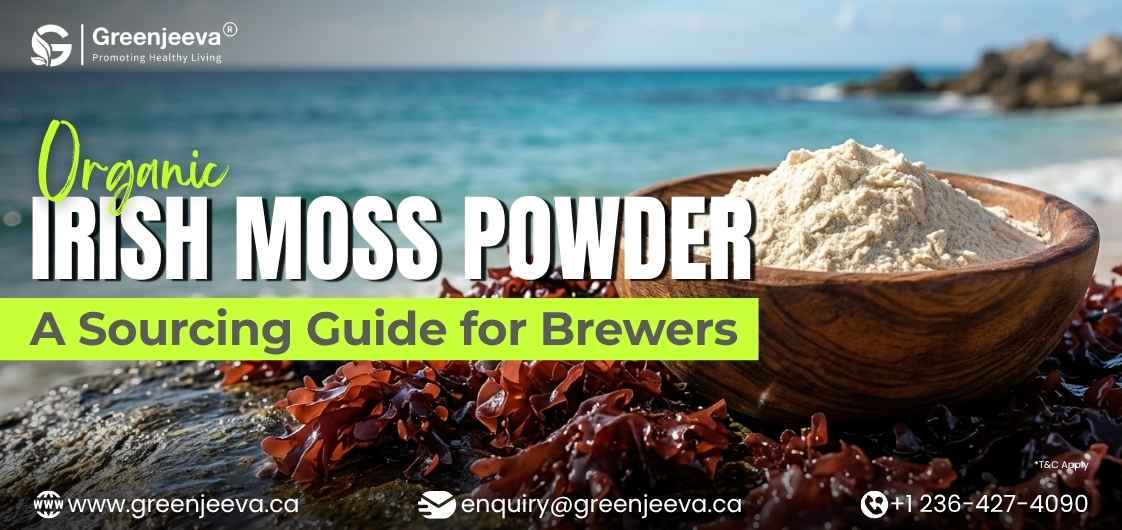
Organic Irish Moss Powder: A Sourcing Guide for Brewers
If you have ever brewed a batch of beer at home, there is a good chance you have thrown a pinch of Irish moss into the kettle without asking too many questions about what it actually is. Fair enough. It works, so why dig deeper?
But if sourcing this ingredient at scale is actually your job, for a brewery, a beverage brand, or an R&D bench, "it works" is not a good enough answer anymore. You need to know what is actuallyn in the bag and how a whole, unrefined Organic Irish Moss Powder compares to the standardized, often multi-species blends that dominate the commercial fining market.
Here is why the timing matters. The market for beer fining agents like this one was worth about $1.5 billion in 2024, and it is on track to reach roughly $2.2 billion by 2033, according to Verified Market Reports. Zoom out further, and the broader brewing additives category (fining agents, stabilizers, enzymes, clarifiers, all of it) is expected to nearly double from $4.6 billion in 2026 to $7.8 billion by 2035, per Global Market Insights. Buyers are backing away from synthetic, heavily processed inputs and reaching for ingredients they can actually explain to their own customers.
At the same time, the beer world is swinging back toward clarity. After years of hazy, cloudy IPAs owning every tap list, drinkers are rediscovering crisp, clear West Coast-style beers, and brewers are noticing, according to The Beer Connoisseur. That shift is putting old-school clarity tools like Irish moss back on the agenda for breweries that had quietly stopped thinking about it.
And it is not only beer. Formulators working on functional drinks, tonics, and other clean-label beverages are running their own trials with this same seaweed, looking for natural texture and stabilization they can list on a label without a synthetic thickener attached to it.
This guide walks through what organic irish moss powder actually is, how it compares to the fining agents you might already be using, and what to check before you commit to a bulk source.
What Organic Irish Moss Powder Actually Is
Chondrus crispus is the seaweed behind this whole story: a red algae that grows along cold Atlantic coastlines in Ireland, the rest of Europe, and North America. The process from there is refreshingly simple. The whole seaweed, called the thallus, gets washed, dried, and milled into a fine powder. Nothing is extracted. Nothing is blended in. That distinction matters more than it sounds like it should, because this is the exact same species that supplies the carrageenan behind most commercial fining and beverage stabilizing products on the market, whether they show up as flakes, tablets, or powder.
Here is the part worth understanding properly, since it makes evaluating suppliers a lot easier later. Carrageenan makes up roughly 55 percent of the plant's dry weight, according to a widely cited species reference, and it carries a negative electrical charge. Wort proteins carry a positive one. Add the powder near the end of the boil, and the two find each other, clump together, and drop out during what brewers call the cold break, which is exactly what gives you a clearer, brighter finished beer.
Brewers have leaned on this trick for close to two centuries, per the American Homebrewers Association. It is also, oddly, a piece of Canadian industrial history. Canada was the world's top producer of Irish moss from roughly 1950 to 1970, with harvests peaking at around 50,000 tonnes in 1974, before cheaper, purified carrageenan from other seaweed species took over most of the global supply, according to The Canadian Encyclopedia.

Whole Powder vs. Formulated Blends: Why the Difference Actually Matters
This is where a lot of buying decisions quietly go wrong, so it is worth slowing down here. A whole, single-species powder and a standardized commercial fining blend share the same active ingredient, but they are not the same product.
Whole thallus powder keeps everything nature put there: carrageenan, plus the plant's other fibers, minerals, and trace compounds. Nothing is standardized, and nothing is added, which also means some natural batch-to-batch variation in gel strength.
Formulated blends go the opposite direction. They are usually refined or semi-refined carrageenan, often pooled across a few different red seaweed species (Chondrus crispus, Eucheuma, and Gigartina) specifically to smooth out that variation and guarantee the same performance every time.

If you are buying apre made,multi ingredientfiningproduct off a shelf, none ofthis mattersmuch to you. But if you are sourcing raw material for private label finings or your own beverage formulation work, this is the first question worth settling: do you want a raw, single origin input that you will validate on your own bench, or a pre standardized blend someone else has already dialed in? Both are legitimate choices.They just carry different QC expectations, and a supplier who is upfront about species and origin gives your team more control over what actually ends up in your formulation.
What to Check Before You Buy in Bulk
If you are evaluating a supplier, including an Irish moss powder supplier in Canada, here is what actually matters once you get past the price sheet.

Hydration behavior. Traditional use means rehydrating the powder in cold water for about 10 minutes before it goes into the boil. Ask your supplier how their specific batch behaves on rehydration, since particle size and drying method both change the answer.
Mesh size and consistency. Finer, more even milling disperses more predictably, whether that is in wort or in a beverage formulation downstream.
Moisture and storage. Seaweed powders pull moisture from the air. Inconsistent control here means clumping and a shorter shelf life, and that problem only gets bigger at bulk volumes.
Documentation, every single batch. Because this is a marine-sourced botanical and not something synthesized in a lab, ask for a Certificate of Analysis, a spec sheet, and organic certification for every batch you receive, not just your first sample.
Origin transparency. A supplier who can name the specific harvest region and processing facility is usually running a more traceable, audit-ready operation. That matters if your finished product carries organic or clean label claims, and it is a real factor when you are weighing a local supplier against something shipped in from overseas.
Format, double-checked. Confirm you are actually getting whole, unrefined powder, not a compressed tablet or a reconstituted product sold under a similar name.
One more thing worth doing before you commit to an Irish moss powder bulk order: run a small bench trial first. Rehydrate a sample, push it through a lab-scale boil or beverage trial, and compare clarity, texture, and settling behavior against whatever you are using right now. That one step tells you more than any spec sheet.
Why This Conversation Is Happening Right Now
Two things are colliding at once. First, clean label pressure across food and beverage manufacturing has procurement teams looking harder at ingredients that have quietly done their job for two centuries, this one included. Second, the craft beer world's swing back toward clear, classic styles means clarity is no longer a nice to have for breweries that spent the last several years leaning hard into haze.
Meanwhile, formulators outside of beer entirely, in functional drinks, plant-based beverages, and other clean label categories, are running their own trials with this same seaweed as an Irish moss powder supplement for beverages: natural texture and stabilization, no synthetic thickener on the label.
Put those two forces together, and there is a real opening right now to revisit whether a raw, traceable, single-species input like this fits your formulation strategy better than a generic, multi-species commodity blend.
What to Actually Do Before You Switch Suppliers
Do not just compare price per kilogram. Request a sample. Confirm the paperwork trail: Certificate of Analysis, spec sheet, organic certificate, and origin disclosure. Then run a small bench comparison against whatever you are using today. That single step will tell your team more about real-world fit than any spec sheet ever could.
→ Ready to see how it performs in your own process? Request a sample.
A note on how this guide was put together: it draws on published industry market research (linked throughout), established food science on Chondrus crispus, and Green Jeeva's own sourcing and QC documentation, including batch level Certificates of Analysis and organic certification. It is written for procurement and R&D teams evaluating suppliers, not as medical or nutritional advice.

.jpeg)