Organic Maitake Mushroom Powder: How Canadian Buyers Verify Real Quality Before They Order
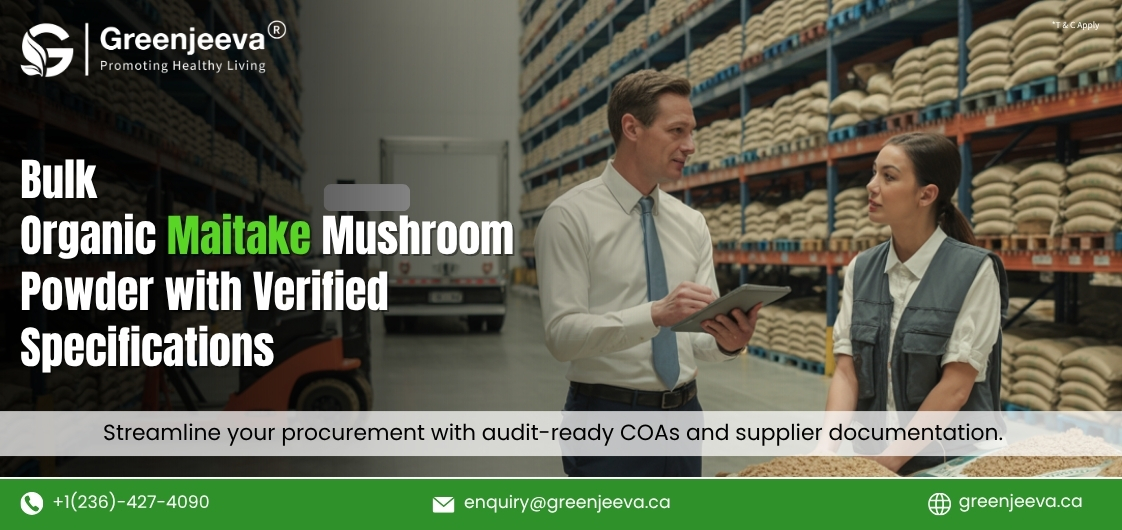
Not every product labeled "maitake mushroom powder" contains what the name implies. Species mislabeling and mycelium-on-grain fillers passed off as fruiting body powder are documented problems across the mushroom ingredient category, and they rarely show up until a formulation underperforms or a lab test comes back unexpected. For Canadian manufacturers buying in bulk, the real quality question isn't just "is it organic," it's "can the supplier prove what's actually in the bag."
This guide walks through what organic maitake mushroom powder should be, the verification step most buyers skip, and the specifications and documentation Canadian formulators should require before committing to a supplier.
What Organic Maitake Mushroom Powder Actually Is
Organic Maitake Mushroom Powder is produced from the fruiting body of Grifola frondosa, commonly known as hen-of-the-woods, native to temperate forests in Japan, North America, and parts of Europe. The mushrooms are harvested, dried, and ground into a fine powder that retains the ingredient's natural polysaccharide and fiber content. Green Jeeva's Organic Maitake Mushroom Powder is sourced this way, from the fruiting body rather than lab-grown mycelium.
Species identification matters more than it seems. Grifola frondosa is one of several Polypora species that can look similar once dried and milled, and blending or substitution is harder to catch visually than it is through lab verification.
Formulators working on higher-potency applications sometimes look for a concentrated version rather than the standard powder. Green Jeeva also supplies an Organic Maitake Mushroom Extract Powder (4:1) for this purpose.
The Verification Gap Most Buyers Miss
A common mistake in mushroom ingredient sourcing is trusting a "total polysaccharide" figure on a spec sheet. That number is not a reliable indicator of mushroom content on its own, because starch from a grain substrate is chemically a polysaccharide too.
This distinction traces back to a validated laboratory method (McCleary and Draga, Journal of AOAC International, 2016) that separates beta-glucans from starch-derived alpha-glucans in mushroom products. Fruiting body extracts typically test meaningfully higher in beta-glucans than mycelium-on-grain material, where beta-glucan content is often diluted by residual grain starch.
The practical takeaway for a Canadian buyer: ask for a beta-glucan figure, not just a polysaccharide figure, and confirm the plant part used is the fruiting body rather than mycelium grown on a grain medium. A supplier unwilling or unable to answer either question directly is worth treating as a flag.
Specification Benchmarks Formulators Should Require
Beyond species and plant part, a handful of measurable specifications separate a properly controlled maitake powder from an inconsistent one. Green Jeeva's own quality parameters for this ingredient include:
Moisture content held at or below 10 percent, since higher moisture increases the risk of microbial growth during storage
Particle size where at least 95 percent passes through an 80-mesh screen, which affects blend uniformity in downstream formulations
Heavy metal screening covering lead, arsenic, mercury, and cadmium
Microbiological testing and heavy metal screening performed per batch, with batch-specific documentation issued alongside each shipment
These aren't checklist items to transcribe onto a buyer's own form. They're the kind of concrete, testable numbers that should appear on any supplier's certificate of analysis, and their absence is usually more informative than their presence.
Batch-to-Batch Consistency and Documentation
Bulk buyers rarely evaluate a single lot in isolation. What matters over a manufacturing cycle is whether lot five looks like lot one. Green Jeeva supplies this ingredient in 25 kg commercial packaging with batch-specific documentation attached to each shipment, which supports traceability back to a specific production run.
For a formulator qualifying a new supplier, requesting a sample lot ahead of a full purchase order is a reasonable way to confirm that documented specifications match the material actually received. Comparing that sample's COA against a second, later batch is a practical way to test consistency before scaling volume.
Organic Certification and Canadian Regulatory Context
Organic claims on this ingredient are backed by certification from CCOF under the Canada Organic Regime (COR), covering the Processor/Handler chapter (reference pr3045), certified as of April 2, 2024. This certification confirms Green Jeeva's compliance with the Canadian Organic Standards under the Safe Food for Canadians Regulations.
For manufacturers building this ingredient into a licensed natural health product, Health Canada's Natural and Non-prescription Health Products Directorate (NNHPD) requires supporting documentation, such as identity testing and specifications, as part of a product license application under the natural health products regulations. Ingredient-level claims should be checked against the current Natural Health Products Ingredients Database (NHPID) monograph rather than assumed. Food-grade use of this ingredient also falls under CFIA oversight for labeling and import compliance.
Canadian buyers should not rely on USDA Organic certification alone as a substitute for COR compliance, since the two programs are not automatically interchangeable for products sold into the Canadian market.
Evaluating and Comparing Maitake Powder Suppliers in Canada
When comparing bulk maitake powder suppliers side by side, a few specific questions tend to surface the gaps that generic "are you certified" conversations miss:
Does the COA specify beta-glucan content, not only total polysaccharides
Is the plant part identified as a fruiting body, and can that be confirmed against a reference standard
Is heavy metal and microbiological testing is performed per batch, with results available on request
Is organic certification current and specific to the SKU being quoted, not just the company as a whole
Will the supplier provide a sample lot for independent testing before a full order is placed
A supplier that answers all five without hesitation is generally operating with the documentation discipline that bulk manufacturing requires.