Adaptogenic Ingredients: What the Term Actually Means for Bulk Buyers
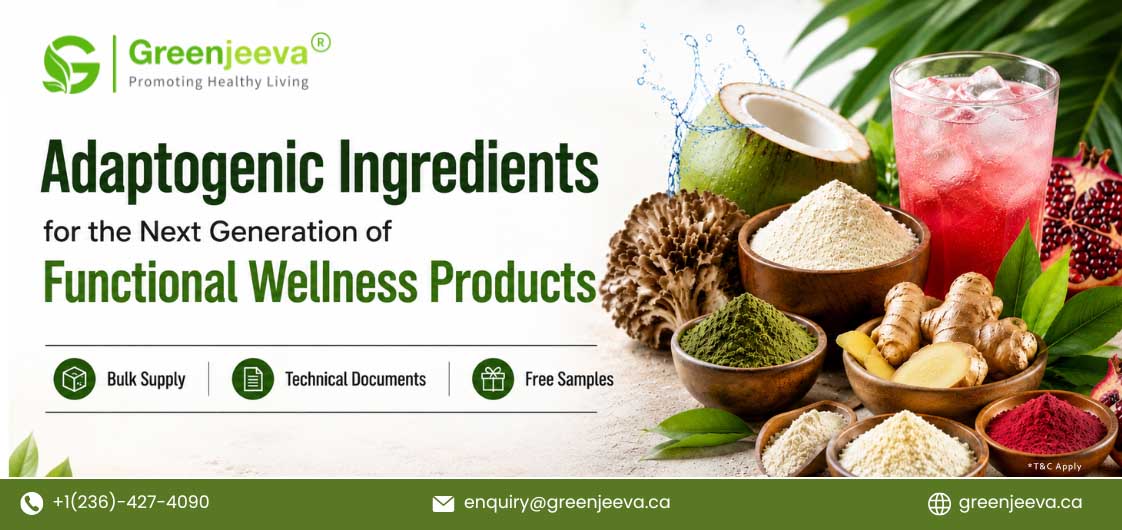
"Adaptogen" gets used loosely in wellness marketing, but it has a specific scientific origin and a real definition behind it. It's also not a term Health Canada recognizes as its own labeling category, which matters for anyone formulating a finished product around it.
This guide covers what actually qualifies an ingredient as adaptogenic, profiles the five adaptogenic botanicals Green Jeeva supplies for Canadian manufacturers, and covers what belongs on a COA before you commit to a supplier.
What Actually Makes an Ingredient "Adaptogenic"
Where the term comes from
The term was introduced by Soviet toxicologist Nikolai Lazarev in 1947, then formalized by pharmacologist Israel Brekhmanand Igor Dardymov in a 1969 paper. Ginseng itself served as the original research model for the concept.
The three criteria that define one
Brekhman and Dardymov's definition requires three things. The substance must be non-toxic at normal doses, it must produce a non-specific increase in resistance to a broad range of stressors rather than targeting one, and it must have a normalizing effect that moves physiology back toward balance regardless of which direction it's off.
That third criterion, bidirectional normalizing, is the most technical and the most often skipped in casual marketing use of the term. Ginseng, ashwagandha, and rhodiola, the three genera in Green Jeeva's current lineup, are among the most frequently studied botanicals against this specific framework.

Five Adaptogenic Ingredients Green Jeeva Supplies for Canadian Formulators
Panax Ginseng Root Extract Powder 10:1, TLC
This is Asian, or Korean, ginseng, native to Korea, China, and parts of Russia, and a member of the Araliaceae family. Green Jeeva's Panax Ginseng Root Extract Powder10:1, TLC is a standardized 10:1 extract, with identity confirmed by Thin Layer Chromatography (TLC) against its characteristic ginsenoside profile.
Traditionally, Asian ginseng is considered a warming herb in Chinese medicine, distinct from its North American counterpart.
Organic American Ginseng Powder
American ginseng, Panax quinque folius, is a different species in the same genus as Asian ginseng, native to North America rather than East Asia. Green Jeeva's Organic American Ginseng Powder is traditionally considered a cooling herb, the opposite traditional classification from Panax ginseng.
This distinction matters because "ginseng" alone doesn't specify species. Panax ginseng, Panax quinque folius, and Eleuthero coccuss enticosus (Siberian ginseng, not even the same genus) are all marketed under overlapping "ginseng" branding despite being botanically and traditionally distinct.
Organic Rhodiola Rosea Powder
Green Jeeva's Organic Rhodiola Rosea Powder is a whole-root powder, not a standardized extract, sourced from Rhodiola rosea traditionally harvested in cold mountainous regions such as Russia and Scandinavia. Whole-root powder retains the full botanical matrix rather than concentrating specific marker compounds.
Buyers needing a standardized rosavin or salidroside content for a specific label claim should confirm with Green Jeeva whether a standardized extract format is available separately, since whole-root powder and a standardized extract serve different formulation purposes even from the same plant.
Organic Ashwagandha Root Powder
Ashwagandha (Withaniasomnifera) belongs to the Solanaceae family, the night shade family, not the ginseng family, despite its common folk name "Indian ginseng."Green Jeeva's Organic Ashwagandha Root Powder is grown on Green Jeeva's own certified organic farms in India, giving direct control over cultivation and post-harvest handling rather than relying on third-party brokers.
Green Jeeva's documentation for this ingredient references microbial testing aligned with American Herbal Products Association (AHPA) limits, covering total plate count, yeast andmold, E. coli, and Salmonella, along with pesticide residue screening through third-party labs against recognized pesticide lists.
Organic Ashwagandha C/S
Green Jeeva's Organic Ashwagandha C/S is a Cut and Sifted format of the same Withaniasomnifera root, a coarser cut rather than a fine powder. This format generallysuits teas, decoctions, and infusions better than encapsulation or dry-blend applications, where the fine powder format is the better fit.
These are two distinct SKUs from the same plant, not the same material in different bag sizes, and buyers should specify which one they actually need.

Why "Adaptogen" Alone Isn't a Compliance Claim in Canada
Health Canada doesn't recognize "adaptogen" as its own approved labeling category. Each of these botanicals instead has its own Natural Health Products Ingredients Database (NHPID) monograph, with specific permitted uses tied to that individual ingredient.
A finished-product claim needs to trace back to the applicable monograph for that specific botanical, not to a general "adaptogen" descriptor. This responsibility sits with the manufacturer building the finished Natural Health Product, but it starts with sourcing an ingredient whose identity and documentation actually support that claim.
What to Check on a COA for Any Adaptogenic Botanical
A complete COA for this ingredient category should include:
Botanical species confirmed by Latin binomial, not just a common name like "ginseng" or "Indian ginseng"
Identity testing by TLC or an equivalent validated method
Marker compound content where relevant, such as ginsenosides for ginseng or withanolides for ashwagandha
Moisture content, generally expected below 5 percent for root botanicals in this category
Heavy metals screening
Microbiological testing covering total plate count, yeast andmold, E. coli, and Salmonella
Pesticide residue screening
Current organic certification specific to the batch, where applicable
How to Source Bulk Adaptogenic Ingredients
Start by confirming the exact species and format you need, since this category has more naming ambiguity than most botanical ingredients. "Ginseng" spans at least two genera in common use, and "ashwagandha" is sometimes confused with true ginseng due to folk naming.
From there, request a COA with identity and marker compound testing, not just an assay percentage. Confirm whether whole-root powder, a standardized extract, or a cut-and-sifted format actually fits your application before placing a bulk order.
**The Food and Drug Administration has not evaluated these statements. This product is not intended to diagnose, treat, cure, or prevent any disease.**