
Air-Dried vs. Freeze-Dried Organic Kale Powder: What Manufacturers Should Know
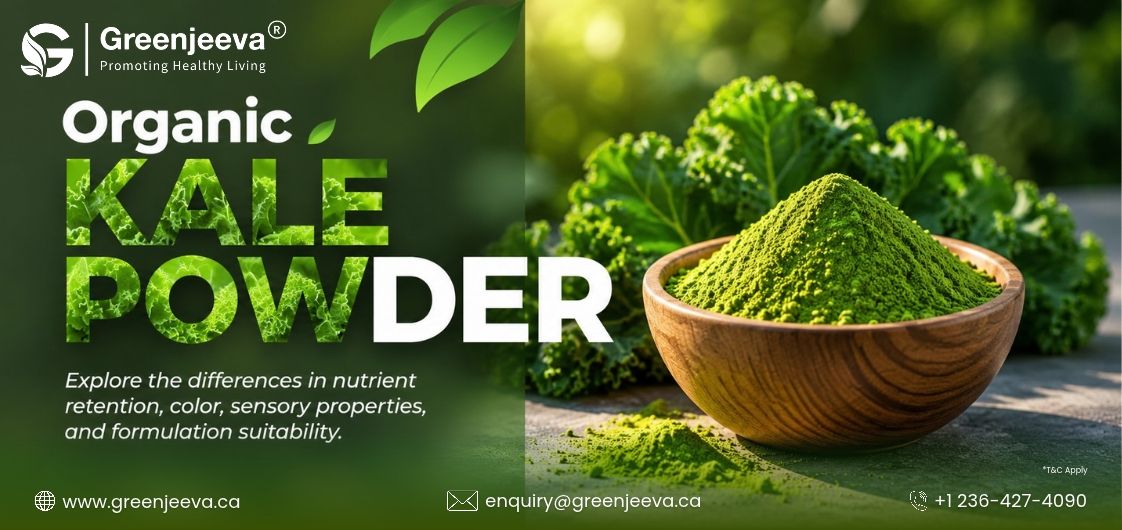
When sourcing organic kale powder, the drying method deserves as much attention as the ingredient's botanical identity and grade. Air-drying and freeze-drying both remove moisture from prepared kale leaves, but they use different processes and can produce powders with different nutritional, physical, and sensory characteristics.
For food, beverage, and nutraceutical manufacturers, the choice is not simply about which process is better. It is about understanding how the processing method may influence the final ingredient and whether the resulting powder is suitable for the intended formulation.
A smoothie blend, a greens powder, a capsule formulation, and a dry food mix may have different requirements for color, flavor, particle size, moisture, and handling.
This guide compares air-dried and freeze-dried organic kale powder, explains the factors manufacturers should evaluate, and outlines what to check before selecting a bulk ingredient.
1. Understanding Organic Kale Powder
Organic kale powder is made by drying and milling kale leaves into a powdered ingredient. It is commonly considered for food, beverage, and nutraceutical formulations where manufacturers want to incorporate a leafy green vegetable ingredient into a dry blend or finished product.
Kale, botanically identified as Brassica oleracea var. acephala, is a leafy vegetable containing naturally occurring vitamins, minerals, pigments, and plant compounds. Its nutritional composition can vary with the cultivar, growing conditions, maturity, harvesting practices, and processing method.
The term organic refers to the applicable organic production and certification requirements. It does not identify the drying process or guarantee a particular nutritional profile.
Similarly, the terms dried kale, kale leaf powder, and organic kale powder do not automatically tell buyers whether the ingredient was air-dried or freeze-dried.
For procurement teams, this distinction matters. Two products may have the same botanical identity and organic status but differ in processing history and finished-powder characteristics.

2. How Is Air-Dried Kale Powder Made?
Air-drying removes moisture by exposing prepared kale leaves to moving air. Depending on the processing setup, the air may be heated or maintained at a controlled temperature.
A typical process involves:
1. Raw material preparation: Kale leaves are selected, sorted, and cleaned to remove unwanted material.
2. Pre-treatment: Depending on the process, leaves may undergo cutting or blanching before drying.
3. Drying: Air circulates around the prepared leaves, gradually removing moisture.
4. Milling: The dried leaves are ground into a powder.
5. Sieving and packing: The powder is screened to achieve the required particle-size range before packaging.
The actual process can vary between manufacturers. Drying temperature, airflow, processing time, leaf thickness, pre-treatment, and moisture targets all influence the finished material.
What should manufacturers know?
Air-drying is an established method for processing vegetables into shelf-stable ingredients. However, exposure to heat, oxygen, and processing time can influence the retention of certain heat-sensitive compounds.
This does not mean that all air-dried kale powder has the same nutritional or physical characteristics. Buyers should assess the actual product specification and, where nutritional composition is important, request supporting analytical data.
3. How Is Freeze-Dried Kale Powder Made?
Freeze-drying, also called lyophilization, removes moisture from frozen material under reduced pressure. Instead of relying primarily on evaporation from a heated product, the process uses sublimation: ice changes directly into water vapor.
The process generally involves three stages:
1. Freezing: Prepared kale leaves are frozen to solidify their water content.
2. Primary drying: Under reduced pressure, ice is removed through sublimation.
3. Secondary drying: Additional moisture is removed to achieve the required final moisture level.
The dried material is then milled, screened, and packaged according to the manufacturer's process requirements.
Because the product remains frozen during much of the moisture-removal process, freeze-drying can help limit some of the heat-related changes associated with conventional drying.
What should manufacturers know?
Freeze-drying is often selected when preserving certain heat-sensitive components, color, and structural characteristics is important. However, the result still depends on raw material quality, pre-treatment, process conditions, milling, and storage.
Freeze-dried powder should not automatically be assumed to have a specific nutrient concentration, particle size, or formulation performance. Those characteristics need to be verified for the actual ingredient.
4. Air-Dried vs. Freeze-Dried Organic Kale Powder: Key Differences
Both methods produce dried kale ingredients, but the processing conditions can influence the characteristics that matter during formulation.
| Evaluation factor | Air-dried kale powder | Freeze-dried kale powder |
| Moisture removal | Uses moving air, often with controlled heat | Uses freezing, reduced pressure, and sublimation |
| Temperature exposure | Depends on drying temperature and duration | Product remains frozen during primary drying |
| Nutrient retention | Can vary with heat exposure, pre-treatment, and storage | Can support better retention of certain heat-sensitive compounds |
| Color | May show greater heat-related color changes under some conditions | May support color retention, depending on processing |
| Flavor | May develop processing-related sensory changes | May retain more of the original sensory profile in some processes, |
| Powder characteristics | Depend on drying, milling, and sieving | Depend on freeze-drying, milling, and sieving |
| Processing considerations | Established and widely used drying approach | More specialized process with higher equipment and energy requirements |
| Buyer evaluation | Check moisture, color, sensory profile, and specifications | Check the same parameters, along with processing documentation |
These are general processing considerations, not guaranteed differences between every commercially available product.
The comparison also highlights an important point: drying method alone does not determine the final powder quality. A well-controlled process and suitable raw material are important regardless of the method selected.
5. How Does Drying Method Affect the Nutritional Composition of Kale Powder?
Nutritional retention is one of the main reasons manufacturers compare air-dried and freeze-dried vegetable ingredients.
Fresh kale naturally contains vitamin C, B-group vitamins, minerals, carotenoids, polyphenols, and other plant compounds. Some of these components are sensitive to heat, oxygen, light, and storage conditions.
Research on kale provides useful insights into how drying methods may influence nutritional composition.
Vitamin C and polyphenols
A 2011 study by Anna Korus, published in LWT – Food Science and Technology, examined the effects of preliminary processing, air-drying, freeze-drying, and storage on antioxidants in kale leaves.
Under the study conditions, the researchers reported higher levels of vitamin C, polyphenols, and antioxidant activity in the freeze-dried samples than in the air-dried samples under the study conditions.
The study also showed that storage and pre-treatment affected retention. This is important because processing does not end when the powder leaves the dryer. Subsequent handling and storage can influence the quality of the ingredient.
B-group vitamins, tocopherols, and minerals
A separate study published in the Journal of Food Science and Technology in 2022 examined minerals, B-group vitamins, and tocopherols in air-dried and freeze-dried kale.
The findings indicated better preservation of the vitamins examined in freeze-dried samples. The researchers also observed that the minerals studied were comparatively stable during drying and storage.
The study highlighted the importance of pre-treatment and storage temperature in determining the final nutritional composition.
What does this mean for manufacturers?
These studies suggest that freeze-drying can support the retention of certain heat-sensitive nutrients in kale. However, their findings should not be treated as guaranteed nutritional specifications for commercial powders.
When nutritional composition is a formulation requirement, manufacturers should request analytical results for the actual product rather than relying on general research about drying methods.
A useful review should consider:
• Nutritional parameters relevant to the intended application
• Analytical methods used to measure them
• Whether values are reported on an as-is or dry-matter basis
• Processing and storage conditions
• Batch-specific test results, where available
6. Choosing a Drying Format for Different Applications
The right form of organic kale leaf powder depends on the finished product, formulation process, sensory expectations, and quality requirements.
There is no universal rule that freeze-dried powder is suitable for every premium formulation or that air-dried powder is suitable only for basic applications.
Manufacturers should evaluate the ingredient in the context of the product they intend to develop.
Smoothie and greens blends
For smoothie mixes and greens blends, color, flavor, particle size, dispersibility, and mouthfeel can influence the finished product.
Both air-dried and freeze-dried kale powders may be considered. The preferred option should be determined through application trials.
Check how the powder disperses in the intended liquid, whether it settles, and whether its flavor and color are acceptable at the planned inclusion level.
Functional food and beverage formulations
For dry beverage mixes, powdered drink bases, and functional food products, manufacturers should consider more than the drying method.
Relevant evaluation points include:
• Moisture content
• Particle-size distribution
• Flow and handling characteristics
• Color and sensory profile
• Dispersion and sedimentation
• Compatibility with other powdered ingredients
If the formulation requires a specific nutritional profile, request analytical data to support that requirement.
Capsule and nutraceutical formulations
For capsule-based products and greens supplements, powder characteristics can influence blending, filling, and handling.
Particle size, moisture, bulk density, and flow properties may be particularly relevant during production trials.
The drying method alone cannot establish whether a kale powder will perform well in a capsule blend. Manufacturers should assess the finished ingredient against their processing requirements.
Dry food mixes and ingredient blends
In dry food mixes, seasoning blends, vegetable blends, and other powdered formulations, the ingredient needs to fit the product's flavor, color, moisture, and handling requirements.
A sample evaluation can help determine whether the selected green vegetable powder works with the other ingredients and the intended processing conditions.
7. What Should Buyers Verify Before Sourcing Organic Kale Powder in Bulk?
Whether purchasing air-dried or freeze-dried material, buyers should evaluate the finished ingredient rather than selecting a product based on its processing label alone.
Before approving bulk organic kale powder, review the following:
What to verify | Questions to ask |
Botanical identity | Is the material identified as kale leaf powder, with the botanical name and plant part specified? |
Organic status | Is the applicable organic certification available and valid for the product and supply chain? |
Processing method | Is the material air-dried, hot-air dried, freeze-dried, or processed using another method? |
Moisture content | What is the specified moisture limit, and is the result available on the COA? |
Particle size | What particle-size range and test method are used? |
Color and sensory profile | Does the sample meet the intended product's color, flavor, and appearance requirements? |
Nutritional data | Are relevant nutritional values supported by analytical results? |
Microbiological quality | Are the required microbiological parameters tested against your specifications? |
Packaging and storage | Does the packaging protect the powder from moisture and other storage-related quality changes? |
Batch traceability | Can the supplied batch be identified and linked to its quality documentation? |
Why sample evaluation matters
A specification sheet and a Certificate of Analysis provide useful information, but they do not replace formulation trials.
A sample allows R&D and quality teams to assess the ingredient under actual or representative production conditions.
For example, a powder may meet the stated particle-size specification but still require further evaluation for dispersion, mouthfeel, color, or compatibility with other ingredients.
This is particularly important when switching from one drying format or supplier to another.
For a more detailed discussion of botanical identity, color, particle size, COA review, and bulk sourcing, read our guide to organic kale powder quality and sourcing in Canada.
Sourcing Organic Kale Powder from Green Jeeva INC
For manufacturers sourcing organic kale powder in Canada, product evaluation should start with the intended application and the quality parameters required for the finished formulation.
Green Jeeva Canada offers Organic Kale Powder for bulk ingredient buyers. Review the available product information and documentation to assess its suitability for your requirements.
Before selecting a processing format, confirm the actual drying method, product specifications, and available batch documentation with the Green Jeeva team.
Explore Green Jeeva's Organic Kale Powder or contact the team to discuss your bulk sourcing requirements.