10 Things to Check When Buying Vitamin B6 Pyridoxine HCl Powder in Bulk
When a nutraceutical manufacturer evaluates a vitamin B6 ingredient, the decision rarely starts with the question, “What are the benefits of vitamin B6?”
The more useful questions come later in the development process.
Which form should we use? What specification do we need? Will it fit our dosage form? Can we verify the documentation? Can the ingredient be sourced consistently at a production scale?
For R&D, QA, and procurement teams, these decisions determine whether an ingredient moves from a formulation trial to an approved commercial raw material.
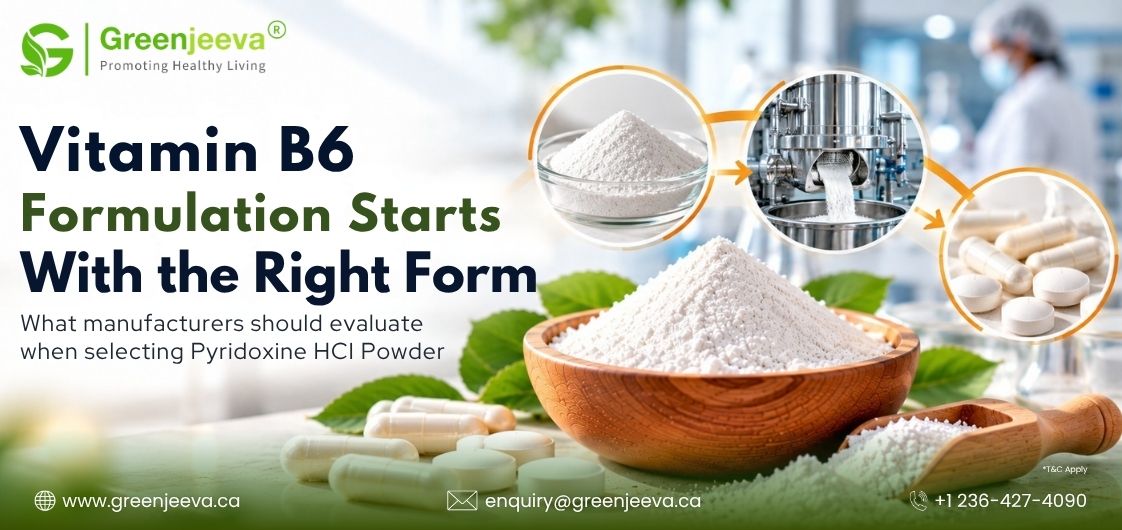
Vitamin B6 Pyridoxine HCl Powder is one ingredient form used in nutritional and nutraceutical formulations. Its suitability depends on how well its identity, specification, physical characteristics, documentation, and supply profile match the manufacturer's requirements.
Here are 10 formulation decisions manufacturers can use when evaluating Pyridoxine HCl.
Which Vitamin B6 Form Does the Formulation Require?
The first decision is ingredient identity.
Vitamin B6 is a broader nutritional term, while pyridoxine hydrochloride is a defined chemical form. When developing a formulation, the selected form should be clearly established in the formulation record and raw-material specification.
This distinction matters because Pyridoxine HCl Powder should not simply be treated as an interchangeable name for every Vitamin B6 ingredient.
For R&D teams, the starting point is therefore simple:
Define the required vitamin B6 form before comparing the vitamin B6 pyridoxine HCl powder supplier.
Does the Ingredient Match the Required Nutrient Level?
Once the form is established, the next decision is formulation quantity.
Vitamin and mineral formulations often require controlled levels of individual nutrients. The amount of pyridoxine HCl added, therefore, needs to be calculated using the applicable assay or potency information in the ingredient specification.
This is where the Pyridoxine HCl specification becomes important.
Rather than calculating from a generic product description, formulators should work from the supplier's current specification and the requirements established for the finished product.

Is Pyridoxine HCl Suitable for the Intended Dosage Form?
A vitamin B6 ingredient may be considered for different nutraceutical formats, including
- Tablets
- Capsules
- Multivitamin blends
- B-complex formulations
- Nutritional premixes
- Suitable powdered supplements
But suitability should be evaluated against the actual manufacturing process.
A tablet formulation, for example, may require the ingredient to integrate effectively into a larger powder blend before compression. A premix may require particularly careful consideration of distribution and blending.
The formulation decision is therefore not simply “Can vitamin B6 be used?” but “Does this ingredient form work within our chosen dosage form and process?”
What Physical Characteristics Does the Blend Require?
The chemical identity of an ingredient is only one part of formulation performance.
R&D teams also need to consider how the powder behaves during weighing, transfer, premixing, and blending. Particle characteristics and other physical properties can influence how an ingredient integrates into a multi-component powder system.
For micronutrients used at relatively low inclusion levels, appropriate manufacturing controls are especially important for achieving the intended distribution.
The exact physical parameters to review should come from the supplier's specification and the manufacturer's process requirements.
What quality parameters need to be written into the raw material of the vitamin b6 specification?
Before approval, QA and R&D teams should establish which quality parameters matter for the intended application.
Depending on the product and applicable requirements, a vitamin B6 specification may address:
- Identity
- Assay
- Appearance
- Purity-related parameters
- Moisture or loss on drying, where applicable
- Elemental impurities, where applicable
- Microbiological requirements, where applicable
- Packaging
- Shelf life
- Storage conditions
This creates a useful distinction between buying a vitamin B6 ingredient and qualifying for a vitamin B6 ingredient.
The latter requires a defined set of acceptance criteria.
Can the Vitamin B6 Ingredient Documentation Be Verified?
For a nutraceutical manufacturer, technical documentation is part of the raw material.
Before approval, the QA or regulatory team may need to review documents such as:
- Product specification
- Certificate of Analysis
- Safety Data Sheet
- Applicable certificates
- Batch-specific documentation
- Traceability information
The exact documentation package will depend on the supplier, ingredient, manufacturer, and target market.
For buyers, the practical question is:
Can our quality team access and verify the documents required for ingredient approval?
That question can be just as important as the price per kilogram.
Does the Ingredient Fit the Finished Product's Manufacturing Requirements?
An ingredient can meet its own specification and still require evaluation within the finished formulation.
Manufacturers may need to consider its interaction with other powdered ingredients, the selected manufacturing process, packaging configuration, and expected shelf life.
This is particularly relevant when developing multi-ingredient nutraceutical products.
R&D teams should therefore evaluate the ingredient in the actual formulation rather than approving it solely from a technical data sheet.
Can the Supplier Support the Required Production Volume?
A formulation that works at the laboratory scale must work commercially.
Once the ingredient has been approved, procurement needs to determine whether the supplier can provide bulk vitamin B6 powder in the quantities required for production.
Important considerations include:
- MOQ
- Current inventory
- Packaging
- Batch documentation
- Supply availability
- Shipment timing
- Commercial terms
For a manufacturer, this changes the supplier conversation from “Can you provide a sample?” to “Can you support our production requirement?”
Can Canadian Buyers Access the Information They Need Before Ordering?
Supplier qualification can become unnecessarily slow when buyers need to request every specification, certificate, inventory update, and quotation separately.
For Canadian nutraceutical manufacturers, a B2B purchasing platform can make this process more direct.
Green Jeeva Canada's B2B e-commerce platform allows registered businesses to:
- View real-time inventory
- Access pricing structures
- Download certificates and product documents
- Verify available documentation
- Request and place quotations
This gives R&D, QA, and purchasing teams access to much of the information needed before moving forward with an order.
Is the Ingredient Ready to Move from Approval to Bulk Purchase?
The final formulation decision is also a procurement decision.
Once the ingredient identity and specification have been approved, documentation has been reviewed, and the production requirement is known, buyers can evaluate the commercial order.
Green Jeeva Canada offers Vitamin B6 Pyridoxine HCl Powder with MOQs starting at 25 kg. The B2B platform provides access to current inventory and pricing structures, document and certificate verification, and quotation functionality.
Same-day shipment is available, along with a zero-question-asked return policy.
For manufacturers, this creates a direct path from ingredient evaluation → approval → commercial sourcing.
A Better Way to Evaluate Vitamin B6 Powder
The strongest ingredient decisions happen when formulation and procurement work from the same information.
For Vitamin B6 Powder, that means moving through a defined sequence:
Ingredient form → formulation requirement → specification → documentation → process evaluation → supply capability → commercial order
Pyridoxine HCl may be a suitable vitamin B6 ingredient for a nutraceutical formulation, but the decision should ultimately be based on the manufacturer's specific product, quality requirements, manufacturing process, and sourcing criteria.
For Canadian buyers, having access to specifications, documentation, inventory, pricing, and quotations in one B2B environment can make that evaluation more straightforward.
Visit the product for more information.