Organic Kale Powder: How Quality, Color & Particle Size Affect Formulation Performance
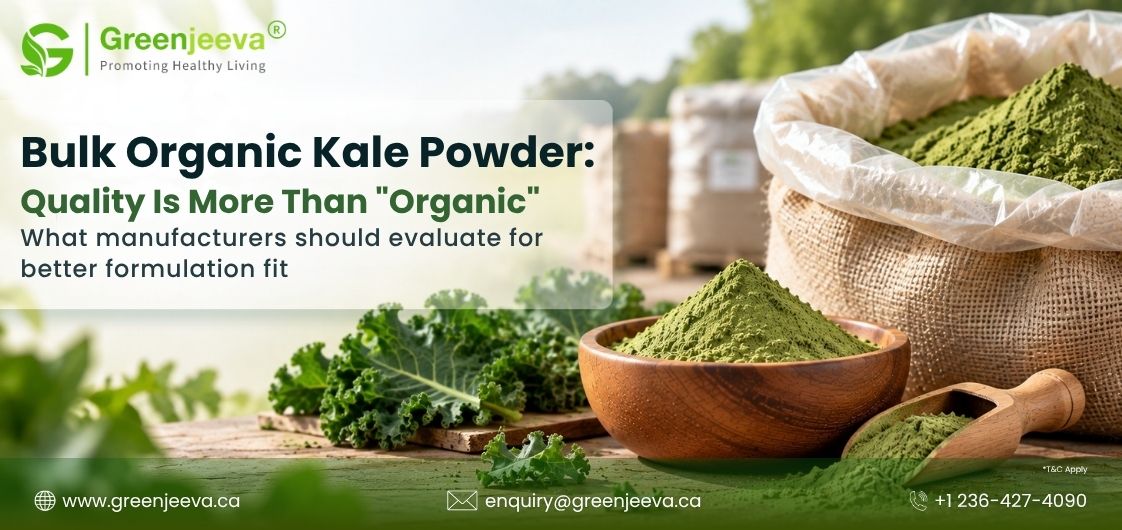
For manufacturers sourcing organic kale powder, the word “organic” is only the starting point.
Two powders can both meet an organic requirement while behaving differently during formulation. Color, particle size, moisture, microbiological quality, sensory characteristics, and ingredient form can all influence how the material performs in a finished product.
For R&D, QA, procurement, and product development teams, the more useful question is not simply:
“Is this kale powder organic?”
It is:
“Does this kale powder meet the specifications my formulation actually requires?”
That distinction becomes particularly important when buying organic kale powder in bulk for beverages, dietary supplements, food products, blends, or other applications.
To make these considerations more practical, this article uses a Certificate of Analysis (CoA) from Green Jeeva Inc. for its organic kale powder as a real-world example. The specifications and test results discussed throughout the article are based on this example CoA and are used to illustrate how manufacturers can interpret key quality parameters such as color, particle size, moisture, microbiological quality, heavy metals, and identity. These values should be viewed as the specifications of the referenced batch, not as universal requirements for all organic kale powder.
1. Why Kale Powder Quality Is More Than “Organic”
Organic certification establishes an important part of an ingredient's identity and production requirements. But it does not, by itself, define every characteristic that matters to a formulation.
A manufacturer may also need to establish:
• Botanical identity
• Plant part used
• Appearance and color
• Particle size
• Moisture or loss on drying
• Microbiological quality
• Heavy-metal limits
• Sensory characteristics
• Storage requirements
• Batch-to-batch consistency
• Suitability for the intended application
A Certificate of Analysis (CoA) provides measurable evidence for many of these parameters.
For example, a kale powder CoA can specify the botanical source as Brassica oleracea and identify the plant part as leaves. It can also establish parameters such as particle size, loss on drying, total ash, heavy metals, and microbiological results.
This is where ingredient quality becomes a formulation question rather than simply a certification question.
2. From Kale Leaf to Powder: Where Quality Is Established
The final powder is the result of several processing stages:
Kale leaves → preparation → drying → milling → sieving → testing → packaging
Each stage can influence the characteristics of the finished ingredient.
Depending on the manufacturing process, the finished material may be described as dehydrated kale powder. Buyers should verify the actual drying method and specification rather than assuming the processing method from the product name alone.
Raw material
The starting material establishes the botanical identity and plant part. For kale powder, manufacturers should confirm that the specification clearly identifies the botanical source and that the intended plant part is being used.
The reviewed CoA identifies the biological source as Brassica oleracea and the plant part as leaves.
Drying
Moisture is one of the measurable outcomes manufacturers should monitor after processing.
The CoA, for example, specifies loss on drying at NMT 10%, with a reported result of 5.75%.
Milling and sieving
Once dried, the material is milled and screened to establish the desired particle-size profile.
The CoA specifies that 90% passes through #60 mesh.
Testing and packaging
The finished ingredient then needs to be evaluated against its specification before being released for use.
This creates an important procurement principle:
The specification should describe the ingredient you need—not simply the ingredient a supplier happens to have.
3. Why Color Matters in Organic Kale Powder
Color is one of the first characteristics noticed when kale powder enters a formulation.
For products where the ingredient contributes to the visual identity—such as green blends, smoothie powders, food mixes, or certain supplement formulations—color can become part of the product experience.
But there is an important distinction between describing color and measuring color.
A CoA may state that the powder is green based on organoleptic evaluation. The example CoA reviewed specifies the color as green and records it as compliant.
That does not necessarily provide a quantitative color measurement.
For a formulation where appearance is critical, an R&D team may therefore want to establish its own acceptance criteria during sample evaluation.
What should manufacturers look at?
During a formulation trial, assess:
• Visual color of the dry powder
• Color after incorporation
• Color consistency between samples
• Changes after processing
• Color contribution to the finished product
The key point is simple:
“Green” is a specification description. Whether that green works for your finished product is a formulation decision.
4. Particle Size: More Than a Mesh Number
Particle size can affect how an ingredient handles and incorporates into a formulation.
A supplier may describe kale powder as “fine” or provide a mesh designation, but manufacturers should understand what that specification actually means.
For example, the reviewed CoA specifies:
90% passes through #60 mesh.
That is more useful than simply calling the material “fine powder,” because it provides a defined screening requirement.
However, finer does not automatically mean better.
The appropriate particle-size profile depends on the application.
Application consideration | What particle size can influence |
Powder blends | Mixing and uniformity |
Beverages | Dispersion and mouthfeel |
Bakery/food applications | Incorporation and texture |
Capsules/tablets | Handling and processing |
Dry blends | Flow and blend characteristics |
The correct question for an R&D team is therefore:
“What particle-size specification works for our process?”
—not:
“What is the finest kale powder available?”
5. Moisture and Storage: Practical Variables Manufacturers Should Not Ignore
Moisture is another specification that connects directly to ingredient handling and storage.
The reviewed kale powder CoA specifies:
• Loss on drying: NMT 10%
• Result: 5.75%
• Test method: USP <731>
The same CoA specifies storage in a well-closed container in a cool, dry environment, away from heat and direct sunlight.
For manufacturers, the important takeaway is that moisture should be considered alongside the actual supply and storage conditions.
A specification can tell you what the material met when tested. Your formulation and warehouse conditions determine what happens afterward.
That is why sample approval, batch testing, packaging, and storage controls should work together.
6. Whole Kale Powder vs. Kale Extract: Know the Ingredient Form
“Kale ingredient” does not necessarily mean one standardized material.
A manufacturer sourcing organic kale powder should distinguish whole-plant/leaf powder from an extract.
Kale powder generally represents processed kale plant material in powdered form. The term powdered kale may also be used interchangeably in product searches, although manufacturers should still verify the actual ingredient specification rather than relying on the product name alone.
Kale powder
Generally represents the processed plant material in powdered form.
Kale extract
Represents an extracted fraction and may have a different specification, concentration, composition, and intended use.
These ingredients should not automatically be substituted for one another simply because both originate from kale.
Before approving a material, confirm:
• Botanical identity
• Plant part
• Ingredient form
• Specification
• Intended application
• Testing requirements
• Documentation
This distinction is particularly important when a formulation was developed around one ingredient form and procurement later proposes an alternative.
7. Organic Kale Powder vs. Organic Freeze-Dried Kale Powder
Another distinction buyers may encounter when researching organic freeze-dried kale powder is the processing method.
“Organic” describes the production/certification status. “Freeze-dried” describes the processing method.
They answer different questions.
Factor | Organic kale powder | Organic freeze-dried kale powder |
Organic status | Depends on certification | Depends on certification |
Processing method | Must be confirmed from supplier | Freeze drying is specified |
Particle size | Must be specified | Must be specified |
Moisture | Should be tested | Should be tested |
Color | Should be evaluated | Should be evaluated |
Application suitability | Requires formulation testing | Requires formulation testing |
Documentation | CoA/certification should be reviewed | CoA/certification should be reviewed |
The important procurement point is not to assume that one processing method is universally better.
If processing method is important to your formulation or product positioning, make it an explicit purchasing specification and verify it with the supplier.
The reviewed kale CoA does not identify the drying method, so the processing method should not be inferred from the CoA.
8. What Manufacturers Should Evaluate During Formulation Trials
A supplier's CoA answers an important question:
Did the batch meet its defined specification?
A formulation trial answers a different question:
Does the ingredient work in our product?
These are not interchangeable.
During a kale powder trial, R&D teams can evaluate:
Appearance
Does the powder provide the expected visual characteristics?
Handling
Does it flow, transfer, and mix appropriately for the process?
Incorporation
Does the ingredient distribute consistently throughout the formulation?
Sensory characteristics
Does its taste or odor fit the finished product?
The CoA reviewed here describes odor and taste as characteristic and compliant by organoleptic evaluation.
Process compatibility
Does the ingredient behave acceptably under the actual manufacturing conditions?
Finished-product performance
Does the ingredient continue to meet the product's requirements after processing?
This is why a sample should be treated as a formulation input—not merely as a purchasing sample.
9. From Lab Sample to Production: What Should Be Confirmed?
One of the common gaps between R&D approval and procurement is assuming that a successful sample automatically means production-scale approval.
A more controlled workflow is:
Supplier sample → Formulation trial → Specification approval → Pilot production → Batch verification → Commercial production
At each stage, manufacturers can confirm that the ingredient still aligns with the approved requirements.
For example:
At sample stage
Evaluate formulation compatibility and establish initial acceptance criteria.
At specification stage
Document measurable requirements such as identity, particle size, moisture, microbiology, and heavy metals.
At pilot stage
Confirm that the ingredient performs under manufacturing conditions.
At production stage
Review the batch-specific CoA and verify that the supplied material meets the approved specification.
The reviewed CoA demonstrates why batch-level documentation matters: it reports actual results for parameters including loss on drying, ash, heavy metals, and microbiology rather than simply describing the ingredient generically.
10. How to Build an Organic Kale Powder Specification for Your Application
There is no single specification that is automatically appropriate for every kale powder application.
Instead, manufacturers can build the specification around the finished product.
A practical specification framework can include:
Specification area | What to establish |
Identity | Botanical source and ingredient identity |
Plant part | Leaves or other specified material |
Appearance | Powder characteristics and acceptable color |
Particle size | Required mesh/profile |
Moisture | Maximum acceptable level |
Total ash | Applicable specification |
Identification | Appropriate analytical method |
Microbiology | TPC, yeast/mold, pathogens, as applicable |
Heavy metals | Applicable limits |
Sensory | Acceptable odor and taste |
Certifications | Organic and other required certifications |
Storage | Defined storage conditions |
Application-specific tests | Requirements established by R&D |
The example CoA includes identity, appearance, particle size, loss on drying, total ash, identification, heavy metals, microbiology, GMO/BSE-TSE status, shelf life, and storage conditions.
The final specification, however, should be determined by the manufacturer's product, regulatory requirements, and quality system.
11. Where to Buy Bulk Organic Kale Powder in Canada?
Canadian manufacturers looking for bulk organic kale powder should evaluate suppliers based on ingredient specifications, batch-specific CoA, organic certification, testing, commercial packaging, MOQ, availability, and documentation. For B2B purchasing, the right supplier should be able to provide enough technical and commercial information for R&D, QA, and procurement teams to evaluate the ingredient before placing a production order.
For buyers comparing kale powder bulk options, key procurement considerations include:
• Ingredient specification
• Batch-specific CoA
• Organic certification documentation
• Required testing
• Commercial packaging
• MOQ
• Availability
• Sample access
• Shipping arrangements
• Documentation required by the manufacturer's QA/regulatory team
For Canadian manufacturers, these checks help distinguish a supplier offering a commercial ingredient from a seller offering only a retail or small-pack product. Canadian suppliers in the current market offer kale powder in different pack sizes and formats, so buyers should compare the actual commercial specification rather than relying only on the product name or advertised organic status.
Green Jeeva Canada: Bulk Organic Kale Powder Supply
Green Jeeva Canada currently lists Organic Kale Powder for B2B buyers, with 25 kg food-grade commercial packaging and a 25 kg MOQ. The product page also states that batch-specific CoA, organic certification documentation, and product specifications are available to support QA and procurement review.
For manufacturers evaluating the ingredient, a practical purchasing sequence is:
Define application → Establish specification → Request sample → Conduct formulation trial → Review CoA and certification → Approve material → Place bulk order
Before ordering, buyers should confirm that the available kale powder matches the approved formulation requirements, particularly for particle size, color, moisture, testing, documentation, packaging, and commercial availability.
12. How Do I Order Kale Powder With Fast Shipping in Canada?
For manufacturers who need fast shipping, availability should be confirmed rather than assumed.
Before placing an urgent order, ask the supplier to confirm:
• Current inventory availability
• Commercial pack size
• MOQ
• Warehouse/fulfillment location
• Order processing time
• Estimated shipping timeline
• Required documentation
• Whether the exact material has already been approved by your QA team
Fast delivery is useful only when the material arriving at your facility is the same specification your formulation requires.
Final Takeaway
Organic kale powder quality is not defined by one attribute.
For manufacturers, the more useful approach is to connect ingredient specifications with formulation requirements:
Identity → Color → Particle Size → Moisture → Safety Testing → Sensory → Application Performance
That is the difference between simply buying an organic ingredient and selecting an ingredient that is technically appropriate for production.
For Canadian manufacturers sourcing kale powder in bulk, the strongest procurement process starts before the purchase order: define what your formulation needs, translate those requirements into a specification, test the ingredient, and then verify commercial batches against the approved standard.