Organic Elderberry Fruit Powder: A Bulk Buyer's Guide to Specifications and Sourcing
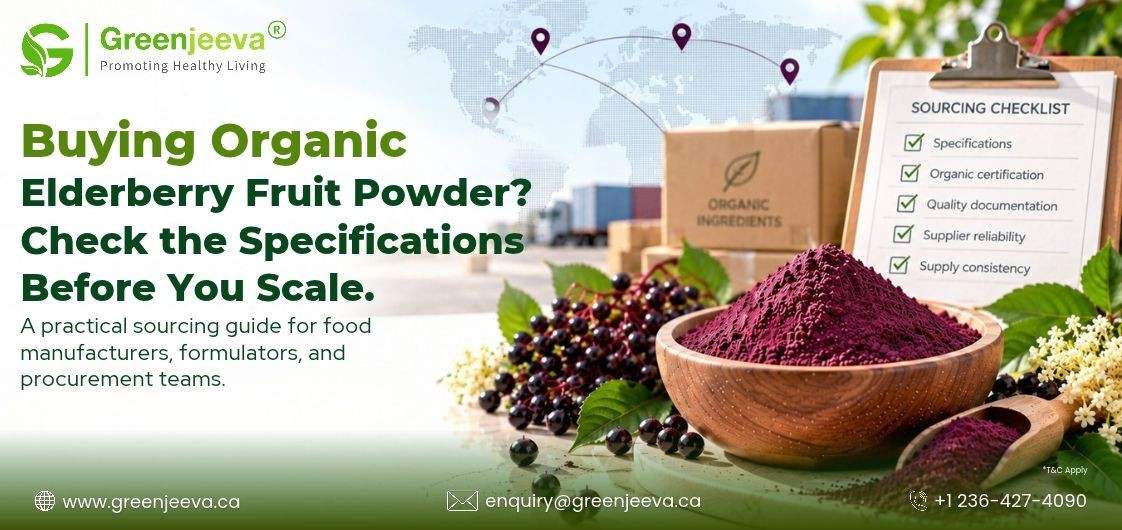
What food manufacturers, formulators, and procurement teams should check before selecting an elderberry powder supplier.
Sourcing a berry powder for commercial use involves more than identifying the fruit and requesting a sample. Processing methods, ingredient composition, quality documentation, and lot-to-lot consistency all influence whether a raw material is suitable for a particular formulation.
That is especially true for organic elderberry fruit powder. Fruit powder, juice powder, and extract powder may originate from the same botanical source, but they are not interchangeable ingredients.
This guide explains what to check when sourcing elderberry powder, which specifications matter, and how to evaluate suppliers for commercial applications.
What is organic elderberry fruit powder?
Organic elderberry fruit powder is produced by drying elderberry fruit and processing it into a powdered ingredient. The botanical identity commonly associated with European elderberry is Sambucus nigra.
Green Jeeva Canada’s organic elderberry fruit powder is identified as Sambucus nigra fruit that has been dried and ground. As with any ingredient, buyers should confirm the current specification, processing details, and quality documentation before approving the material for commercial use.
When evaluating organic elderberry powder, buyers should establish the following details:
- Botanical identity: Confirm the scientific name and the plant part used.
- Processing method: Establish how the fruit is dried and converted into powder.
- Ingredient composition: Check whether the product contains only elderberry fruit or includes carriers and other ingredients.
- Quality parameters: Review the applicable physical, chemical, and microbiological specifications.
- Documentation: Request the current specification sheet, lot-specific Certificate of Analysis (COA), and relevant organic certification documentation.
These checks help ensure that the ingredient being evaluated matches the requirements of the intended formulation.
Elderberry fruit powder vs. juice powder vs. extract powder
The term elderberry powder can refer to different ingredient formats. Before comparing samples or quotations, buyers should establish exactly what each supplier is offering.
Ingredient format | How it differs | What buyers should confirm |
Elderberry fruit powder | Produced from processed elderberry fruit. The exact method depends on the supplier and product. | Plant part, drying method, particle size, composition, and quality parameters. |
Elderberry juice powder | Made from elderberry juice that is processed into powder. A carrier may be used, depending on the process. | Juice source, carrier type and percentage, solids content, and declared composition. |
Freeze-dried elderberry powder | Produced using freeze-drying, a specific dehydration method. | Confirmation of the processing method, ingredient composition, and suitability for the application. |
Elderberry extract powder | Produced through an extraction process intended to obtain particular constituents from the source material. | Extraction method, extract ratio where applicable, carrier status, and any declared standardization parameters. |
Elderberry fruit powder, elderberry juice powder, and elderberry extract powder are different ingredient formats. Confirm the plant part, processing method, carrier status, and analytical basis before comparing samples or quotations.
Freeze-dried elderberry powder is one possible format, but it is not the default meaning of “elderberry powder.” Green Jeeva Canada’s listed product is dried and ground fruit; buyers requiring freeze-dried material should state that requirement explicitly before requesting quotations.
Similarly, a buyer seeking organic Sambucus nigra powder should confirm whether the material is whole-fruit powder, juice powder, or an extract. Botanical identity alone does not establish processing method or composition.

What should an organic elderberry powder specification include?
An organic elderberry powder specification should provide enough information for the technical, quality, and procurement teams to assess the ingredient against their internal requirements.
The precise parameters will depend on the product, supplier, and intended application. The following checklist can help structure the review.
Botanical identity and plant part
Confirm that the ingredient is identified as Sambucus nigra and that the plant part is fruit. This helps distinguish the requested raw material from products made using other plant parts or different elderberry species.
Processing method
Clarify whether the ingredient is dried and ground, freeze-dried, produced from juice, or manufactured through extraction. Do not assume that two powders are equivalent simply because they share the same botanical name.
Physical and sensory characteristics
Review the specification for relevant parameters, such as:
- Appearance and colour
- Characteristic flavour and aroma
- Particle size or mesh range
- Moisture content
- Flowability and dispersibility, where relevant to the application
These parameters should be confirmed against the current specification and, where appropriate, an approved sample. They should not be assumed to remain identical across all lots.
Composition and analytical parameters
Determine whether the formulation requires any declared compositional or analytical values. If a supplier provides an anthocyanin, polyphenol, or other constituent value, ask how it was measured and whether the result is supported by a defined test method.
A claim about a particular constituent should not be treated as a guaranteed specification unless it is documented and applicable to the supplied material.
Safety and quality testing
Ask which tests are performed and how frequently. Depending on the product and destination-market requirements, the review may cover:
- Heavy metals
- Microbiological parameters
- Pesticide residues
- Other relevant contaminants or impurities
Confirm the applicable limits, analytical methods where required, and whether the available results relate to the specific lot being purchased.
Documentation and traceability
Request the current product specification, a lot-specific COA, relevant organic certification documents, and available traceability information. Additional documentation may be necessary depending on the buyer's quality system, intended application, and destination market.
The goal is to establish a documented basis for ingredient approval rather than relying on a product description alone.
What are the applications of elderberry powder in food manufacturing?
The suitability of elderberry fruit powder depends on its composition, processing method, sensory profile, and the technical requirements of the finished product.
Potential applications for elderberry-derived powders include:
- Functional beverages and drink mixes: For beverage concepts where berry flavour, colour, and ingredient compatibility are relevant.
- Herbal teas and infusions: For dry blends that incorporate fruit-based ingredients.
- Smoothies and powdered blends: For formulations that use fruit powders as part of a broader ingredient system.
- Gummies and confectionery: Where the ingredient's sensory properties, processing stability, and compatibility with the formulation have been assessed.
- Capsules and tablets: Where the selected powder meets the formulation's requirements for composition, particle characteristics, and manufacturing performance.
These are potential application areas, not a guarantee that every elderberry powder is suitable for every product type. Manufacturers should assess the ingredient in the context of their formulation and processing conditions.
For example, a powder intended for a beverage may need to meet different dispersibility and sensory requirements from one intended for a dry blend or capsule. Sample evaluation and technical review help determine whether the material meets those needs.
For a broader discussion of why “polyphenol-rich” is not a single, standardized claim, see Green Jeeva’s guide to polyphenol-rich berry powders.( add link here of the existing blog)
How to choose an organic elderberry powder supplier
Selecting an organic elderberry powder supplier requires more than comparing product names. Procurement teams should evaluate the supplier's ability to provide the right ingredient, the documentation required for approval, and a clear process for maintaining quality across commercial orders.
Use the following checklist when evaluating potential suppliers.
Supplier evaluation checklist
- Product identity: Can the supplier confirm the botanical name, plant part, and exact ingredient format?
- Processing transparency: Is the drying, grinding, juice-processing, or extraction method clearly identified?
- Specification availability: Can the supplier provide a current specification sheet with relevant quality parameters?
- Testing and documentation: Are COAs and applicable testing records available for review?
- Organic certification: Can the supplier provide current documentation that covers the specific product and applicable supply chain?
- Traceability: Can the ingredient be linked to relevant lot and sourcing records?
- Sample evaluation: Can buyers assess a representative sample before commercial approval?
- Supply requirements: Are availability, packaging, lead time, and other commercial terms clearly communicated?
These checks help buyers compare suppliers using consistent criteria and reduce the risk of approving a material that does not meet the intended requirements.
Before requesting a quotation, ask:
- Is this elderberry fruit powder, juice powder, or extract powder?
- What is the botanical identity and plant part?
- What drying or processing method is used?
- Does the material contain a carrier?
- What testing is performed for each lot?
- What documentation is available for the destination market?
- How will commercial lots be compared with the approved sample?
Clear answers make supplier comparisons more meaningful and help technical and procurement teams align before an order is placed.
What certifications should an elderberry powder supplier provide?
Certification requirements depend on the buyer's market, product positioning, and quality assurance procedures. For buyers sourcing organic elderberry fruit powder, the first step is to verify that the organic certification documentation is current and applicable to the specific product and relevant operations.
Depending on the transaction and destination market, buyers may also need to review:
- Organic certification: Confirm the certifying body, validity, scope, and applicability to the product being supplied.
- Product specification and COA: Review the declared parameters and lot-specific analytical results.
- Food safety and quality documentation: Request relevant records that support the supplier's quality management process.
- Traceability documentation: Establish what sourcing and lot-tracking information is available.
- Additional certifications: Confirm whether other certifications, such as Kosher or Halal, are available if they are required by the buyer.
Do not assume that every supplier holds every certification or that a certification automatically establishes compliance with all destination-market requirements. Buyers should verify the applicable documents with the supplier and their own quality or regulatory team.
How to source bulk organic elderberry powder
Sourcing bulk elderberry fruit powder is more efficient when technical requirements are established before supplier comparisons begin.
A structured process can help buyers avoid evaluating materials that do not meet their formulation or documentation needs.
Step 1: Define the ingredient format
Specify whether the requirement is for whole-fruit powder, juice powder, freeze-dried powder, or extract powder. Include the botanical name and plant part.
Step 2: Establish the specification
Document the required physical characteristics, moisture limits, particle size, compositional parameters, testing requirements, and any other criteria relevant to the intended application.
Separate mandatory acceptance criteria from preferences that can be evaluated during sample review.
Step 3: Request documentation
Ask the supplier for the current specification sheet, relevant COA, organic certification documentation, and available traceability and quality records. Review the documents before moving to final approval.
Step 4: Evaluate and approve a sample
Assess the sample against the agreed specification and intended use. Where necessary, involve quality assurance, R&D, formulation, and procurement teams in the approval process.
An approved sample is not a substitute for commercial-lot control. Record the approved specification and confirm how future lots will be assessed against it before placing a bulk order.
Step 5: Confirm commercial requirements
Before ordering, clarify availability, packaging, lead time, order requirements, documentation supplied with the shipment, and the process for addressing quality deviations.
For a bulk elderberry powder supplier, the ability to communicate these requirements clearly is an important part of the procurement evaluation.
Factors to consider before buying elderberry powder wholesale
When comparing elderberry powder wholesale options, buyers should assess the complete ingredient and supply requirements rather than relying on a product name or quotation alone.
Consider these factors before approving a supplier:
- Ingredient format: Confirm that the material matches the intended formulation and processing requirements.
- Specification alignment: Compare products using the same parameters and analytical basis.
- Documentation: Ensure that the required quality, organic, and traceability documents are available.
- Sample-to-bulk consistency: Establish how the approved sample and specification will be used to assess future lots.
- Application suitability: Check that the powder is appropriate for the finished product and manufacturing process.
- Supply planning: Confirm availability, lead time, packaging, and other commercial requirements before placing the order.
A consistent evaluation framework allows procurement teams to compare suppliers on factors that matter to the final product, not just the ingredient description.