Bulk Niacinamide Powder in Canada: Why Purity Alone Doesn't Guarantee Consistency
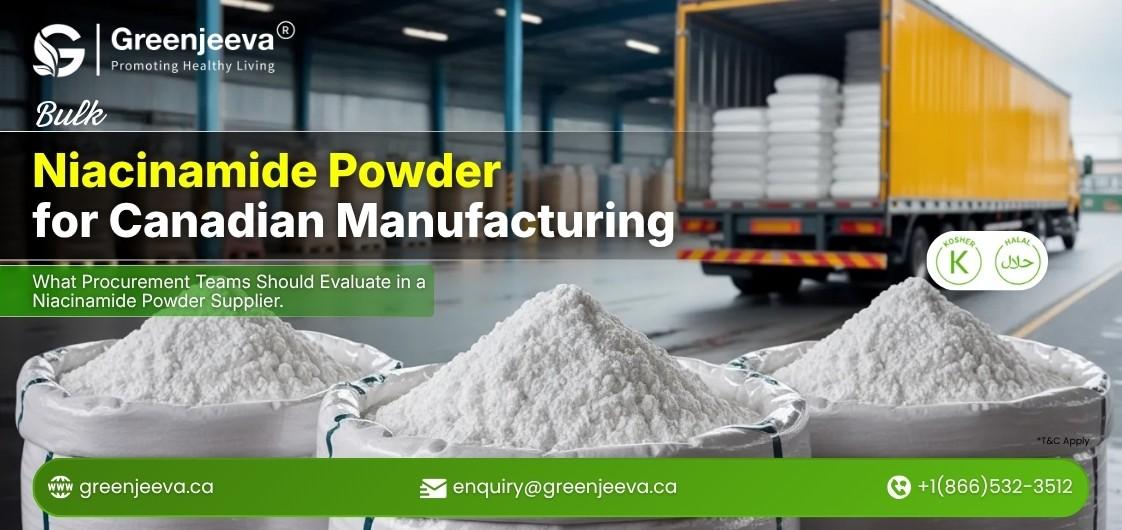
Almost every compliant niacinamide supplier can show a certificate reading 99 percent purity or higher. That number is table stakes, not a competitive advantage, and buyers who stop their evaluation there are missing the variables that actually determine how a batch performs on a blending line, in a capsule fill, or in a beverage premix. Two niacinamide powders can carry an identical purity figure and still behave differently once they're in production.
This guide covers what niacinamide powder actually is, why purity alone doesn't tell a Canadian buyer what they need to know, and the specification benchmarks that genuinely separate a consistent supplier from an inconsistent one.
What Niacinamide Powder Actually Is
Niacinamide, also known as nicotinamide, is the amide form of vitamin B3. Unlike the botanical ingredients most bulk buyers also source, niacinamide is produced synthetically through controlled chemical manufacturing rather than extracted from a plant or animal source. Green Jeeva's Niacinamide Powder is supplied as a raw material for food, dietary supplements, and cosmetic formulations, typically manufactured to food-grade (FCC) or pharmacopeial (USP) specifications depending on end use.
Because it's a synthesized ingredient rather than an agricultural one, organic certification frameworks like the Canada Organic Regime don't apply to niacinamide. Buyers should instead look for the certifications that are actually relevant to a synthetic raw material: Halal, Kosher, non-GMO status, and grade-specific pharmacopeial compliance.

Purity Is Table Stakes, Not a Differentiator
Pharmacopeial monographs (USP, FCC, EP) generally set niacinamide assay at 99.0 to 101.0 percent, calculated on a dried basis. Any supplier selling compliant material should already meet this range consistently, which means a "99% pure" claim on a specsheet is closer to a baseline qualification than a meaningful point of comparison between suppliers.
This is worth stating plainly because it reframes the sourcing question. If purity is essentially fixed across the market, the real due diligence work is in the variables that pharmacopeial purity doesn't capture at all.
What Actually Varies: Particle Size, Bulk Density, and Related Substances
Three variables consistently separate niacinamide suppliers even when their purity numbers match.
Particle size distribution is the most operationally significant. Niacinamide is manufactured in different granulation profiles, from fine powder to coarser granular grades, and even within a single grade classification, the percentage passing through a given mesh size can vary meaningfully between suppliers. This affects flowability, dusting during handling, blend uniformity in dry mixes, and fill consistency in capsule and tablet manufacturing.
Bulk density, both untapped and tapped, is a related but distinct variable. Two powders at identical purity can pack differently into the same volume, which directly affects fill-weight accuracy on capsule and tablet equipment calibrated to a specific density assumption.
Related substances, the process-related impurities left over from synthesis, are capped individually under pharmacopeial monographs, typically limiting compounds such as nicotinic acid and synthesis intermediates to small individual thresholds with a slightly higher combined limit for unknown impurities. A supplier's actual related-substances result on a given batch says more about manufacturing process control than the headline assay number does, since it reflects how tightly the synthesis and purification steps are managed run to run.
Specification Benchmarks Formulators Should Request
A complete niacinamide certificate of analysis should go well beyond a single assay figure. At minimum, Canadian buyers should expect:
Assay by HPLC or titration, within the applicable pharmacopeial range
Loss on drying and residue on ignition, which reflect moisture control and inorganic residue
Particle size distribution or mesh data specific to the batch, not a generic grade description
Bulk density, both untapped and tapped
Related substances breakdown, not just a combined "impurities" pass/fail statement
Heavy metals screening
Microbiological testing, particularly for food and supplement-grade material
A supplier that provides all of this as standard practice, rather than only on request, is generally operating with tighter process control.
Food-Grade vs. Pharmaceutical-Grade Niacinamide
Niacinamide sold in Canada crosses several regulatory categories, and the grade should match the intended use. Food Chemicals Codex (FCC) grade material is the relevant standard for food fortification and dietary supplement use under Canadian food regulations, with CFIA oversight applying to labeling and import compliance. Manufacturers building niacinamide into a licensed natural health product should confirm current dosage and use parameters against Health Canada's Natural Health Products Ingredients Database (NHPID) monograph as part of a Product Licence Application through the NNHPD. Cosmetic-grade use falls under Health Canada's Cosmetic Ingredient Hotlist framework rather than the NHP system.
Buying the wrong grade for the intended application, or assuming grades are interchangeable because the assay numbers look similar, is a common and avoidable compliance gap.

Batch-to-Batch Consistency: What to Ask a Niacinamide Supplier
Since purity alone doesn't distinguish suppliers, the more useful qualifying questions focus on documentation depth and consistency over time:
Does the COA report a full related-substances breakdown, not just an overall assay and a pass/fail impurities line
Is particle size or mesh data provided per batch, rather than as a static grade specification
Is bulk density disclosed, particularly for capsule or tablet applications sensitive to fill weight
Can the supplier provide COAs from multiple historical batches for side-by-side comparison
A supplier that answers all four without hesitation is generally the more consistent long-term source, regardless of how their headline purity number compares to a competitor's.