
Coconut Ingredients for Modern Food & Beverage Formulation: Milk Powder, Water Powder and More
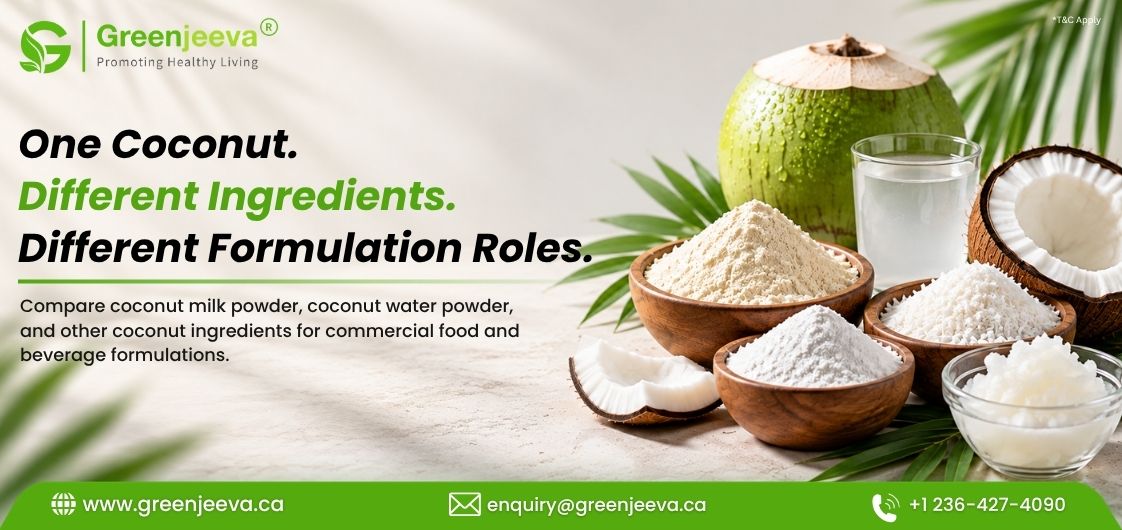
From instant beverage mixes and smoothie powders to bakery products, confectionery, sauces, soups, and plant-based formulations, coconut ingredients are being used across a wide range of commercial food and beverage products.
But for manufacturers, choosing a coconut ingredient is rarely as simple as selecting “coconut powder” from a supplier catalogue.
Coconut milk powder, coconut water powder, and other coconut-derived powders have different starting materials, compositions, processing characteristics, and formulation roles. A powder that fits a coconut beverage mix may not be the right choice for a bakery formulation. Likewise, a coconut water powder intended for a hydration-focused product should be evaluated differently from a coconut milk powder intended to provide coconut milk solids and flavour.
The better sourcing question is not simply, “Which coconut ingredient do we need?” It is, “What does the finished product require, and which coconut ingredient can meet that requirement consistently?”
Start With the Product You Are Making
The finished application should guide the ingredient decision.
For manufacturers developing a dry beverage mix, coconut ingredients may need to provide a recognizable coconut profile while working within a dry formulation and storage system. A coconut milk powder can be relevant when the formulation calls for coconut milk-derived solids, while coconut water powder may be considered for products built around a coconut-water profile.
For smoothie, nutrition, and powdered beverage blends, the ingredient's powder characteristics become particularly important. The formulation team may need to assess how the ingredient disperses, interacts with other dry components, and performs under the intended preparation conditions.
In bakery and confectionery, coconut-derived powders can be incorporated into dry mixes, fillings, coatings, and other formulations where the manufacturer needs a consistent powdered ingredient rather than a liquid coconut component.
For soups, sauces, and savory products, coconut milk powder can provide a practical dry format when the formulation requires a coconut-milk component without bringing a liquid ingredient into the production process.
There are also opportunities in plant-based food formulations and private-label products, where manufacturers may be developing finished products around specific ingredient, organic, or label requirements.
The application therefore comes first. Once that is defined, the right coconut format becomes easier to evaluate.
When Coconut Milk Powder Fits the Formula
Coconut milk powder is produced from coconut milk and converted into a dry ingredient. Its role in a formulation is different from that of coconut water powder because the two begin with different coconut materials.
For food and beverage manufacturers, coconut milk powder can be considered when the formulation calls for characteristics associated with coconut milk in a convenient dry format.
This can include:
- Instant beverage and drink mixes
- Bakery and confectionery formulations
- Sauces and soups
- Dry meal and recipe mixes
- Plant-based food products
- Smoothie and powdered food formulations
For commercial production, however, the ingredient name is only the starting point.
A bulk coconut milk powder specification should be evaluated against the actual formulation requirements. Depending on the application, buyers may need to review factors such as ingredient composition, moisture, microbiological specifications, physical characteristics, storage conditions, shelf life, and processing method.
This is also where working with a qualified coconut milk powder manufacturer or ingredient supplier becomes important. The manufacturer should be able to provide the documentation needed for product qualification rather than relying only on a product description.

When Coconut Water Powder Makes More Sense
Coconut water powder serves a different formulation purpose.
Because it is derived from coconut water rather than coconut milk, it should not be treated as a direct substitute for coconut milk powder. The appropriate choice depends on what the finished product is designed to contain.
Coconut water powder can be relevant to:
- Powdered beverage mixes
- Coconut-water-based drink formulations
- Smoothie and beverage powders
- Hydration-oriented formulations
- Sports and nutrition beverage concepts
For formulations where coconut water powder electrolytes are part of the product concept, buyers should look beyond the ingredient name and review the actual specification. Mineral composition can vary, so the formulation team should verify the supplier's documented mineral or electrolyte profile before deciding how the ingredient fits the finished product.
This distinction matters when sourcing from a coconut water powder supplier. The supplier should be able to provide a current specification and batch documentation that allow R&D and quality teams to assess the ingredient against the finished-product requirements.
Organic and Clean-Label Requirements Need Their Own Check
“Organic” and “clean label” are often discussed together, but they are not interchangeable specifications.
For manufacturers sourcing organic coconut powder or other organic coconut ingredients, certification and documentation need to support the claim being made on the finished product.
In Canada, organic products making regulated organic claims are subject to the Canada Organic Regime. Products sold interprovincially or internationally with an organic claim must meet the applicable certification requirements, and the CFIA states that products with at least 95% organic content may be labelled or advertised as “organic” under the applicable rules.
Clean-label requirements are broader and depend on the manufacturer's formulation and positioning. A buyer may, for example, want a simpler ingredient statement, specific exclusions, or documentation around processing aids and additives. Those requirements should be established during formulation and supplier qualification rather than assumed from the phrase “clean label.”
Canadian labelling requirements also matter at the finished-product level. For multi-ingredient prepackaged foods, ingredients generally must be declared in descending order by weight, while applicable allergens, gluten sources, and added sulphites must be declared according to the rules.
For that reason, a clean-label sourcing decision should involve both the R&D and regulatory or quality teams.
What Spray-Dried Coconut Milk Powder Tells You
Spray dried coconut milk powder is produced by converting a liquid feed into a dry powder through spray drying.
For manufacturers, the important point is that spray dried describes the processing method, not the complete quality specification.
Two ingredients can both be described as spray dried while having different specifications and different suitability for a particular application.
When evaluating a spray-dried coconut milk powder, buyers should therefore look beyond the processing description and review:
- Ingredient composition
- Moisture specification
- Microbiological requirements
- Physical and powder characteristics
- Storage conditions
- Shelf life
- Packaging
- Batch-level documentation
- Application-specific performance requirements
The right question is not whether an ingredient is spray dried. It is whether the resulting powder meets the specification required by the formulation and manufacturing process.
Choosing Between Coconut Milk Powder and Coconut Water Powder
The simplest way to approach the decision is to work backward from the product.

This is also why organic coconut powder should not automatically be treated as synonymous with coconut milk powder. “Coconut powder” is a broader description. Buyers need to establish what part of the coconut the ingredient comes from and how it has been processed.
What to Look for in a Coconut Ingredient Supplier
Once the formulation team has identified the required ingredient format, supplier qualification becomes the next step.
A suitable supplier should be able to support the technical and commercial requirements of the project.
Specification and CoA
Start with the current product specification and representative or batch-specific Certificate of Analysis. These documents allow quality and R&D teams to assess whether the ingredient meets internal requirements.
Certification
If organic status is important, verify the applicable certification rather than relying on a marketing statement. The same principle applies to other certifications required by the finished-product program.
Ingredient and allergen information
The supplier should provide enough information for the manufacturer's regulatory team to assess the finished-product label.
Origin and traceability
Country of origin, batch identification, and traceability information become increasingly important as ingredient programs move from sample quantities into commercial production.
Bulk supply
For manufacturers moving beyond product development, bulk coconut milk powder supply requires consistency in specification, packaging, availability, and documentation.
Private-label support
For brands developing finished products under their own labels, private label coconut powder programs may require additional coordination around packaging, specifications, documentation, and recurring supply.
The supplier conversation should therefore begin with the product requirement rather than simply the price per kilogram.
What 2026 Coconut Milk Powder Market Trends Mean for Formulators
Current market research points to continued commercial interest in coconut milk powder across food and beverage applications, including beverages, bakery, confectionery, savory products, and other food categories. However, published market estimates differ substantially because research firms use different market definitions, datasets, and methodologies. For example, 360iResearch estimates the global market at about $905 million in 2026, while Fortune Business Insights reports a 2026 estimate of approximately $1.26 billion.
That variation is worth keeping in mind before using a single market-size figure in a business case.
For manufacturers, the more useful takeaway is what the category's development means at the formulation and sourcing level: powdered coconut ingredients can support dry-format product development across beverages, bakery, confectionery, savory foods, and other applications.
As a result, ingredient qualification still matters more than a headline market number. The commercial opportunity is only useful if the selected ingredient can meet the formulation, documentation, quality, and supply requirements of the finished product.
A Practical Checklist Before Approving a Coconut Ingredient
Before moving a coconut ingredient from sampling to commercial production, confirm:
1. Ingredient identity
Is it coconut milk powder, coconut water powder, or another coconut-derived powder?
2. Application fit
Does its specification suit the intended food or beverage format?
3. Composition
Does the ingredient meet the required formulation parameters?
4. Processing method
Is the drying or processing method suitable for the intended use?
5. Documentation
Are the specification, CoA, origin, certification, and relevant quality documents available?
6. Organic status
If an organic claim is required, does the certification support the intended Canadian market and claim?
7. Label compatibility
Can the ingredient information be incorporated into the finished-product label correctly?
8. Commercial supply
Can the supplier support samples, qualification quantities, and ongoing bulk requirements?
9. Storage and shelf life
Do the recommended conditions work with the manufacturer's warehouse and production system?
10. Traceability
Can batches be identified and traced through the supply chain?
Final Thoughts
Coconut ingredients can serve very different roles across modern food and beverage formulations.
Coconut milk powder may be the appropriate format when a formulation calls for coconut milk-derived solids and characteristics. Coconut water powder serves a different role when the formulation is built around coconut water. Other coconut powders may fit still different applications.
For manufacturers, the sourcing decision should therefore move in a clear sequence:
Define the product → identify the required coconut format → review the specification → verify documentation → qualify the supplier → scale to commercial supply.
That approach keeps the ingredient decision tied to the finished product rather than the marketing language around it.
For Canadian food and beverage manufacturers sourcing coconut ingredients in bulk, Green Jeeva Canada can support ingredient evaluation with product specifications, documentation, samples, and commercial supply options suited to formulation and procurement requirements.