Bulk Taurine, Glycine, and Inositol Powder: Sourcing the Stack Formulators Keep Ordering Together
A sourcing conversation about taurine almost never stays a conversation about taurine. Talk to enough procurement leads and R&D scientists about how they ended up buying glycine and inositol from the same vendor, and the story repeats: someone was qualifying a taurine supplier for a beverage or nutrition product, and by the second or third call, glycine and inositol had quietly joined the same purchase order. That’s not a coincidence; it’s how formulation briefs in this category get written, and why treating these three as one sourcing decision, not three separate vendor relationships, can save a QA team real time.
What Is the Taurine, Glycine, and Inositol Stack, and Why Do Formulators Buy It as a Set?
These three ingredients can appear together on formulation briefs because each has different technical and formulation characteristics. Taurine is a sulfur-containing amino sulfonic acid commonly used in food, beverage, sports nutrition, and dietary supplement formulations. Glycine is an amino acid that is also used in food and supplement formulations. Inositol, particularly myo-inositol, is a carbohydrate-related compound commonly supplied as a powder for food, beverage, and dietary supplement applications.
None of that reads like marketing copy, and that’s the point: formulators may source these three together because they are established, well-documented ingredients with different formulation characteristics, not because they need interchangeable ingredients.
None require a specialty botanical extraction process, so landed cost can remain competitive relative to many botanical ingredients. That can make them practical components of multi-ingredient formulations. Where it goes wrong is treating them as interchangeable and splitting a dose evenly across them. They’re not. Each has its own specification, formulation role, and applicable use requirements, so copying a ratio from a competitor’s label without checking the intended application is not a reliable sourcing or formulation strategy.

What Should You Verify Before Buying Bulk Taurine Powder?
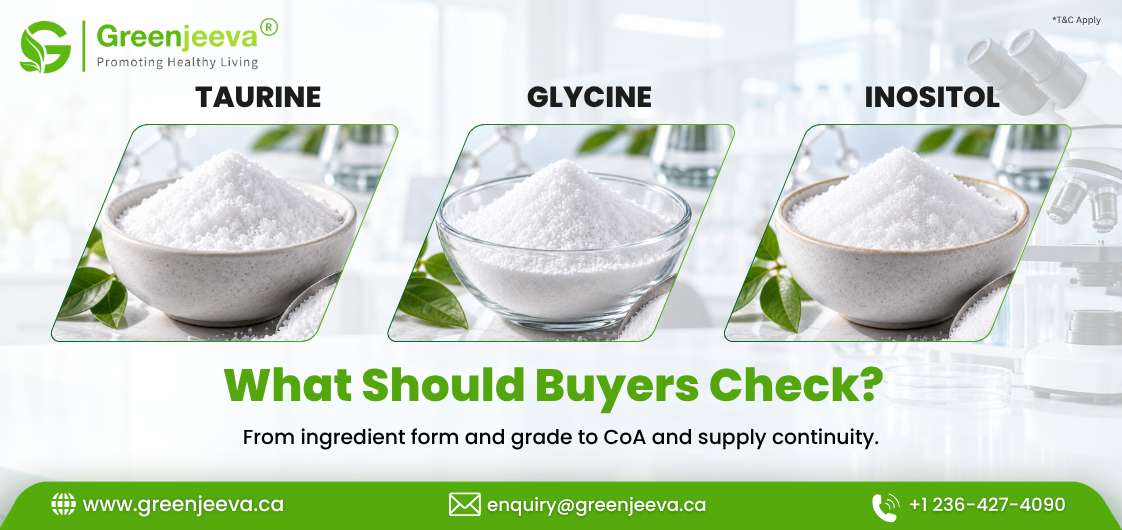
Whether you’re calling it bulk taurine powder, pure taurine powder, or food-grade taurine powder and whether the source is a taurine powder manufacturer or a wholesale distributor the checklist doesn’t change. Get the CoA before the PO goes out, and review assay, heavy-metal limits, microbial testing, country of manufacture, and other applicable specifications.
Commercial taurine has traditionally been produced primarily through chemical synthesis. If a supplier describes taurine as natural or organic, verify the source, manufacturing method, certification, and supporting documentation before making a sourcing or labeling decision.
Standard crystalline taurine is commonly identified by CAS 107-35-7 and molecular formula C₂H₇NO₃S. Do not rely on a generic assay range when qualifying material. Instead, compare the supplier's CoA against the applicable USP, FCC, customer, or product specification. Beverage formulators should also ask about particle size before price: particle-size distribution can affect dissolution and dispersion, and the required grade should be confirmed before pilot production.
What Makes USP-Grade Glycine Different from Food-Grade Glycine, and Does It Need to Be Vegan-Sourced?
If you’re comparing a bulk glycine powder listing against one labeled glycine USP grade powder, the difference is primarily in the applicable specification and documentation, not the underlying molecule. USP-grade glycine is expected to meet the applicable USP/NF monograph requirements, including specified identity, purity, and quality tests. Food-grade glycine is intended for food applications and should be evaluated against the relevant food-grade specification and regulatory requirements.
Manufacturing routes can vary between suppliers. If vegan sourcing is important for the finished product, do not assume it from the ingredient name alone. Ask the supplier to confirm the source, manufacturing process, and current vegan documentation in writing before establishing a recurring bulk account.
Glycine is also naturally sweet, which cuts both ways. In a stevia- or monk-fruit-sweetened beverage it can influence the overall flavor profile, while in an unflavored powder blend its sweetness may become noticeable. Ask for an organoleptic data sheet alongside the CoA, not just a purity number.
What’s the Difference Between Myo-Inositol and D-Chiro-Inositol, and Which One Do Buyers Actually Need?
Myo-inositol and D-chiro-inositol are distinct forms of inositol. A formulation brief should identify the required form rather than relying on the general term “inositol.”
Some formulations specify a particular myo-inositol to D-chiro-inositol ratio, including ratios such as 40:1. The required form or ratio should always be confirmed against the finished-product specification and customer requirements.
This is an important sourcing distinction regardless of how the listing is worded: pure inositol powder, food-grade inositol powder, and inositol powder bulk may refer to different specifications or forms. If a brief simply says “add inositol,” confirm the required form with the buyer before quoting or supplying material. Myo-inositol is identified by CAS 87-89-8.
A certification claim, such as organic certification, should also be verified against the specific supplier, facility, product, and lot documentation rather than assumed from a generic ingredient listing.

*MOQ varies by supplier, grade, packaging format, and order volume. Confirm the current MOQ before placing an order.
How Does Regional Warehousing Affect Sourcing Logistics for This Stack?
The real cost of overseas sourcing isn’t always the per-kilo price; it’s the lead time between order and product arriving at the production site, and what that does to a manufacturing schedule. Buying ingredients from a supplier that already holds domestic inventory can shorten that window considerably, particularly when a production schedule requires a rush reorder.
Canada has a strong base of food, beverage, nutrition, nutraceutical, and consumer-product manufacturers, with notable activity across Ontario, Quebec, British Columbia, and Alberta. For Canadian buyers, ingredient sourcing involves more than unit price, it can also depend on landed cost, import requirements, documentation, and reliable replenishment. Working with a supplier that can provide multiple ingredients may simplify procurement coordination and documentation management, although each ingredient still requires its own applicable specifications, testing, and regulatory compliance documentation.
Where Can You Buy Bulk Taurine, Glycine, and Inositol Powder?
There are really two paths: import directly from an overseas manufacturer, which may offer pricing advantages but requires buyers to manage lead time, logistics, import requirements, and documentation, or buy through a domestic B2B supplier that has already qualified the manufacturing source and holds inventory closer to the customer.
Green Jeeva Canada follows a similar procurement-focused model for Canadian buyers. Bulk ingredients such as taurine powder, glycine powder, and inositol powder can be supplied in practical bulk packaging, supported by batch-specific CoAs, samples, and streamlined fulfillment. For Canadian procurement teams, whether they search for “bulk taurine B2B,” “food-grade glycine powder,” or “inositol powder bulk supplier,” the evaluation comes down to the same fundamentals: ingredient specifications, documentation, quality verification, packaging, landed cost, and reliable delivery to the Canadian facility.
Before signing off on a vendor, work through a short checklist rather than defaulting to whoever ranks first in a search:
1. Get the CoA and spec sheet for each ingredient assay, heavy metals, microbial testing, and other applicable quality parameters rather than relying on a generic purity claim.
2. Confirm the exact form and grade in writing before a sample ships myo-inositol versus a myo/D-chiro blend, and USP versus food-grade glycine.
3. Bench-test the sample yourself solubility, dispersion, taste, and other relevant characteristics in your actual finished-product matrix, not water alone.
4. Check MOQ, pricing tiers, and commercial terms and confirm whether discounts apply per SKU or only on a combined order. Confirm country of manufacture and warehouse location, since these factors affect lead time and the documentation available for the specific material.
5. File the CoA, spec sheet, allergen/GMO statement, and applicable certification documents by batch and lot number before the first commercial order.

What Are the Common Pitfalls When Formulating With This Stack?
Assuming the three ingredients share one dose. Each ingredient has its own formulation specifications and intended application. Copying a ratio from another product without understanding its formulation requirements is not a reliable approach.
Skipping form verification on inositol. Ordering “inositol” without specifying myo-inositol or a myo/D-chiro blend can create an avoidable SKU mismatch.
Underestimating glycine’s sweetness and assuming source characteristics. Glycine can influence the sensory profile of a finished formulation. Bench-test the flavor system first. For taurine, verify any claims about source, manufacturing method, or certification with supplier documentation.
Underweighting particle size for beverage applications. Particle size can affect dissolution and dispersion. Evaluate the specified particle-size distribution and test the ingredient in the intended formulation matrix before selecting a grade.
Single-sourcing without a backup vendor. These are widely available commodity-type ingredients with multiple qualified manufacturers globally. Qualify a primary and backup source where supply continuity is important.