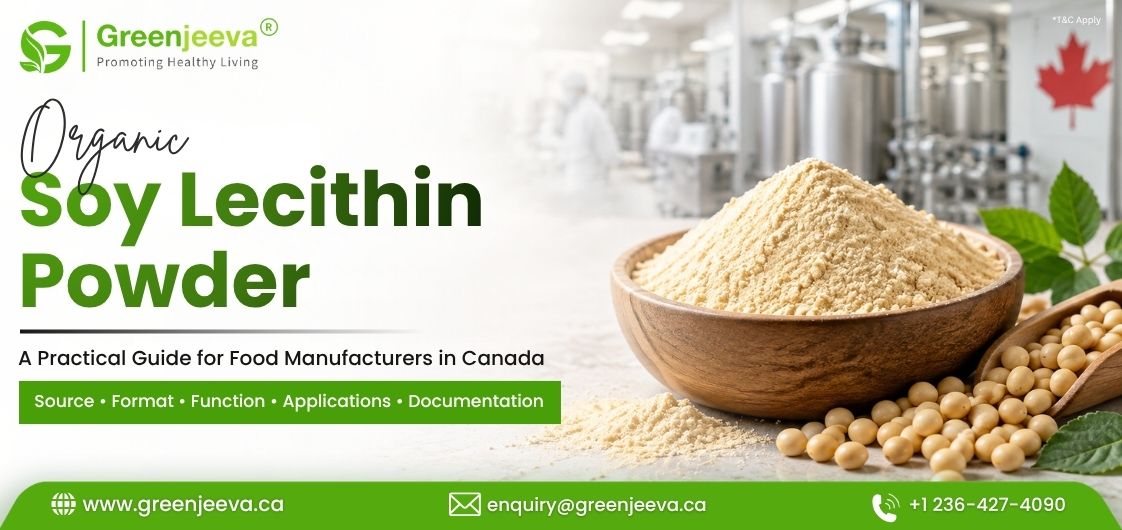
Organic Soy Lecithin Powder: A Practical Guide for Food Manufacturers in Canada
For food manufacturers, lecithin is not simply another ingredient on a raw-material list. Its source, format, phospholipid profile, documentation, and intended application can all influence whether it fits a commercial formulation.
That is why choosing between conventional soy lecithin, sunflower lecithin, liquid lecithin, and organic soy lecithin powder requires more than comparing prices per kilogram. Manufacturers need to consider how the ingredient will perform in the formulation, how easily it fits their production process, and whether the supplier can provide the documentation required by their quality and procurement teams.
For manufacturers sourcing organic soy lecithin powder in Canada, the evaluation goes one step further. An organic claim needs to be supported by the appropriate certification and documentation under Canada's organic framework when applicable.
This guide looks at what soy lecithin powder is, the phospholipids it contains, where manufacturers use it, how powdered and liquid formats differ, and what Canadian buyers should check when sourcing an organic lecithin ingredient in bulk.
What Is Soy Lecithin?
Soy lecithin is a mixture of naturally occurring phospholipids obtained from soybean sources. It is commonly used as a natural emulsifier and processing aid in food manufacturing.
The term "lecithin" describes a group of phospholipids rather than a single compound. Depending on the source and processing method, lecithin can contain phospholipids such as:
- Phosphatidylcholine
- Phosphatidylethanolamine
- Phosphatidylinositol
These soybean phospholipids contribute to lecithin's functionality in different food and formulation systems.
When supplied as a powder, lecithin is typically referred to as lecithin powder or soy lecithin powder. An organic version is generally selected when the finished product or formulation has an applicable organic sourcing requirement.
For products marketed as organic in Canada, manufacturers should verify that the ingredient's certification and documentation meet the applicable requirements of the Canada Organic Regime.
What Is Organic Soy Lecithin Powder?
Organic soy lecithin powder is a powdered lecithin ingredient derived from organically produced soybeans and processed according to the applicable organic requirements.
For Canadian buyers, the word organic is more than a sourcing preference. Organic claims on food products sold between provinces or imported into Canada are regulated under the Safe Food for Canadians Regulations and the Canada Organic Regime. Products making an organic claim must meet the applicable Canadian organic requirements and certification rules.
This makes documentation particularly important when sourcing organic lecithin powder for commercial production.
A buyer evaluating an organic soy lecithin ingredient should therefore look beyond the product name and review the available certification, specification, analytical documentation, allergen information, and other quality records.
Why Is Lecithin Used in Food Formulations?
Lecithin is widely used because phospholipids can interact with both oil and water phases. This makes lecithin useful in formulations where manufacturers need better control over how ingredients interact during processing.
As a food emulsifier, soy lecithin may be used in applications such as:
- Chocolate and compound coatings
- Bakery products
- Confectionery
- Protein powders
- Dry mixes
- Nutrition products
- Powdered beverages
- Certain dietary supplement formulations
Its role depends on the formulation and processing conditions.
For example, bulk soy lecithin for chocolate manufacturing may be selected to support processing characteristics and manage viscosity, while bulk soy lecithin for bakery manufacturing may be used as part of a formulation designed for consistent processing.
The required grade, dosage, particle characteristics, and other specifications should always be determined according to the finished product and manufacturer's process.
What Are the Main Phospholipids in Soy Lecithin?
The composition of lecithin can vary, but three phospholipids are particularly relevant when discussing soybean-derived lecithin.
Phosphatidylcholine
Phosphatidylcholine is one of the major phospholipids associated with lecithin. It has both hydrophilic and lipophilic characteristics, which contribute to the functional properties of lecithin in formulations.
Phosphatidylethanolamine
Phosphatidylethanolamine is another naturally occurring phospholipid found in soybean-derived lecithin.
Its proportion can vary depending on the source and processing of the lecithin.
Phosphatidylinositol
Phosphatidylinositol is also present in soybean phospholipid mixtures and contributes to the overall phospholipid profile of lecithin.
For B2B buyers, the important point is that lecithin should be evaluated against the supplier's actual specification rather than assuming that every lecithin product has an identical phospholipid composition.

Where Is Soy Lecithin Powder Used?
The versatility of lecithin makes it relevant to several commercial applications.
Chocolate and Confectionery
Soy lecithin is commonly considered in chocolate and confectionery formulations where manufacturers need an ingredient that supports processing and formulation performance.
Buyers looking for bulk soy lecithin for chocolate manufacturing should evaluate the ingredient specification alongside the processing requirements of their chocolate or coating system.
Bakery
Soy lecithin powder for bakery manufacturing can be incorporated into various bakery formulations. The appropriate grade and inclusion level depend on the recipe, processing conditions, and desired finished-product characteristics.
Protein Powders
Soy lecithin powder for protein powder applications can be used in dry formulations where manufacturers need to consider powder handling and dispersion characteristics.
Confectionery
Soy lecithin powder for confectionery is relevant to products such as coatings, fillings, and other confectionery systems where lecithin's functional properties can be useful.
Nutraceutical Formulations
Manufacturers sourcing organic soy lecithin for nutraceutical formulations should assess the ingredient according to the intended product category, applicable regulations, formulation requirements, and documentation.

Soy Lecithin Powder vs. Liquid Lecithin
The main difference is physical format.
Liquid lecithin is typically supplied as a viscous material, while soy lecithin powder provides a dry ingredient format.
Powdered lecithin may be preferable for manufacturers working with:
- Dry blends
- Powdered beverages
- Protein powders
- Premixes
- Encapsulated products
- Dry formulation systems
Liquid lecithin may be more appropriate for certain liquid or semi-solid manufacturing processes.
The choice should therefore be based on the formulation and manufacturing process rather than assuming one format is universally better.
Soy Lecithin vs. Sunflower Lecithin
Both soy and sunflower can be used as sources of lecithin, but they are different raw-material sources.
The appropriate choice depends on factors such as:
- Source requirements
- Organic certification
- Allergen considerations
- Formulation requirements
- Label positioning
- Availability
- Cost
- Supplier documentation
Manufacturers considering organic lecithin should confirm the certification status of the specific ingredient rather than relying only on the supplier's product name.
Is Organic Soy Lecithin Non-GMO?
Organic production standards place restrictions on genetically modified organisms, but manufacturers should still verify the specific certification and supporting documentation for the ingredient they are purchasing.
In Canada, organic claims are regulated, and imported or interprovincially traded foods making organic claims must meet the requirements of the Canada Organic Regime.
For procurement teams, the practical approach is simple: verify the certificate and product documentation before approving an ingredient for an organic formulation.
How Should Manufacturers Source Organic Soy Lecithin Powder in Canada?
For manufacturers, sourcing is not simply about finding the lowest price per kilogram.
A reliable organic soy lecithin powder supplier in Canada should be able to provide information relevant to procurement and quality teams, including:
- Product specification
- Certificate of Analysis (COA)
- Organic certification, where applicable
- Allergen information
- Technical documentation
- Country-of-origin information
- Packaging details
- Shelf-life information
- Batch information
- MOQ and bulk pricing
For companies looking to source bulk soy lecithin powder in Canada, these details can help the purchasing and quality teams evaluate whether an ingredient is suitable for commercial production.
A Canadian supplier of organic soy lecithin powder can also simplify communication, documentation review, and supply planning for Canadian manufacturers.
What Should Buyers Check Before Ordering?
Before approving an organic soy lecithin ingredient, procurement teams should compare the supplier's documentation against their internal raw-material specifications.
Important checkpoints include:
- Identity: Confirm the ingredient is the required type of soybean-derived lecithin.
- Organic status: Verify applicable certification and documentation.
- Quality specifications: Review parameters such as appearance, moisture, microbiological specifications, and other applicable analytical requirements.
- Allergen information: Confirm soybean declaration and any other relevant allergen information.
- Application fit: Make sure the powder format and specification suit the intended formulation.
- Supply requirements: Check MOQ, packaging, lead time, available inventory, and bulk pricing.
For companies seeking a bulk organic soy lecithin powder supplier in Canada, these checks are particularly important when moving from sample evaluation to recurring commercial orders.
Source Organic Soy Lecithin Powder for Commercial Production
For Canadian food manufacturers, choosing a soy lecithin ingredient is ultimately a sourcing decision as much as a formulation decision.
The right supplier should provide more than a product name and price. Product specifications, organic certification, quality documentation, sample availability, MOQ, packaging, and supply capability all matter when an ingredient is moving toward commercial production.
Green Jeeva Canada supplies bulk ingredients for manufacturers and formulators looking for consistent sourcing, technical documentation, and commercial ingredient support.
If your team is looking for organic soy lecithin powder for food manufacturing, bakery, chocolate, confectionery, protein powder, or nutraceutical applications, contact Green Jeeva Canada to discuss your required specification and bulk sourcing needs.