Organic Cassava Flour in Canada: Bulk Buying Guide for Food Manufacturers
For a food manufacturer, choosing organic cassava flour is not simply a matter of finding an organic ingredient at the right price.
Two products may both be sold as cassava flour while differing in particle size, moisture, composition, microbiological specifications, documentation, origin, and certification status. Those differences can matter when an ingredient moves from a sample bench to commercial production.
That is why experienced procurement and QA teams look beyond the product name.
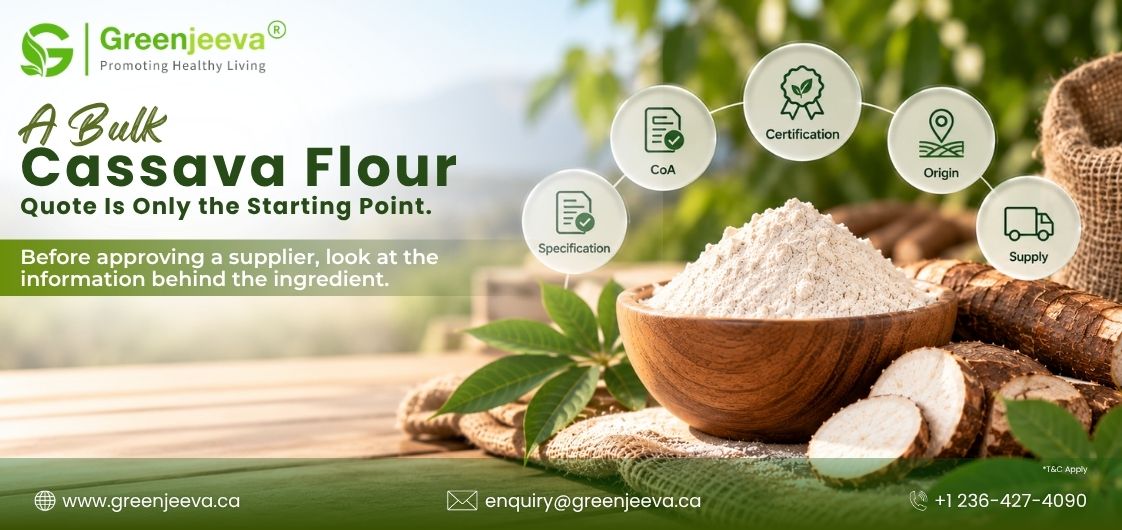
Before approving a bulk cassava flour supplier, buyers may review the ingredient identity, specification sheet, batch-specific Certificate of Analysis (CoA), organic certification, country of origin, testing parameters, packaging, MOQ, and supply capability.
For Canadian manufacturers, imported organic ingredients also need to meet applicable Canadian organic and import requirements.
So, what should buyers actually check?
Why Cassava Flour Should Be Evaluated as a Specification, Not Just a Commodity
Cassava flour is produced from the root of Manihot esculenta and is used across food processing, baking, plant-based products, and other formulations.
But a commercial buyer needs more information than botanical identity.
A useful purchasing specification can answer questions such as:
• What particle size does the powder meet?
• What is the moisture specification?
• What is the starch content?
• Is a functional parameter such as viscosity measured?
• What microbiological tests are performed?
• What contaminants are monitored?
• What organic certification applies?
• Where was the ingredient produced?
• Can the supplier provide batch-level documentation?
• Can the supplier support the required MOQ and recurring volume?
This is why cassava flour quality should be evaluated against a defined specification rather than judged from appearance or price alone.
First, Confirm What You Are Actually Buying
Before comparing cassava flour suppliers, make sure the products being compared are actually the same type of ingredient.
Cassava Flour vs. Cassava Starch
Cassava flour is made from the cassava root, while cassava starch is the extracted starch fraction. They originate from the same plant but are not automatically interchangeable in a formulation.
A quotation described simply as "cassava powder" may therefore not provide enough information for a technical buyer.
The procurement specification should identify:
Botanical identity → plant part → ingredient form → processing specification
This removes ambiguity before a sample or commercial lot reaches the production process.
7 Cassava Flour Specifications Buyers Should Review on a CoA
A Certificate of Analysis is more useful when a buyer knows what the individual results are telling them.
A current batch CoA for Green Jeeva Canada's Organic Cassava Flourprovides an example. The document identifies Manihot esculenta as the biological source, tubers/roots as the plant part, and India as the stated country of origin.
The following parameters illustrate the type of information a buyer may review.
1. Particle Size or Mesh
The CoA specifies 98% passing through #80 mesh, with USP <786> listed as the test method.
Mesh information gives the buyer a defined measure of powder fineness.
For manufacturers, particle size can be relevant to:
• Dry blending
• Batching
• Handling
• Dispersion
• Formulation development
There is no universally "best" mesh size for every application. The appropriate specification depends on the manufacturer's process and finished-product requirements.
Buyer question:
Does the supplier's particle-size specification match the range required for our formulation and process?
2. Moisture or Loss on Drying
The batch CoA reports 9.6% loss on drying against a specification of not more than 14%.
Moisture is a routine but important parameter for dry ingredients. Buyers should understand both the supplier's maximum specification and the actual batch result.
The more useful procurement question is:
Does the batch consistently meet the moisture specification we have approved?
That distinction becomes increasingly important when moving from sample quantities to recurring production supply.
3. Starch Content
The CoA reports 86.6% starch content on a dry basis, against a specification of not less than 80%.
A composition parameter such as starch content gives buyers additional information about the tested material beyond its product name.
When qualifying bulk organic cassava powder or flour, procurement teams should determine whether the supplier's stated specification is appropriate for the intended application.
The objective is consistency between:
Product specification → approved sample → production batch
4. Viscosity
The CoA reports 884 cps at a 5% solution, against a minimum specification of 800 cps, with USP <911> listed as the method.
This is a useful example of why buyers should review the test conditions, not just the number.
A viscosity result describes behavior under a specified test setup. It should not automatically be translated into a claim that the ingredient will deliver a particular finished-product performance in every formulation.
For an R&D team, the more useful question is:
Does the supplier's tested specification align with the functional requirements established during our formulation trials?
5. Brightness and Appearance
The batch reports 98.25% brightness against a minimum specification of 98%.
Appearance can be relevant where the color of a flour or powder influences the intended finished product.
A buyer should determine:
• What appearance range is acceptable?
• Is the result consistent between lots?
• Does the ingredient match the approved sample?
• Could variation affect the finished product?
This turns an apparently simple specification into a practical quality-control checkpoint.
6. Microbiological Testing
Microbiological testing is another area where buyers should examine the actual test panel.
The supplied CoA reports:
• Total Plate Count: 1,270 cfu/g
• Yeast and mold: 62 cfu/g
• E. coli: Negative
• Salmonella: Absent
• Coliforms: Negative
The important point is that one batch result does not represent every future batch.
Instead, buyers should ask:
What microbiological parameters does the supplier routinely test, what are the specifications, and is batch-specific documentation available?
That becomes particularly relevant when a raw material enters a repeat manufacturing program.
7. Heavy Metals
The CoA also includes testing for total heavy metals as well as lead, arsenic, mercury, and cadmium.
The reported batch results include:
• Lead: 0.014 ppm
• Arsenic: 0.012 ppm
• Mercury: 0.22 ppm
• Cadmium: 0.013 ppm
Buyers should compare actual results with the applicable specification and requirements for the intended use, rather than treating an individual result as a universal safety conclusion.
For QA teams, the value of this documentation is traceability: the result is connected to a defined batch and testing method.
Organic Certification Is a Separate Procurement Check
"Organic" should not be treated as simply another marketing descriptor on a supplier website.
For Canadian buyers, organic products making regulated organic claims in interprovincial or international trade are subject to the applicable Canadian organic requirements.
For imported organic products, buyers should verify:
• Current organic certificate
• Certification body
• Applicable organic standard or equivalency arrangement
• Product name on the certificate
• Certificate validity
• Product list or addendum where applicable
• Alignment with shipping and product documentation
The U.S. and Canada have an organic equivalence arrangement, but products must still meet the terms of that arrangement and applicable Canadian requirements.
Practical takeaway: Do not approve an organic ingredient based only on an organic logo. Review the certification documentation.
What Does Country of Origin Tell a Canadian Buyer?
A Canadian supplier does not necessarily mean that the agricultural raw material originated in Canada.
For example, the batch CoA provided for Green Jeeva's Organic Cassava Flour identifies India as the country of origin, while the supplier documentation identifies Green Jeeva Canada.
This simply means that supplier location and ingredient origin should be treated as two separate pieces of information.
A procurement team may therefore want to ask:
• Where was the cassava grown?
• Where was it processed?
• Where was the final ingredient packaged?
• Which operation is covered by the applicable organic certificate?
• What documentation establishes traceability through the supply chain?
For imported organic products, documentation alignment is an important part of the procurement review.
5 Supplier Red Flags When Buying Cassava Flour in Bulk
Price comparisons can make it easy to overlook information gaps during supplier qualification. These are five issues worth investigating before approving a supplier.
1. No Batch-Specific CoA
If a supplier can provide only a generic specification sheet but not batch-level documentation, the buyer has less visibility into the actual lot being purchased.
Ask: Can the CoA be provided for the commercial batch?
2. An Organic Claim Without Current Certification
An organic logo or website statement does not replace certification documentation.
Ask: Which certification body issued the certificate, is it current, and is the specific product covered?
3. Unclear Product Identity
Terms such as "cassava powder" may not tell a technical buyer whether the material is flour, starch, or another cassava-derived ingredient.
Ask: Does the specification clearly identify the botanical source, plant part and ingredient form?
4. No Defined Particle-Size Specification
If particle size matters to the manufacturing process but the supplier does not define it, comparing samples and production lots becomes more difficult.
Ask: What mesh or particle-size range is specified and how is it tested?
5. Limited Supply or Documentation Visibility
A supplier may be able to fulfill a sample order but provide limited information about recurring volume, packaging, lead time or documentation.
Ask: Can the supplier support the required MOQ, production volume, documentation and repeat supply?
These red flags do not automatically mean that a supplier should be rejected. They identify areas where additional verification may be needed before commercial approval.
What Should Canadian Buyers Ask a Cassava Flour Supplier?
Before approving a supplier for cassava flour bulk requirements, use a qualification checklist.
Ingredient identity
• Is the ingredient Manihot esculenta?
• Which plant part is used?
• Is it flour or cassava starch?
Specification
• What mesh or particle-size specification applies?
• What is the moisture limit?
• What composition parameters are specified?
• Are functional parameters such as viscosity relevant?
Quality testing
• What microbiological parameters are tested?
• Is heavy-metal testing available?
• Are results provided on a batch-specific CoA?
Organic status
• Which certification body issued the certificate?
• Is the certificate current?
• Is the specific product listed?
• Does the certification meet the requirements applicable to the Canadian market?
Supply
• What is the MOQ?
• What packaging formats are available?
• Is recurring bulk supply supported?
• Can documentation be provided before commercial approval?
This is where evaluating a cassava flour supplier becomes more than comparing price per kilogram.

Bulk Supply Is More Than Price Per Kilogram
For a manufacturer, the first order is only one part of the sourcing decision.
A supplier also needs to fit the company's operational requirements.
Relevant considerations include:
MOQ → packaging → specification → documentation → lead time → inventory → repeat availability → logistics
Green Jeeva Canada currently lists its Organic Cassava Flour in 25 kg food-grade bulk packaging with a 25 kg MOQ. Its product page also states that batch-specific documentation, including a CoA, is available upon request.
For a company moving toward recurring production, these details can matter as much as the initial quotation.
A useful sourcing process is:
Sample evaluation → specification approval → QA documentation → commercial order → batch verification → repeat supply
Where Can I Buy Cassava Flour Online in Canada?
Canadian buyers can find cassava flour through both retail and commercial ingredient suppliers, but the evaluation criteria are different.
Someone buying a small retail pack may primarily compare:
• Package size
• Price
• Availability
A food manufacturer purchasing bulk cassava flour should additionally evaluate:
• Ingredient identity
• Specification
• CoA
• Microbiological testing
• Contaminant testing
• Organic certification
• Country of origin
• Packaging and MOQ
• Recurring supply capability
For commercial requirements, Green Jeeva Canada's Organic Cassava Flour is available in 25 kg food-grade bulk packaging, with product specifications and batch documentation available for procurement and QA review.

No single parameter tells the whole story.
A good procurement review connects the ingredient identity, specification, test results, certification and supply documentation into one qualification process.
Need to Qualify Bulk Organic Cassava Flour?
If you're evaluating organic cassava flour for commercial production in Canada, don't make the decision from a product page or price quotation alone.
Start with the documents.
Request the current product specification, batch CoA and organic certification from Green Jeeva Canada and compare them against your formulation, QA and procurement requirements.
Before placing a bulk order, verify:
✓ Ingredient identity
✓ Particle-size specification
✓ Moisture and composition
✓ Microbiological and contaminant testing
✓ Current organic certification
✓ Country of origin and traceability
✓ MOQ and commercial packaging
Ready to review the documentation?
Request Organic Cassava Flour Specifications & CoA
Green Jeeva Canada currently offers Organic Cassava Flour in 25 kg food-grade bulk packaging with a 25 kg MOQ, with batch-specific documentation available for evaluation.
Final Takeaway
For Canadian food manufacturers, choosing organic cassava flour should go beyond finding a product labeled organic and available in bulk.
A more reliable evaluation starts with seven questions:
What is the ingredient?
What does its specification say?
What does the batch CoA show?
How is it tested?
Is the organic certification current and applicable?
Where did the ingredient originate?
Can the supplier support the required volume and documentation?
These checks become particularly important when an ingredient moves from a development sample to recurring commercial production.
For manufacturers sourcing bulk cassava flour in Canada, Green Jeeva Canada provides Organic Cassava Flour in commercial 25 kg packaging, with product specifications and batch documentation available for procurement and QA review.