The Benefits of Organic Anise Seed Powder in Food Manufacturing
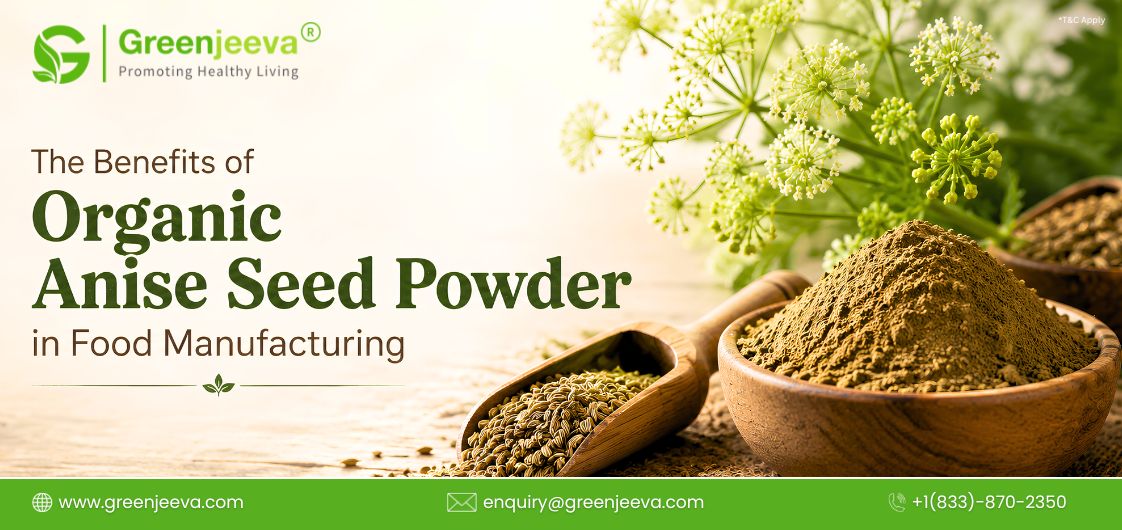
Anise has been part of the pantry for thousands of years, tracing back to ancient Egypt and the eastern Mediterranean. What has changed is where it shows up today. Organic anise seed powder, the finely ground form of Pimpinella anisum, has moved well past the spice rack and into the ingredient decks of manufacturers building bakery lines, functional beverages, confectionery, and clean label spice blends.
Part of the reason is flavor. Anise's sweet, licorice-like profile is instantly recognizable and hard to replicate synthetically without adding to an ingredient list that starts working against a clean label claim. Part of it is timing. Three research firms that track the global anise seed market independently, using different methodologies and different years of data, still land in a similar range.
Market snapshot: Verified Market Reports puts the market at USD 1.7 billion in 2023, growing to USD 2.6 billion by 2031 at a 5.9% CAGR. Lucintel projects the market will reach USD 2.3 billion by 2030, growing at a 5.4% CAGR from 2024. DataIntelo's more recent read puts the 2025 market at USD 1.82 billion, climbing to USD 2.97 billion by 2034 at a 5.6% CAGR. Three firms, three different baseline years, and they all point the same direction: steady, mid-single-digit growth into the early 2030s.
That's the backdrop. Here's what organic anise seed powder actually does in a formulation, how it compares to fennel powder, and what matters when sourcing it for commercial production.
What Is Organic Anise Seed Powder?
Organic anise seed powder is a finely ground spice made from the dried seeds of Pimpinella anisum, a flowering plant in the Apiaceae family native to the Mediterranean and Southwest Asia. Seeds are harvested, cleaned, dried, and milled into a fine powder. How carefully that drying and grinding is handled has a real effect on how much of the seed's essential oil, and therefore flavor strength, survives into the finished organic anise spice.
The compound doing most of the work is anethole. Research on aniseed essential oil composition consistently places it at roughly 75 to 90 percent of the oil's makeup, with the exact figure shifting depending on growing conditions and harvest timing. Estragole, anise aldehyde, limonene, and pinene round out the profile in smaller amounts. Anethole and related compounds have been studied for antimicrobial activity in laboratory settings, which helps explain anise's long history in food preservation, though that's a research finding worth noting rather than a claim to build packaging language around.
Where Organic Anise Seed Powder Fits in Food Manufacturing
Ground anise shows up across a genuinely broad set of categories:
- Bakery. Cookies, cakes, and bread, where the sweet anise note is often the point rather than a background flavor.
- Confectionery. Licorice-style candy and specialty confections where anise carries the product.
- Beverages. Herbal teas and select alcoholic beverages, where anise infuses or distills cleanly.
- Dairy. Yogurt and ice cream formulations looking for a distinctive flavor profile outside the usual vanilla and fruit lineup.
- Meat processing. Certain Mediterranean and Middle Eastern-style sausages and cured meats use anise as a traditional seasoning ingredient.
A few things make organic anise seed powder a genuine formulation tool rather than a novelty flavor. It works as a natural flavor enhancer, delivering a distinctive sweet-spicy note without reaching for an artificial flavor system. Its natural compounds have shown antimicrobial activity in lab studies, which may support shelf life in some applications, though this varies by formulation and isn't a substitute for standard food safety controls. As a single, recognizable, organic spice powder, it fits clean label positioning without the multi-ingredient flavor systems that synthetic alternatives often need. And because it works as both a lead flavor in sweet applications and a supporting note in savory ones, it gives formulators more than one route to the same ingredient, not unlike how organic paprika powder does double duty for color and flavor in savory manufacturing.

Organic Anise Seed Powder vs. Fennel Powder: What's the Difference?
This comes up constantly, since the two are frequently substituted for each other and share a dominant flavor compound.
One clarification worth making, since it trips up a lot of formulators: anise seed is not star anise. Star anise (Illicium verum) is an unrelated plant native to China and Vietnam. It happens to share anethole as its dominant flavor compound, which is why the two taste similar, but they come from entirely different botanical families and aren't interchangeable in a formulation that depends on a specific regulatory or allergen profile.

What to Consider Before Sourcing Organic Anise Seed Powder
A handful of practical factors separate a smooth production run from a supply headache.
- Batch consistency. Essential oil content, and therefore flavor strength, shifts with growing conditions and harvest timing. Building batch testing into your quality process is worth it rather than assuming every lot behaves the same.
- Storage sensitivity. Keep organic anise seed powder in an airtight container, away from light and heat. Essential oil content degrades with exposure, and that directly affects flavor intensity over time.
- Supply and price variability. As a seed spice tied to specific growing regions, anise sees the same weather and harvest-driven price swings as other specialty spices. It's worth factoring into longer-term supply agreements rather than relying on spot buying alone.
Sourcing Organic Anise Seed Powder in Canada: Certification and Supplier Essentials
For manufacturers formulating with organic anise seed powder, sourcing comes down to three things: certification, consistency, and traceability.
Any organic claim on a food product sold in Canada needs certification under the Canada Organic Regime (COR), which the Canadian Food Inspection Agency (CFIA) oversees through accredited certification bodies. That's a separate framework from USDA Organic certification under the National Organic Program (NOP), which governs the US market. A supplier holding USDA certification alone doesn't automatically satisfy Canadian labelling requirements, so it's worth confirming COR status specifically if you're selling into the Canadian market.
Green Jeeva Canada Inc. is listed in CCOF's certification directory as COR certified since April 2024, holding COR Food Processing, EU and UK Equivalence, and US and Canada Equivalence certifications, with anise and anise seed both named on its certified product list. That's the kind of detail worth confirming directly through a certifying body's public directory rather than taking a certification claim at face value, and it applies whether you're evaluating an organic anise seed powder supplier, manufacturer, or wholesale partner.
Beyond certification, a few things are worth checking before committing to a bulk organic anise seed powder supplier:
- Certification verifiable through the certifying body's own directory, not just stated on a spec sheet
- A Certificate of Analysis (COA) per lot, covering essential oil content, microbial testing, and particle size
- Traceability from farm to finished powder, since flavor strength ties directly to growing and harvest conditions
- Batch-to-batch consistency guarantees on flavor and particle size
- Flexibility on format and program size, whether you're building a private label organic anise powder line or sourcing at organic anise seed powder exporter volume
You can review Green Jeeva Canada's full certification scope on the certifications page and cross-check specific ingredients through certified ingredients search.

Ready to Source Organic Anise Seed Powder?
If you're formulating with organic anise seed powder, start with a supplier who can document certification and essential oil consistency per lot, not just an organic label on a spec sheet. Explore Green Jeeva Canada's certified ingredient catalog or browse the full product range to request a COA and discuss bulk or private label programs.
**The Food and Drug Administration has not evaluated these statements. This product is not intended to diagnose, treat, cure, or prevent any disease.**