
Organic Cacao Powder for Formulation: Applications, Specifications, and What Canadian Buyers Should Evaluate
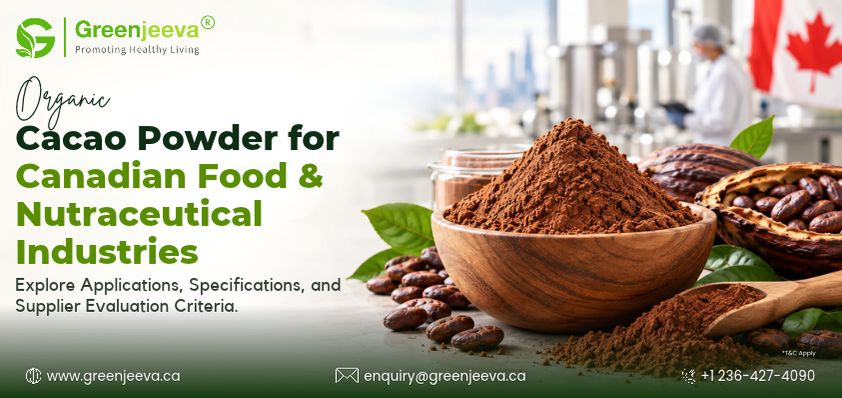
Organic cacao powder is often positioned as a “superfood” ingredient, but for formulators and product developers, the more useful question is practical: where does this powder actually fit in a formulation, and what should Canadian buyers evaluate before approving it?
Cacao powder is an ingredient derived from processed and ground cacao beans, botanically identified as Theobroma cacao.
But not all cacao powders are equivalent. Differences in processing method, alkalization status, particle size, moisture content, and organic certification can affect how the ingredient performs in a finished product.
For businesses sourcing organic cacao powder in Canada, evaluating product specifications, certification, and supplier documentation is an important step before ingredient approval.
This guide explains how organic cacao powder fits into bakery, confectionery, beverage, and supplement formulations and what Canadian buyers should check before approving a supplier.
What Is Organic Cacao Powder?
Organic cacao powder is made from organically cultivated cacao beans (Theobroma cacao), which are processed and milled into a fine brown powder. Organic cacao beans are cultivated and handled in accordance with applicable organic production and certification standards. Buyers should verify the relevant organic certificate and supply-chain documentation before approving the ingredient for an organic product line.
Cacao beans are the seeds of the cacao tree, traditionally used as the base material for chocolate and cocoa products. When processed and milled, they produce a fine, dark-brown powder with a characteristic rich, cocoa-like flavor profile.
For B2B buyers, the terms cacao and cocoa may be used differently across product listings and markets. However, the names alone do not establish the exact processing method. Manufacturers should confirm whether the powder is roasted, alkalized, or non-alkalized, along with other relevant processing details, before evaluating it for a formulation.
Botanical identity
Attribute | Description |
Botanical name | Theobroma cacao |
Plant part used | Bean |
Ingredient format | Fine powder |
Processing | Confirm against the current product specification |
Color | Brown, as specified |
Flavor | Evaluate against the product sample and specification |
Where Does Organic Cacao Powder Fit in Product Development?
Organic cacao powder can serve different roles in a formulation depending on the product category, processing requirements, and desired sensory characteristics.
Formulation consideration | What buyers should evaluate |
Flavor | Compatibility with the desired flavor profile |
Color | Contribution to the finished product’s appearance |
Composition | Available analytical and nutritional information |
Texture | Particle size and effect on the finished formulation |
Ingredient positioning | Organic certification and suitability for the intended product concept |
For buyers, the key is matching the powder’s characteristics to the finished product’s requirements not selecting it based on the “superfood” label alone.
Organic Cacao Powder in Bakery and Confectionery Applications
Organic cacao powder can be evaluated across bakery and confectionery applications where cocoa-derived ingredients contribute to flavor, color, and product positioning. Its suitability should be assessed through formulation trials and review of the ingredient’s specifications.
Chocolate and confectionery manufacturing
Cacao powder can be evaluated in chocolate-flavored confectionery products, coatings, and other confectionery formulations. Its flavor and color contribution should be assessed under the intended processing conditions, including heat exposure and interaction with other ingredients.
Bakery products
The powder can be blended into cakes, brownies, cookies, and other baked goods. Its particle size, distribution, and incorporation into the batter or dough should be evaluated during formulation trials.
Desserts and frozen products
Cacao powder can be evaluated in desserts, ice creams, and frozen confections. Buyers should assess its dispersion, texture, flavor intensity, and contribution to the finished product under the intended processing conditions.

Organic Cacao Powder in Beverage Applications
Organic cacao powder can be evaluated in hot and cold beverage formulations, including chocolate-flavored drinks, functional beverage mixes, protein shakes, and plant-based beverages. Manufacturers should assess dispersion, sedimentation, flavor intensity, mouthfeel, and compatibility with other ingredients at the intended inclusion level.
Functional beverages
For functional beverage applications, cacao powder can contribute to flavor and ingredient positioning. Buyers should evaluate flavor intensity and compatibility with the beverage base at the intended use level.
Protein shakes and meal replacements
In protein shakes and meal replacement products, cacao powder can contribute to flavor masking, mouthfeel, and dispersion. Buyers should assess these parameters at the intended inclusion level.
Plant-based beverages
For plant-based beverage applications, cacao powder can be evaluated for compatibility with the beverage base, texture, and sedimentation behavior. Buyers should confirm that the powder’s flavor and color profile align with the target product concept before formulation.
Organic Cacao Powder in Supplement and Functional Food Formulations
Organic cacao powder is used in nutraceutical powder blends, functional food products, and plant-based nutrition formulations.
Nutraceutical powder blends
Cacao powder can be blended with other botanical powders, proteins, and nutritional ingredients in superfood blends and greens powders. Its flavor and color contribution should be evaluated in the intended blend format.
Functional food products
For functional food applications, cacao powder can be used as a cocoa-derived ingredient in bars, snacks, and fortified products. Buyers should evaluate flowability, compressibility, and moisture content as parameters to assess—not assume as established properties of the supplied powder.
What buyers should confirm
Before using cacao powder in a supplement or functional food, verify:
- Organic certification scope and validity.
- Moisture content and water activity.
- Particle size and flowability.
- Microbiological and contaminant limits.
- Country of origin and traceability.
- COA and specification documentation.
Cacao Powder vs. Cocoa Powder: What Buyers Should Verify
A common formulation question is whether to use cacao powder or cocoa powder. The right choice depends on the formulation objective and the specific product’s processing characteristics.
Comparison point | What buyers should verify |
Processing | Whether the beans are roasted or processed using another method |
Alkalization | Whether the powder is alkalized or non-alkalized |
Flavor | Flavor intensity, bitterness, acidity, and sensory profile |
Color | Actual color and consistency |
Fat content | Specified cocoa/cacao butter content |
pH | Relevant to bakery and beverage formulation |
Particle size | Texture, blending, and dispersion requirements |
Alkalization can influence several quality characteristics of cocoa powder, including color, flavor, and other physicochemical properties, making processing details important when evaluating ingredients for specific applications. Research on the effects of cocoa alkalization on quality characteristics further demonstrates why manufacturers should evaluate the processing method rather than relying solely on ingredient terminology.
What Should Buyers Evaluate Before Approving a Supplier?
A dependable organic cacao powder supplier should be able to provide documentation that connects the ingredient, batch, shipment, and quality controls.
What to check | What buyers should confirm |
Botanical identity | Is Theobroma cacao clearly identified? |
Organic certification | Is the organic certification valid and scoped to the product? |
Country of origin | Is the sourcing region disclosed and traceable? |
Processing method | Is the processing and milling method documented? |
Alkalization status | Is the product non-alkalized or alkalized, and is this documented? |
Particle size | Is the mesh size or particle-size distribution suitable for the application? |
Moisture | Is the limit and batch result documented? |
Microbiological quality | Are required parameters tested against the buyer’s specification? |
Contaminants | Are heavy metals, pesticide residues, and other applicable parameters addressed? |
COA | Is a batch-specific document available? |
Traceability | Can the supplied lot be identified and traced? |
Packaging | Does it protect the material during storage and transport? |
Sample evaluation | Has the material been assessed under relevant conditions? |
Repeat orders | Can the supplier maintain the approved requirements across batches? |
When sourcing bulk organic cacao powder in Canada, manufacturers should evaluate more than the ingredient description. Product specifications, batch documentation, organic certification, traceability, and consistency across repeat orders should all form part of the supplier qualification process.
For Canadian buyers, organic certification verification should consider the Canada Organic Regime (COR), the certification scope, and any applicable equivalency arrangements for imported ingredients. Green Jeeva Canada’s guide to what Canadian buyers should verify on an organic ingredient certificate provides additional context on certification scope, validity, and traceability.
Source Organic Cacao Powder for Your Manufacturing Requirements
Green Jeeva Canada offers bulk organic cacao powder for Canadian businesses sourcing ingredients for food, beverage, nutraceutical, and functional product formulations.
The product is listed in 25 kg commercial packaging, with a 25 kg MOQ. Before selecting an organic cacao powder, review the available product specification and documentation against your internal quality standards. Buyers can also confirm the processing method, alkalization status, particle size, certification, and applicable documentation before proceeding with a sourcing inquiry.
For a broader look at how Canadian buyers should evaluate ingredient quality and documentation, see Green Jeeva Canada’s guide on what Canadian buyers should check before sourcing activated charcoal powder.
Check Product Availability for Green Jeeva Canada’s Organic Cacao Powder