
Organic Celery Leaf Powder for Seasoning Blends and Commercial Food Processing
A seasoning blend can contain the right herbs and spices yet still fall short of its intended flavor profile. Sometimes the issue is not the number of ingredients but the role each ingredient plays in the blend.
Celery leaf powder offers food manufacturers another way to incorporate a celery-derived flavor into dry seasoning systems and selected savory formulations. However, celery leaves, stalks, and seeds are different raw materials. Their flavor contributions, composition, and processing characteristics should not be treated as interchangeable.
For product developers, the decision involves more than choosing an organic botanical powder. The ingredient must fit the intended flavor profile, blend consistently with other components, and meet the specifications required for commercial production.
Organic celery leaf powder is best evaluated as a formulation ingredient, with its plant-part identity, sensory contribution, and technical specifications considered together.
The leaf, stalk, and seed are not interchangeable ingredients.
Celery (Apium graveolens) is used in food manufacturing in several forms, including leaves, stalks, and seeds. Although these materials come from the same plant, their composition and typical culinary roles differ.
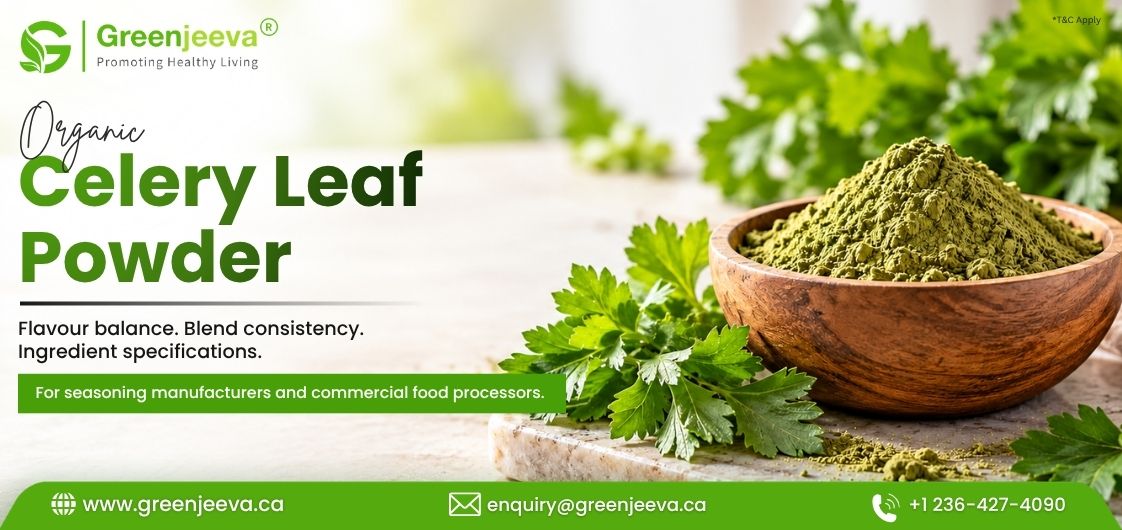
Celery leaf powder is made from the leafy portion of the plant. Depending on the raw material and processing method, it can contribute a recognizable celery character to herb blends, savory seasonings, and other food formulations.
Celery stalk powder comes from a different plant part and may be selected for applications where the characteristics of the stalk material suit the recipe. Celery seed powder, meanwhile, is used as a distinct spice ingredient with its own concentrated aromatic profile.
These differences matter when reformulating an existing recipe or developing a new seasoning blend. Replacing one celery ingredient with another at the same inclusion rate does not guarantee the same flavor or finished-product result.
For manufacturers evaluating a celery leaf ingredient, the first step is to confirm the plant part used in the commercial product. The product description and specification should clearly identify the material rather than relying on the broad term “celery powder.”
The same care applies to organic status. A botanical source alone does not establish that the finished ingredient is certified organic. Buyers should verify the relevant certification and product documentation before making an organic purchasing decision.

Building a seasoning blend around celery leaf powder
In seasoning development, the purpose of an ingredient is defined by the role it plays in the complete recipe. Organic celery leaf powder may contribute a celery note, but its practical value depends on how that flavor interacts with the other components.
Three formulation decisions are particularly important.
- Establish the intended flavor balance
Start by defining what celery should contribute to the finished seasoning. Is it meant to be a noticeable flavor, a supporting herbal note, or part of a broader savory profile?
The answer influences the amount to test and the ingredients against which the powder must be evaluated. Garlic, onion, pepper, other herbs, and salt can all affect how the celery character is perceived.
Rather than selecting an inclusion rate based on a generic recommendation, prepare small trial batches at controlled levels. Evaluate the blend on its own and in the intended food application. A seasoning that tastes balanced as a dry mix may behave differently when added to a sauce, soup, or snack coating.
- Check how the powder blends with other ingredients
Seasoning systems often combine ingredients with different particle sizes, densities, and physical characteristics. If the celery leaf powder differs significantly from the rest of the blend, uniform distribution may become more difficult.
This can affect the consistency of the seasoning from one portion to another. Manufacturers should assess the powder's particle characteristics and blending behavior, particularly when working with large batches or complex dry mixes.
Where necessary, the blending sequence and mixing time can be evaluated during process trials. The objective is a uniform blend that meets the manufacturer's requirements, not simply a visually consistent mixture.
- Evaluate the flavor in the finished food
A seasoning ingredient should not be approved based on a dry-blend tasting alone. The food matrix, cooking conditions, and processing method may alter the way its flavor is perceived.
For example, a seasoning intended for a dry snack coating has different evaluation requirements from one incorporated into a soup mix or sauce base. The manufacturer should test the powder in the product it is intended to serve.
This application-led approach helps determine whether the selected grade delivers the desired flavor contribution at a practical inclusion level.
What changes when the blend moves from lab to production?
A small laboratory batch is useful for establishing a flavor direction. Commercial production introduces additional variables that need to be considered before a formulation is approved for routine manufacturing.
Blend uniformity. Ingredient distribution should remain consistent across the production batch. Particle characteristics, ingredient proportions, and the mixing process can all influence the result.
Moisture management. Dry seasoning ingredients can be affected by moisture exposure during handling and storage. The manufacturing environment and packaging and storage conditions should be appropriate for the ingredient and finished blend.
Batch repeatability. The approved formulation should have defined ingredient specifications and a repeatable manufacturing process. Sensory checks and relevant quality controls can help identify differences between batches.
Processing and finished-product performance. A dry seasoning may be exposed to heat, moisture, or other processing conditions after blending. Test the formulation under conditions representative of its intended use instead of assuming that the initial bench result will remain unchanged.
These checks are especially relevant when a manufacturer moves from sample evaluation to bulk dried organic celery leaf powder for industrial use. Commercial approval should be based on a defined specification and process, not solely on the performance of an initial sample.
The specifications that matter for commercial celery leaf powder
A supplier's product name is only the starting point for ingredient qualification. R&D, quality assurance, and procurement teams need enough information to determine whether the ingredient matches the formulation brief and the company's purchasing requirements.
For Organic Celery Leaf Powder, review the following details where applicable.

Not every ingredient requires the same specification limits. Acceptance criteria should be based on the intended application, the supplier's documented product characteristics, and the manufacturer's quality requirements.
For example, particle size may be especially important when a seasoning manufacturer needs a particular texture or blending behavior. For another application, sensory consistency or microbiological requirements may be more significant.
A Certificate of Analysis helps verify the quality parameters reported for a particular batch, but it should be read alongside the full product specification. Organic certification and batch quality testing also serve different purposes: one does not replace the other.
For buyers sourcing an organic dried herb powder, these documents establish a clearer basis for ingredient approval and help make repeat purchasing more consistent.
Sourcing organic celery leaf powder for commercial production in Canada
Once a grade has been evaluated for flavor and processing performance, the next step is to determine whether it meets the requirements for commercial purchasing.
For manufacturers looking for an organic celery leaf powder supplier in Canada, five purchasing considerations deserve attention.
Product and specification alignment. Confirm that the material offered matches the grade evaluated by the formulation team. Changes in plant part, processing, or product specification may affect the suitability of the ingredient.
Organic documentation. Verify the certificate applicable to the product and supply chain. For products marketed as organic in Canada, certification and labelling must comply with the applicable Canadian requirements.
Sample evaluation. Where samples are available, use them to assess flavor, blending behavior, and performance in the intended recipe. Document the approved grade and acceptance criteria before moving to a commercial order.
Bulk quantities and packaging. Manufacturers considering bulk celery leaf powder or organic celery powder wholesale should confirm available order quantities, packaging formats, and minimum order requirements directly with the supplier.
Supply continuity. Establish lead times, ordering arrangements, and the documentation expected with subsequent batches. These details become especially important when the ingredient is part of a standardized seasoning blend produced regularly.
Conclusion
For companies sourcing bulk organic celery leaf powder for seasoning manufacturers or commercial food processing, the objective is to align the ingredient's technical suitability with the practical requirements of purchasing and production.
Green Jeeva Canada can be contacted to inquire about Organic Celery Leaf Powder specifications, applicable documentation, and bulk purchasing requirements. Product-specific details should be confirmed before finalizing a formulation or purchase order.