The 1% Problem: What Actually Happens to Curcumin After You Swallow It
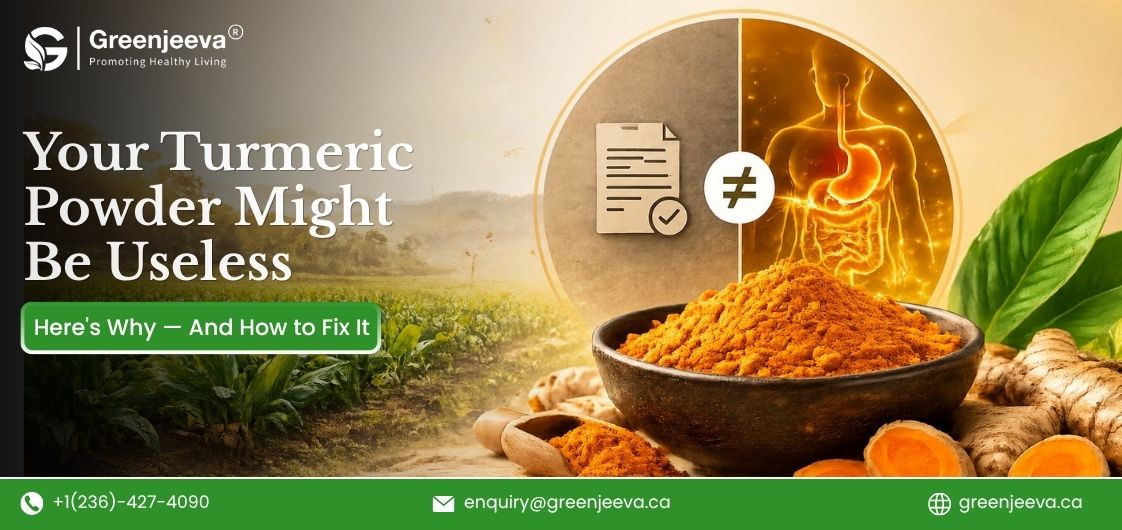
Curcumin's oral bioavailability is commonly reported at under 1 percent. That figure gets repeated so often in pharmacology literature that it's easy to skim past, but it's worth sitting with: for every gram of curcumin someone swallows, the amount that reaches systemic circulation intact is a small fraction of a percent of that gram.
A "95% curcuminoids, HPLC-verified" spec sheet confirms what's in the jar. It says nothing about how much of that curcumin will still be curcumin by the time it matters. This guide follows curcumin's actual journey after ingestion, puts real numbers to the absorption gap, and covers what to check before sourcing any of Green Jeeva's three turmeric formats.
What Organic Turmeric Root Powder Actually Is
Organic Turmeric Root Powder is the dried, milled rhizome of Curcuma longa, a member of the Zingiberaceae (ginger) family native to South Asia. Green Jeeva's Organic Turmeric Root Powder is sourced from India and China and retains the complete botanical matrix, including volatile oil compounds like turmerone, atlantone, and zingiberene, alongside naturally occurring, non-standardized curcuminoid content.
That non-standardized level is the key distinction from an extract. Whole root powder's curcuminoid content sits in a much lower, naturally variable range than a standardized extract, which is exactly why it suits whole-food and clean-label positioning rather than a declared potency claim.
Following Curcumin's Journey: Why So Little Survives
Swallow a spoonful of turmeric or a capsule of standardized extract, and curcumin immediately runs into a problem: it's lipophilic, meaning it dissolves in fat but resists water. The small intestine is an aqueous environment, so instead of dispersing evenly, curcumin particles clump together and much of the dose passes through largely unabsorbed.
Whatever does cross the intestinal wall meets the second barrier almost immediately. Phase II enzymes in the gut lining and liver convert free curcumin into glucuronide and sulfate metabolites, essentially tagging it for disposal, within the same pass through the body. Curcumin is also chemically unstable at intestinal pH, degrading further before absorption can even happen.
The result, measured directly in human pharmaco kinetic studies: one study found that ingesting up to 3.6 grams of curcumin per day produced plasma concentrations of only about 10 nanomolar. A separate study using 6 to 8 grams per day reached peak serum levels of roughly 0.5 to 1.8 micromolar. Researchers generally estimate that meaningful pharmacological activity requires concentrations in the range of 10 to 20 micromolar, meaning even these high-dose studies landed well below the level typically associated with biological effect.
That's the real gap behind the "under 1 percent" figure: not a rounding error, but multiple compounding barriers between the dose on a label and the concentration in the bloodstream.
The Piperine Study Everyone Cites, and Why It Deserves a Second Look
The most frequently cited figure in this category comes from a 1998 study reporting a roughly 2000 percent increase in curcumin bioavailability when co-administered with piperine, the bioactive compound in black pepper. Piperine does appear to genuinely inhibit the glucuronidation pathway responsible for rapidly deactivating curcumin, and that mechanism is well supported.
The specific 2000 percent figure, however, has come under more recent scrutiny. Later methodological review has pointed out that the original study's assay didn't clearly distinguish pharmacologically active, unconjugated curcumin from inactive glucuronide and sulfate conjugates before quantification, which may have inflated the apparent effect. The mechanism is real; the exact magnitude most commonly quoted is less certain than the widely repeated figure suggests.
Two More Assumptions Worth Checking
"Darker turmeric means more curcumin" is a common shortcut, and it's only partially true. Curcuminoids do contribute to color intensity, but moisture content, ash content, and cultivar differences can all darken or lighten a batch independently of actual curcuminoid concentration, so color alone isn't a substitute for a COA.
"Whole root powder is just a weaker version of the extract" is also off the mark. It's not weaker, it's a different tool: the whole matrix, including the volatile oils that standardized extraction typically removes, serves a genuinely different formulation purpose than a concentrated, standardized-potency ingredient.
Other Approaches to Improving Curcumin Absorption
Beyond piperine co-administration, documented approaches to improving curcumin absorption include phospholipid or phytosome-based complexation, particle size reduction through micronization or nanoparticle formulation, and combination with dietary fat, since curcumin's own lipophilicity means it absorbs better in the presence of fat rather than in spite of it. Each approach has its own evidence base and tradeoffs, and none of them show up in a curcuminoid percentage.
A buyer assuming a "95% curcuminoids" ingredient carries built-in absorption enhancement, without confirming it directly, is making an assumption the spec sheet doesn't support.
Choosing Between Green Jeeva's Three Turmeric Formats
Different formulation goals call for different formats, not a single default choice.
If the goal is whole-food, clean-label positioning where the complete botanical matrix is the point, Organic Turmeric Root Powder is the fit. If the goal is a declared, standardized curcuminoid content without an organic requirement, Turmeric Extract Powder 95% Curcuminoids delivers that potency. If the formulation needs standardized potency and organic certification together, with identity verified by HPLC, Organic Turmeric Extract Powder 95% Curcuminoids, HPLC is built for that combination.
These are three genuinely different products, not the same ingredient at three price points, and the right one depends on the claim the finished product actually needs to support.
Specification Benchmarks and Documentation to Request
A complete turmeric COA, for any of the three formats, should include:
- Confirmed species (Curcuma longa), since other Curcuma species are sometimes substituted
- Total curcuminoid percentage with the test method disclosed, HPLC being the more reliable standard over UV-based methods
- Individual curcumin, demethoxycurcumin, and bisdemethoxycurcumin ratio, where relevant to the application
- Moisture content
- Ash value, since a value above roughly 5 percent can indicate added inorganic material or adulteration
- Heavy metals screening
- Microbiological testing
- Explicit disclosure of whether any bioavailability-enhancing technology has been applied, rather than assuming it from the curcuminoid percentage alone
How Bulk Turmeric Powder Should Be Stored
Turmeric powder and its extracts should be stored in a cool, dry environment away from direct light, in airtight packaging. Curcumin is sensitive to both moisture uptake, which increases microbial risk and caking, and prolonged light exposure, which can degrade color and potency over time.
This article is for educational purposes for food and supplement industry professionals. It does not constitute legal or regulatory advice. Consult qualified regulatory counsel before finalizing label claims.